Get Full Government Meeting Transcripts, Videos, & Alerts Forever!
Get email alerts on the Austin Housing Report topic
No spam. Unsubscribe anytime.
Austin Housing outlines monthly report approach, highlights $3.6M emergency rental program
Summary
Nefertiti Jackman proposed a regular monthly report format for the commission and summarized displacement-prevention programs: I Belong in Austin ($3,600,000 ongoing, served 932 households in FY25), eviction-representation services (277 households received legal services; 4,600 received information/counseling), Community Land Trust accelerator and other Project Connect programs.
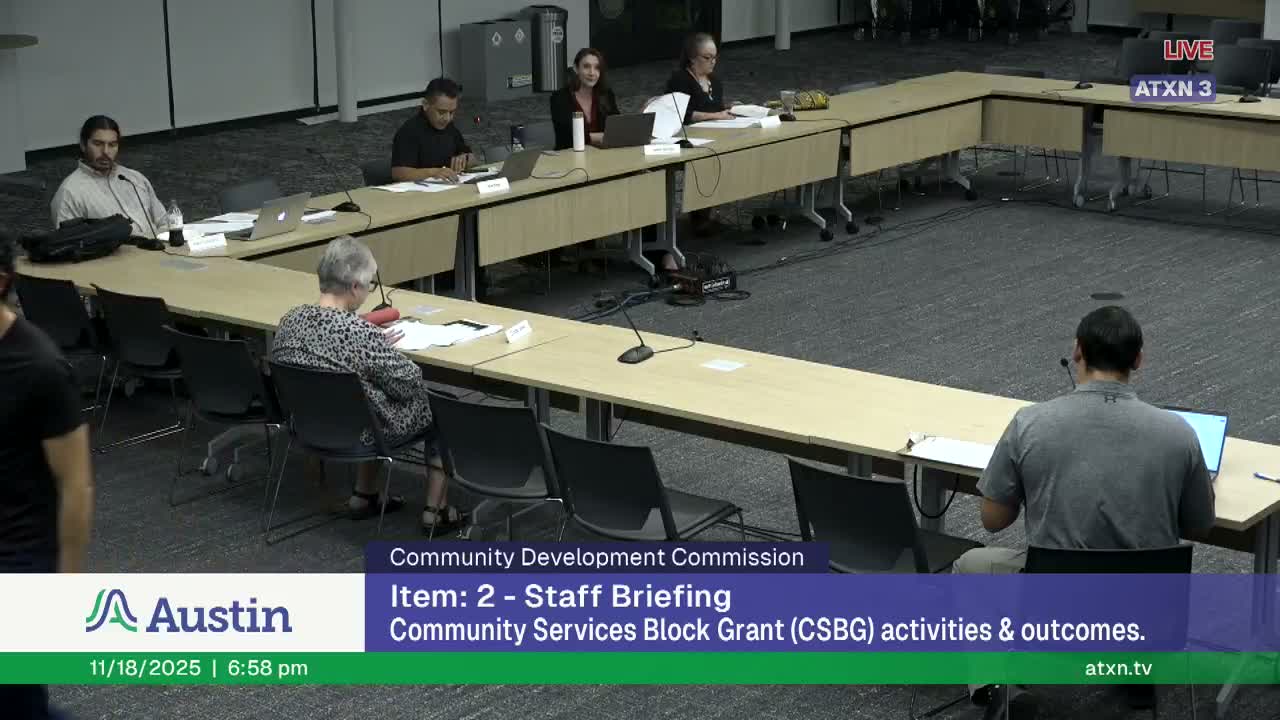
Nefertiti Jackman, community displacement prevention officer at Austin Housing, presented the department's first proposed monthly report to the Community Development Commission on Nov. 18 and highlighted several programs aimed at stabilizing renters and homeowners.
Jackman identified I Belong in Austin (often described as an emergency rent program) as currently approved for ongoing funding at $3,600,000 and serving 932 households in FY25. She described the eviction-representation and education program, noting it provided legal services to 277 households and information or counseling to about 4,600 households. Jackman also summarized geographically focused Project Connect initiatives including Connections to Work (operated by Goodwill of Central Texas; 145 unique households participated) and an Austin Community Land Trust (CLT) Accelerator operated by Business and Community Lenders of Central Texas in partnership with Guadalupe Neighborhood CDC.
Jackman said program partners reach households citywide and in station-area corridors, and that the department prioritizes households at or below 30% median family income for many interventions. She read a beneficiary's letter of gratitude submitted by El Buen Samaritano describing how rental debt relief preserved dignity and enabled recovery.
Commissioners asked for a clearer funding breakdown (one-year vs. multiyear amounts) and suggested a regular report format that includes supply-and-demand data, narrative client stories, and vendor or client presentations to illustrate outcomes on the ground. Jackman agreed to produce alternative report scenarios and to post materials publicly alongside agenda packets.
Why it matters: The report would create a regular public record of housing investments and outcomes and help the commission monitor program capacity, vendor performance and demand. Commissioners flagged the need to track changes in funding (one example discussed was a proposed reduction of rental assistance from $4,000,000 to $3,600,000 in the current budget process) and recommended including both macro (departmental budgets) and micro (vendor/client experience) data in the monthly reports.
Next steps: Jackman will provide a follow-up breakdown of funding sources and proposal scenarios for the CDC to review, and staff will consider inviting program vendors and clients to give periodic testimony.