Get Full Government Meeting Transcripts, Videos, & Alerts Forever!
Get email alerts on the Planning Policy topic
No spam. Unsubscribe anytime.
Commission rejects town‑led land‑use change for 10‑acre town‑center parcel after homeowner opposition
Summary
After hours of public comment from Manor Drive neighbors and lengthy discussion about buffers, traffic and civic uses, the Planning & Zoning Commission voted 6–0 to deny a staff‑initiated future‑land‑use amendment that would have converted a 10‑acre parcel on the south side of FM‑407 to mixed‑use/local retail.
Argyle’s Planning & Zoning Commission on March 4 voted unanimously to deny a staff‑initiated future‑land‑use amendment that would have reclassified a 10‑acre town‑owned adjacent parcel from single‑family (1‑acre) to mixed use/local retail and set the stage for a local‑retail zoning request.
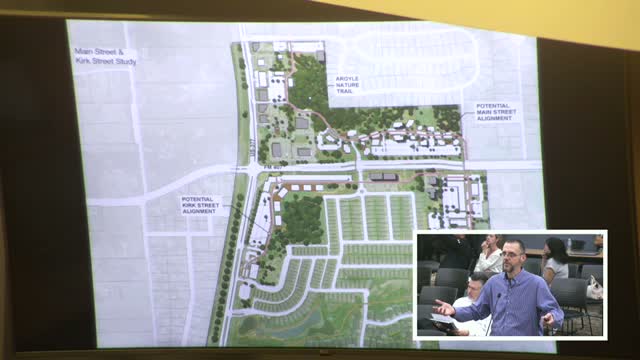
Town staff presented a small‑area ‘Town Center’ concept that envisions a Main Street on both sides of FM‑407 with civic uses (a proposed police building and town hall) on six town‑owned acres and mixed retail/office frontage adjacent to that civic core. Staff said the designation to local retail would have prohibited residential on the 10‑acre parcel and would create a 50‑foot landscaped buffer where the retail abutted existing single‑family zoning.
But residents from several adjacent neighborhoods — including Frenchtown Manor and Manor Drive — told commissioners the change would skip an important transitional buffer and place parking lots, deliveries and lighting directly behind multimillion‑dollar homes. Jim Jurgens, the HOA president for adjacent Frenchtown Manor, said the neighborhood bought properties expecting the area to remain residential and asked the commission to preserve a gradual land‑use transition.
Commission discussion reflected those concerns. Several commissioners said they supported the idea of a walkable Main Street and a civic presence — but that the proposed south‑side rezoning reached too deeply into land that currently serves as a residential transition. The commission voted 6–0 to deny the future‑land‑use amendment; staff said that, without the FLUP change, approving a rezoning to local retail would be out of alignment with adopted planning documents.
That procedural point left the record tangled in the meeting: the commission held a separate public hearing on the corresponding zoning case immediately afterward and the roll‑call discussion included contradictory statements about whether the zoning vote could proceed after the FLUP was denied. Staff and the town attorney clarified that a zoning approval inconsistent with the adopted future‑land‑use plan would be out of alignment; the P&Z vote therefore operated as a recommendation to council and the denial of the FLUP constrains any later council action unless the FLUP is reconsidered.
Next steps: staff will forward the P&Z recommendation (to deny the FLUP change) to the Town Council for their March 23 meeting. Residents were told they can present their positions again to council; commissioners encouraged continued public input as staff refines planning, thoroughfare and park‑board proposals for a town center in other configurations.
Why it matters: the vote preserves the existing transition between large‑lot residential and the FM‑407 corridor for now and signals that the commission expects a more sensitive treatment of buffers and civic‑use siting if the town pursues a connected ‘Main Street’ concept in the future.