Get Full Government Meeting Transcripts, Videos, & Alerts Forever!
Get email alerts on the Jail Health topic
No spam. Unsubscribe anytime.
Jail Health Services briefs council on MOUD expansion and Medicaid reentry waiver effort
Summary
King County Jail Health Services reported on 24/7 care across two facilities, expansion of medications for opioid use disorder (including long‑acting injectables), and operational work to pursue a Medicaid 1115 reentry demonstration waiver with a target go‑live of July 1; staff warned short jail stays and scale-up needs pose operational challenges.
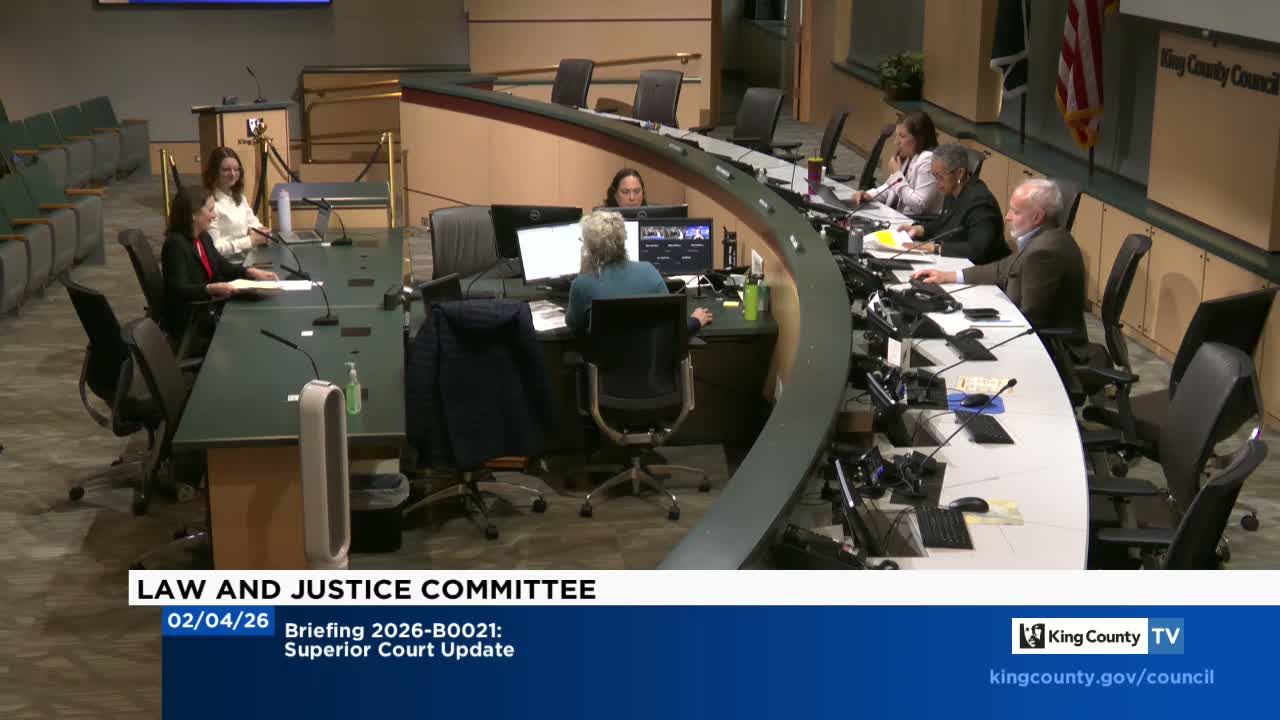
Denotra McBride, director of Jail Health Services (Public Health — Seattle & King County), and Megan Murphy, project manager for the reentry demonstration initiative, briefed the Law and Justice Committee on Feb. 4 about expansion efforts, accreditation, MOUD services and a proposed Medicaid 1115 waiver intended to reimburse certain pre‑release reentry services.
McBride said Jail Health is unique in Washington because it is part of public health rather than the sheriff’s office; the division provides 24/7 care across two adult facilities (the King County Correctional Facility in Seattle and the Meiling Regional Justice Center in Kent) and is accredited by the National Commission on Correctional Health Care. She reported an average daily population of about 1,400 (down from roughly 2,000 pre‑COVID), about 17,564 bookings last year and a median length of stay of about three days.
McBride described staffing and service mix: nurses comprise about 42% of the division’s staff, social‑services staff about 18%, psychiatric services about 9% and administration roughly 3.7%. She highlighted expanded reentry supports, community health worker involvement and a coordinated discharge program to bridge medications and services for people leaving custody.
On treatment for substance use disorders, McBride said Jail Health began offering long‑acting injectable MOUD in November 2024 and reported a snapshot count of about 247 individuals receiving MOUD on Jan. 12. She said offering full access to FDA‑approved MOUD medications is required under current ADA guidance and that methadone expansion is under active consideration. McBride noted MOUD administration is labor‑intensive (nursing observation for buprenorphine, training for injectables) and that staffing and space constraints pose challenges.
Murphy explained the Medicaid 1115 reentry demonstration initiative, which—if King County participates—would allow certain pre‑release healthcare and supportive services (up to 90 days pre‑release) to be reimbursed for Apple Health–eligible people. She said King County aims to be part of cohort 3 with a planned go‑live of July 1, subject to a Healthcare Authority readiness assessment due in March and subsequent approval.
Murphy and McBride described operational constraints: about half of people in custody are released within 0–3 days, making it difficult to meet waiver timelines that anticipate up to 90 days pre‑release engagement; they estimate the county may need to scale some services by roughly 75 percent to cover Apple Health–eligible clients. The team said they are forming a cross‑sector steering committee (King County, City of Seattle and community partners), work groups for operational design, and billing and revenue analyses to estimate possible Medicaid reimbursement streams.
In Q&A, McBride agreed to provide requested data on booking deferrals (she said deferrals for medical reasons run around 6–8%, with peaks near 10% in some reviews). She confirmed that Dr. Sanders, a longtime medical director, retired after 24 years and that new medical director Dr. Alice Tin started in November. Committee members asked for follow‑up on MOUD uptake, screening improvements, and partnerships to ensure continuity of care after release; McBride and Murphy described warm‑handoff practices with community clinics and the goal of improving release notifications and coordination with legal partners to enable more reliable pre‑release planning.
What’s next: Jail Health staff will continue work on the March readiness assessment, refine billing/revenue estimates with public health billing experts, and provide follow-up data requested by the committee.