Get Full Government Meeting Transcripts, Videos, & Alerts Forever!
Get email alerts on the Court Operations topic
No spam. Unsubscribe anytime.
Presiding Judge Rothrock outlines court caseload shifts, CPO surge and facilities concerns
Summary
New King County Superior Court Presiding Judge Avril Rothrock told the Law and Justice Committee the court’s largest workload is civil cases, civil protection orders have risen more than 300% since 2019, unlawful detainer filings remain high, remote proceedings improved access, and long‑term courthouse planning and IT staffing are urgent priorities.
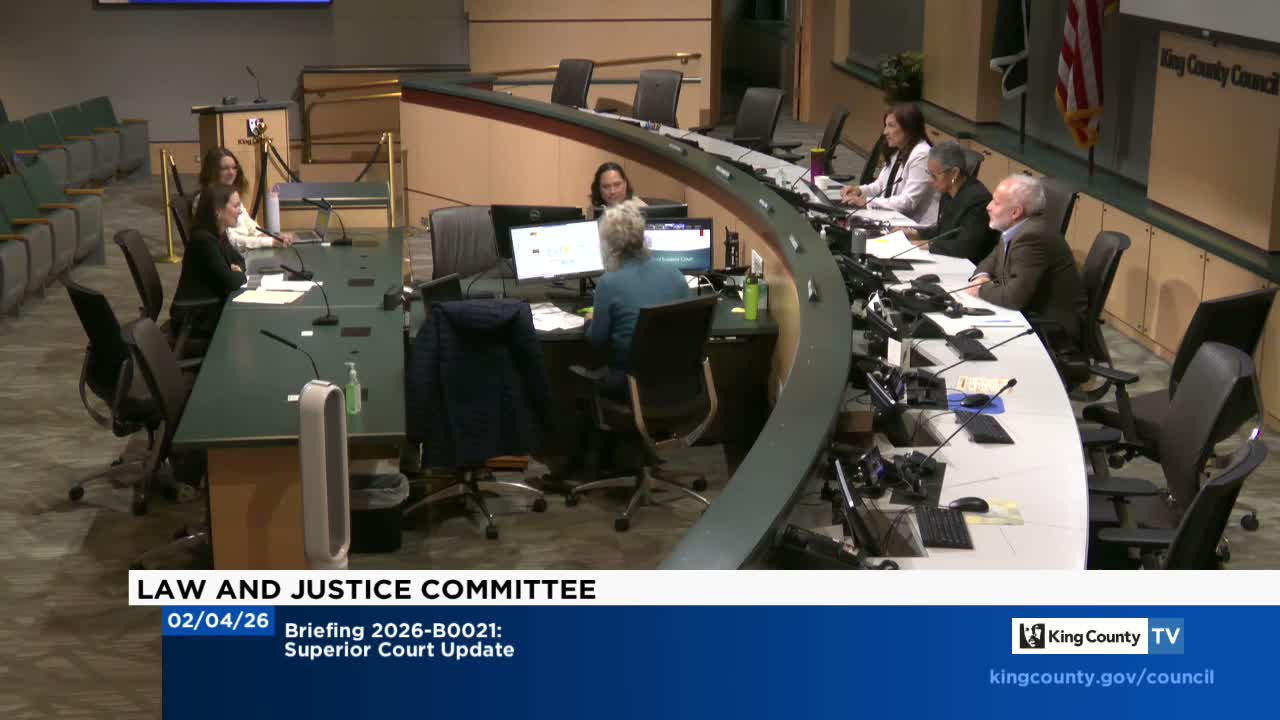
Presiding Judge Avril Rothrock on Feb. 4 briefed the Law and Justice Committee on the state of King County Superior Court, stressing that civil work comprises the majority of the court’s caseload and that recent legal and social trends have reshaped demand for judicial services.
Rothrock, who was elected presiding judge by her peers and began the role on Jan. 12, told the committee the court has 56 judges, 13 commissioners, approximately 385 employees and a biennial budget of about $168.5 million. She said the court hears cases across four primary facilities, including Seattle, the Meiling Regional Justice Center in Kent, and Harborview (the latter for Involuntary Treatment Act work).
The presiding judge highlighted that civil matters make up roughly 49% of the court’s work (including torts, business disputes and small-business matters), followed by probate and guardianship (about 15%), Involuntary Treatment Act cases (~10%), and criminal filings (~9%). She said civil protection orders (CPOs) have surged—citing a 309% increase since 2019—driven largely by anti‑harassment petitions after a 2021 law change that removed some filing fees and expanded grounds.
Rothrock said unlawful detainer filings (evictions) also remain elevated—she cited roughly 8,730 unlawful detainer filings in 2025 versus pre‑COVID figures of about 4,500—and that pandemic-era moratoria changes contributed to the post‑pandemic influx. She told council members the court has added judges and commissioners for unlawful detainers and is seeing improved scheduling: initial show‑cause hearings can now be set within two weeks, with second hearings following more quickly than in past bottlenecks.
Rothrock credited remote proceedings and new courtroom technology with improved access and efficiency (including remote jury selection), but warned those benefits require investment and IT staffing. She said the court has leveraged pandemic-era funding to expand remote access and that sustaining those gains depends on improved technical support and operational benchmarks.
On the family‑law docket, Rothrock told the committee the court can shift resources based on reliable data rather than frequent short-term shifts. She also noted personnel moves to increase family‑law capacity (assigning a newly appointed judge to family court and piloting staffing changes to the family law motion calendar beginning in March).
Rothrock closed by urging the council to consider long‑term facility planning and maintenance for King County courthouses, citing deferred maintenance and safety concerns that will require multi‑year planning and funding decisions.
What’s next: Rothrock offered to return for deeper briefings on specific areas; council members requested follow-up data on family‑law calendars, attorney representation rates in unlawful detainer cases, and other operational metrics.
Representative quote: “Our mission is to equitably serve our diverse public by administering justice in accessible, inclusive, and unbiased forums,” Rothrock told the committee.