Get Full Government Meeting Transcripts, Videos, & Alerts Forever!
Get email alerts on the Immigration Enforcement Response topic
No spam. Unsubscribe anytime.
Immigrant advocates urge King County to block ICE staging, fund legal aid and protect data; executive announces $2M emergency fund and guidance deadline
Summary
Community members and immigrant‑service organizations urged the King County Council to ban ICE staging on county property, expand legal and rental assistance, end data sharing and review contracts. The executive office announced an order with seven steps, including $2 million in emergency funds and a March 16, 2026 deadline for sheriff guidance on potential federal enforcement actions.
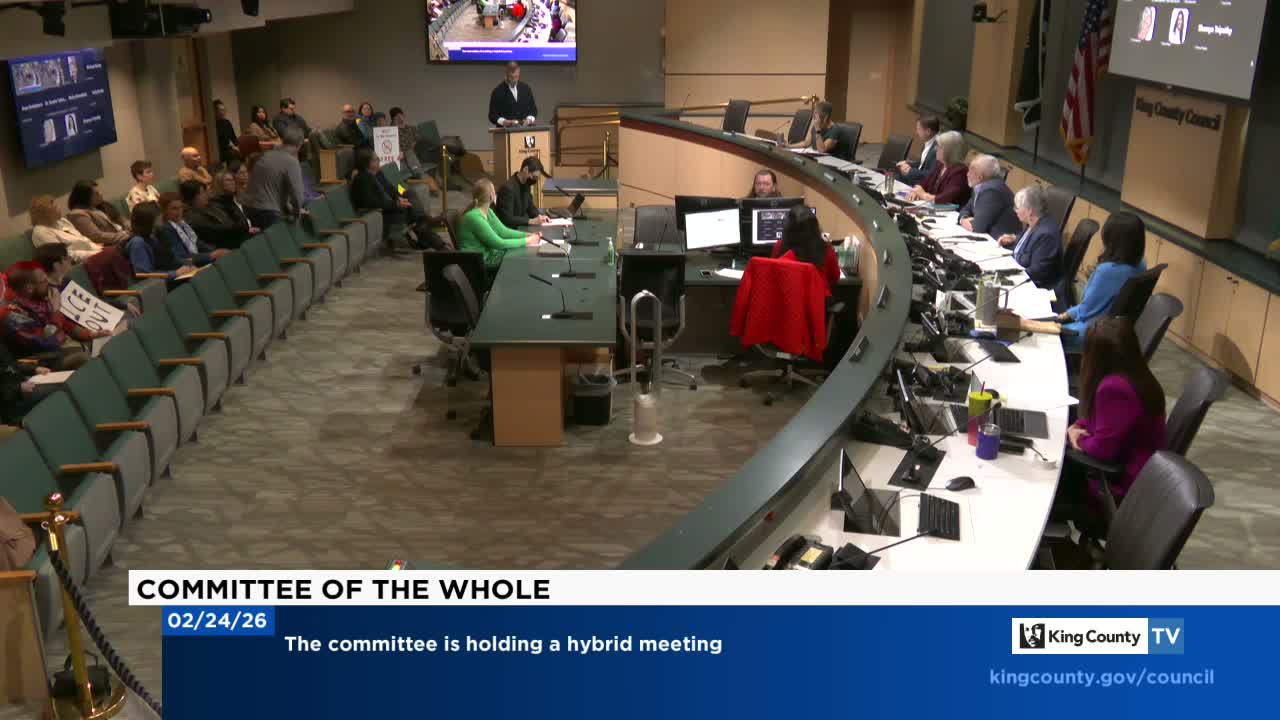
Dozens of public commenters and community organizations pressed King County elected officials on Feb. 24 to take immediate steps to protect residents from escalating federal immigration enforcement and to invest in legal and basic‑needs support.
Residents who came to the Committee of the Whole urged a countywide ban on ICE conducting enforcement on county‑owned property, stronger protection for schools, rental and food assistance, and guaranteed legal representation for people in removal proceedings. "We have close to 3,000 people who signed in support of our demands," Rosario Lopez, a Central District resident, told the committee.
Community groups presented data and recommendations. Vanessa Reyes, policy manager at the Washington Immigrant Solidarity Network, said the statewide deportation defense hotline has received more than 2,000 calls so far in 2026 with about 160 intakes from King County residents in January and early February. Reyes described multi‑agent operations in public spaces, use of unmarked vehicles, agents covering identity tags and multiple reports of detentions during traffic stops and in parking lots. "We don't have any reports that can confirm that any of these arrests happen with the use of judicial warrants," Reyes said, and urged the council to pass ordinances limiting enforcement on county property, review county contracts and invest in legal services and mutual‑aid funds.
Shomia Tripathi of Asian Counseling and Referral Service described growing client fear about data sharing and said case managers have escorted clients to cars when ICE was reportedly seen near service sites. "Clients ask their case managers not to write information down because of this fear," Tripathi said, adding that providers need navigators and funding to reach communities with limited English proficiency.
Malou Chavez of the Northwest Immigrant Rights Project described a rise in detention work and a legal strategy that has included habeas petitions to secure release for eligible detainees. Chavez provided counts the organization has tracked: ICE‑related arrests in their data more than doubled between 2024 and 2025 (the presentation cited roughly 974 arrests in 2024 and about 1,992 in 2025) and reported increased detainers and average daily population at Tacoma detention facilities.
King County Prosecuting Attorney Lisa Mannion told the committee her office is preparing to respond to unlawful use‑of‑force incidents by federal agents and is coordinating investigations with independent teams and partners. "We are using every legal tool at our disposal to protect our community and all of our residents from unconstitutional and unlawful federal overreach," Mannion said, noting both criminal investigation capacity and civil litigation already under way.
Misha Werschkel, deputy director for Policy and Innovation in the executive's office, summarized an executive order issued Feb. 12 that includes seven initial steps: creating a welcoming county subcabinet, allocating $2,000,000 in emergency funding for immigrant and refugee communities (for rental, food and legal aid to be dispersed through the Department of Community and Human Services), directing the sheriff's office to publish guidance and a community FAQ by March 16, 2026, prohibiting immigration authorities from staging enforcement in non‑public county spaces, and continuing federal advocacy to oppose additional ICE funding. Werschkel said the executive's office has been coordinating with council staff on draft ordinance language (proposed ordinance 2026‑0027) to bar staging and limit enforcement on county property.
Council members thanked speakers and pressed for actionable, deployable steps. The chair pledged additional hearings to bring county departments into the conversation; remaining county presenters who were scheduled to speak were deferred to future briefings.
Next steps identified in the hearing: the council will consider ordinance language developed with the executive, the sheriff's office will publish guidance and an FAQ by March 16, and the executive's office will disperse the allocated emergency funding through DCHS.