Get Full Government Meeting Transcripts, Videos, & Alerts Forever!
Get email alerts on the Water Policy topic
No spam. Unsubscribe anytime.
Surprise staff propose ‘high water user’ ordinance with 100,000 gpd threshold and 15‑year service agreements
Summary
City staff presented a draft municipal code update to define 'high water users' ( >100,000 gallons per day), require a Sustainable Water Service Agreement with a 15‑year term, and give the council discretion to allocate additional supply; staff said the rule would apply only to customers served by the city's system and would not be retroactive.
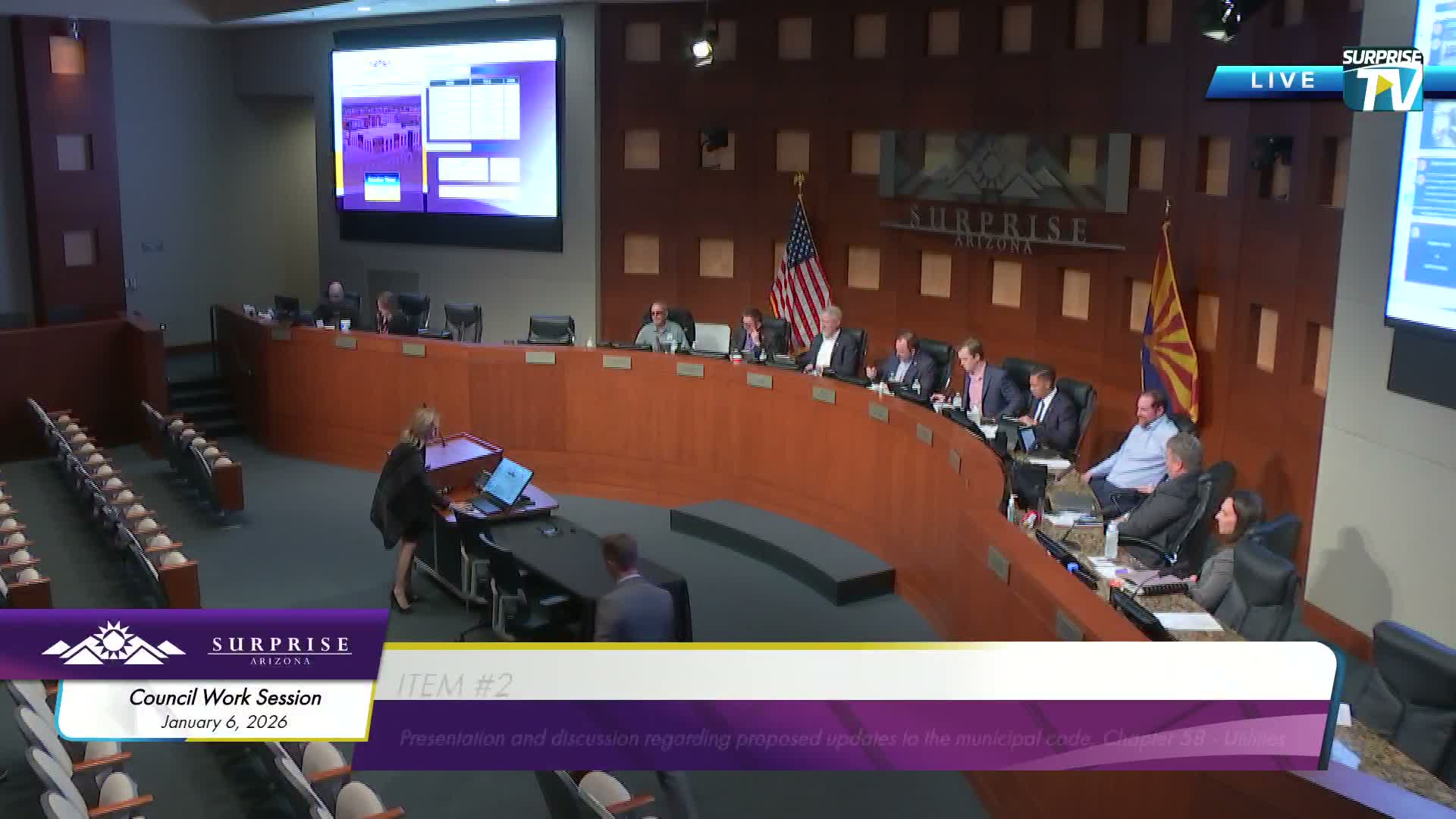
City staff briefed the Surprise City Council on Jan. 6 about a proposed update to Chapter 58 establishing a 'high water user' ordinance and a new Sustainable Water Service Agreement designed to manage large industrial or commercial water demands.
Amy, a water resources staff member, told the council "the way that we're defining a high water user is any industrial or commercial customer who uses more than a 100,000 gallons per day of water." The draft ordinance would require such users to submit an application as part of development review, document water demands and a conservation plan, enter a 15‑year agreement with the city (with renewal or reevaluation at term end), and accept an initial base allocation of 100,000 gallons per day.
Under the draft policy, the council may exercise discretion to grant an additional 100,000 gpd (a "level 2" allocation) for projects judged to have high community benefit. Any demand beyond the council‑allocated amount would require the applicant to secure and dedicate additional water resources — for example, via water credits or a surface water right — before city service is extended. Staff said the agreement also documents required off‑site infrastructure and financial penalties for exceeding allocations.
Staff emphasized the ordinance as a forward‑looking tool: as Amy noted, Surprise’s largest current industrial user uses about one‑third of the 100,000 gpd threshold, and the rule "would not be retroactive" to existing users. The ordinance as drafted would apply only to customers served by the city’s water system; staff said privately served customers (for example, in EPCOR service areas inside city limits) would not be governed by this code section.
Council members asked whether the council could block a user who had secured its own water resources. Mike Buey (presenting with Amy) said that if a user brings its own water and the situation is beyond the discretionary level, "they can proceed with what they intend to do." Council member Judd pressed for details on how annual averages and equivalencies are calculated; staff responded allocations are based on an annual average (previous‑year consumption divided by 365) and provided a math example for council review. Judd also asked whether the council’s discretion could be used to deny a suitably prepared application; staff said the ordinance was not the appropriate mechanism to overturn property‑rights questions and that zoning and other processes would apply.
Staff said they will gather additional feedback and expect to return with final Chapter 58 amendments at an upcoming council meeting later in the month. No formal vote took place at the work session.
The draft ordinance and example calculations will be posted with staff materials; council members requested more detailed crash/data statistics and a penalty math example for future meetings.