Get Full Government Meeting Transcripts, Videos, & Alerts Forever!
Get email alerts on the Entheogens Motion topic
No spam. Unsubscribe anytime.
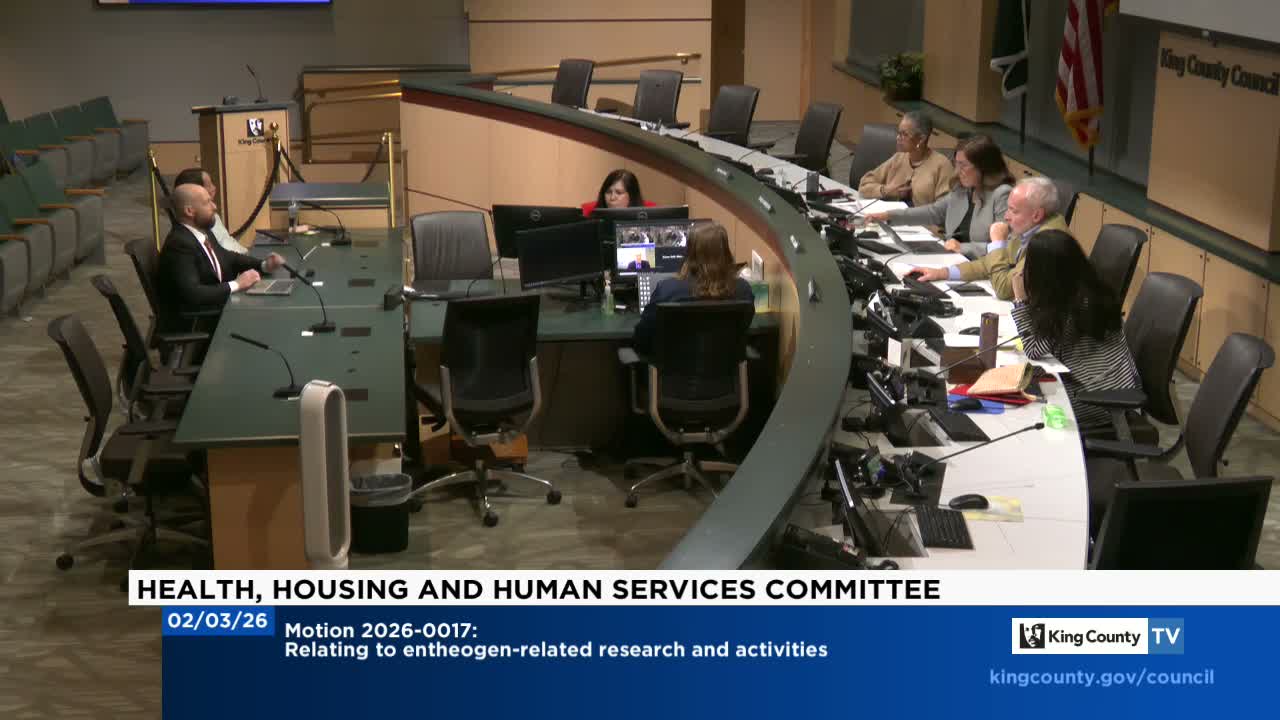
King County committee hears staff briefing on entheogen motion; PAO and sheriff describe low enforcement priority for personal use
Summary
Central staff described proposed Motion 2026‑0017 urging support for entheogen research and decriminalization at state and federal levels; the Prosecuting Attorney’s Office and Sheriff’s Office told the committee that personal‑use cases are rarely prosecuted locally and that deputies typically confiscate entheogens and dispose of them.
Central staff briefed the committee on a draft motion (2026‑0017) asking King County to support continued research into entheogen‑based treatments and to urge decriminalization or deprioritization at the state and federal level for personal use. The motion would ask that investigation, arrest and prosecution of adults cultivating or using entheogens for religious, spiritual or therapeutic purposes be designated among the county’s lowest enforcement priorities in unincorporated areas, while explicitly excluding conduct that endangers public safety or involves minors or commercialization.
Nick Bowman (central staff) walked members through the motion’s scope and summarized feedback gathered from the Prosecuting Attorney’s Office and the King County Sheriff’s Office. Dan Clark of the PAO told the committee he could not recall a single prosecution for the personal use of entheogens during his 30‑year career and said such cases are rare; cases that do reach the PAO are typically diverted to treatment programs or deflection. KCSO staff reported a search of 2023–2025 records that found 125 mentions of entheogen‑related terms, with 11 incidents involving enforcement; most encounters led to confiscation and disposal, and law enforcement prioritized investigations tied to public safety and trafficking.
Supporters — including clinicians and patients who testified earlier in the meeting — framed the motion as a narrow, symbolic step to reduce fear among people seeking experimental or therapeutic treatments and to encourage more clinical research. Some councilmembers signaled support with suggested edits: narrowing age thresholds consistent with state law, clarifying the motion’s inapplicability inside city jurisdictions, and tightening public‑safety carve‑outs (for example, driving under the influence and use on public transit).
Chair Mosqueda and sponsors asked colleagues to submit proposed amendments by Feb. 17 so staff can prepare a revised draft for consideration; the committee intends to revisit the motion at its March meeting. No formal vote was taken in this session.