Get Full Government Meeting Transcripts, Videos, & Alerts Forever!
Get email alerts on the Foundational Public Health Services topic
No spam. Unsubscribe anytime.
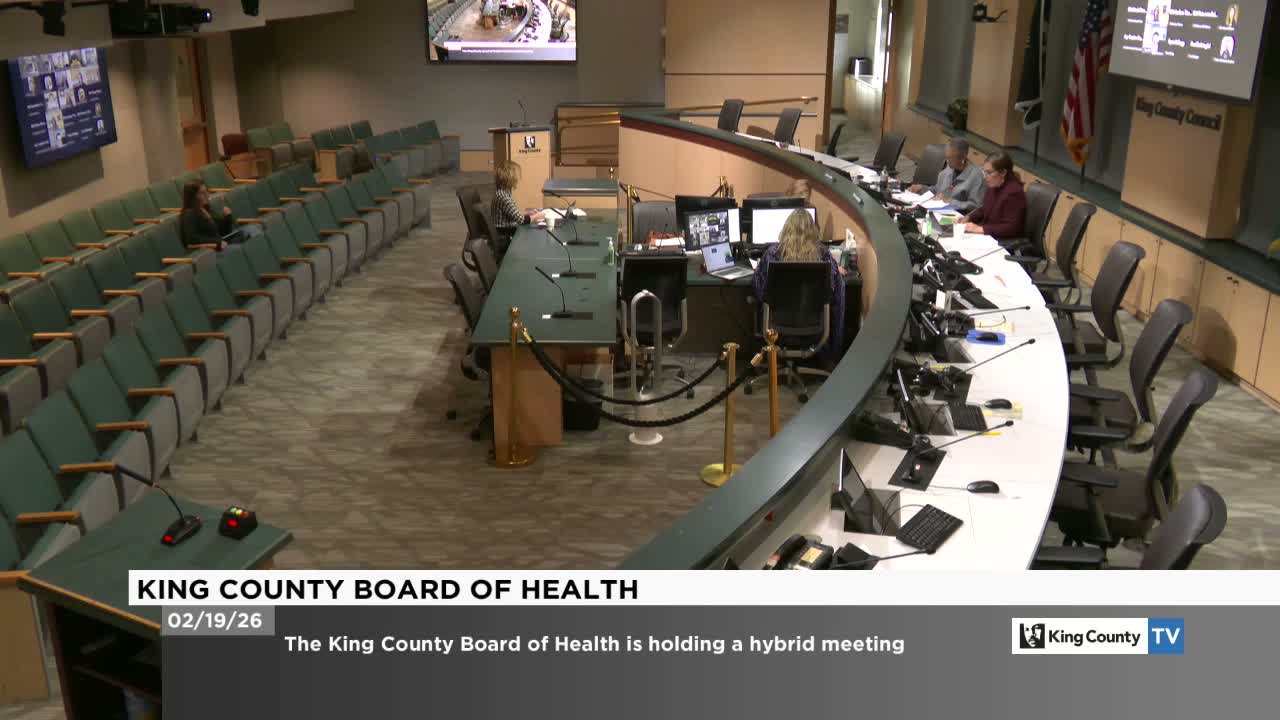
King County Board of Health unanimously urges state to shore up foundational public health services funding
Summary
The King County Board of Health unanimously adopted Resolution 26-03 calling on the Washington State Legislature to address cuts and revenue changes that threaten foundational public health services funding, citing an estimated $4'$6 million impact to the county under current proposals.
The King County Board of Health voted unanimously on Feb. 19 to adopt Resolution 26-03, urging the Washington State Legislature to restore and stabilize foundational public health services (FPHS) funding amid proposed budget reductions and changes to tobacco and vapor tax revenue. Vice Chair Daniels moved the resolution and the board recorded a final tally announced as 20 ayes.
Public Health Seattle King County's government relations officer, Simon Villa, told the board the agency receives roughly $18,000,000 a year in FPHS funding that supports communicable disease surveillance, vaccination clinics, food and water safety work, emergency preparedness and dozens of staff positions that operate those programs. "Without FPHS funding, King County would face increased avoidable deaths, hospitalizations and illnesses," Villa said.
Why it matters: Villa and panelists described two concurrent fiscal threats — a governor-proposed supplemental reduction cited in the presentation and an unexpected loss of vapor/tobacco revenue following recent statutory changes — that together create a substantial gap in statewide FPHS investments. Villa and Matthias Valenzuela, director of the Office of Equity and Community Partnerships, estimated the statewide picture could be as much as a combined reduction on the order of tens of millions of dollars and said King County's share of current proposals would likely be in the $4'$6 million range. "An approximately $50,000,000 reduction on FPHS investments represents a likely cut for King County that would be between 4 and 6,000,000 a year," Valenzuela explained during the panel presentation.
Community impact: Panelists from community organizations described how FPHS-funded activities are used on the ground. Jackie Vaughn, executive director of Surge Reproductive Justice, said local, disaggregated public-health data and FPHS-funded partnerships helped secure state birth-equity funding following documented disparities in Black maternal outcomes. Rosie Mbolitinibi, Pacifica Food Network manager, described FPHS support for food access work, including a 2025 leverage of roughly $300,000 for farm-to-community programs and a $250,000 USDA grant; she warned that losing FPHS funding would eliminate the county's only dedicated food access lead and slow or stop grantmaking and technical assistance to community organizations.
Environmental health: Ryan Kellogg, Assistant Division Director of Environmental Health Services, highlighted FPHS-supported work that keeps restaurants, beaches and school environments safe, supports septic-to-sewer transitions, and funds language-access services and climate-driven hazard planning. He told the board that cuts would curtail those daily protections and preparedness capacity.
Board discussion and vote: Members asked staff to clarify bill numbers, the status of a ghost-gun bill (HB 2320) and a tribal billing bill (HB 2555); Villa said the team is tracking those bills and offered to provide written follow-up on nicotine/tobacco revenue formulas. Vice Chair Daniels moved the FPHS funding resolution; after the clerk called the roll the chair announced adoption of proposed Resolution 26-03.1 and corrected an early tally so the record showed unanimous support. The board asked Public Health staff and partners to continue rapid outreach to legislative leaders once budget proposals were released.
What comes next: The resolution records King County's support for preserving FPHS funding and directs the board's advocacy channels to relay urgency to Olympia as the House and Senate finalize budgets. Staff committed to distributing detailed bill analyses and the revised presentation slides to the board so members can assist with outreach.
Quote: "FPHS funds the basic protections that the state and communities require," Matthias Valenzuela said. "Cutting FPHS does not eliminate that responsibility; it shifts costs, risks and accountability to cities, counties and communities that may not have the resources."