
King County Flood Control District reports widespread December flood damage; $71.1M preliminary damage assessment
Get AI-powered insights, summaries, and transcripts
Sign Up Free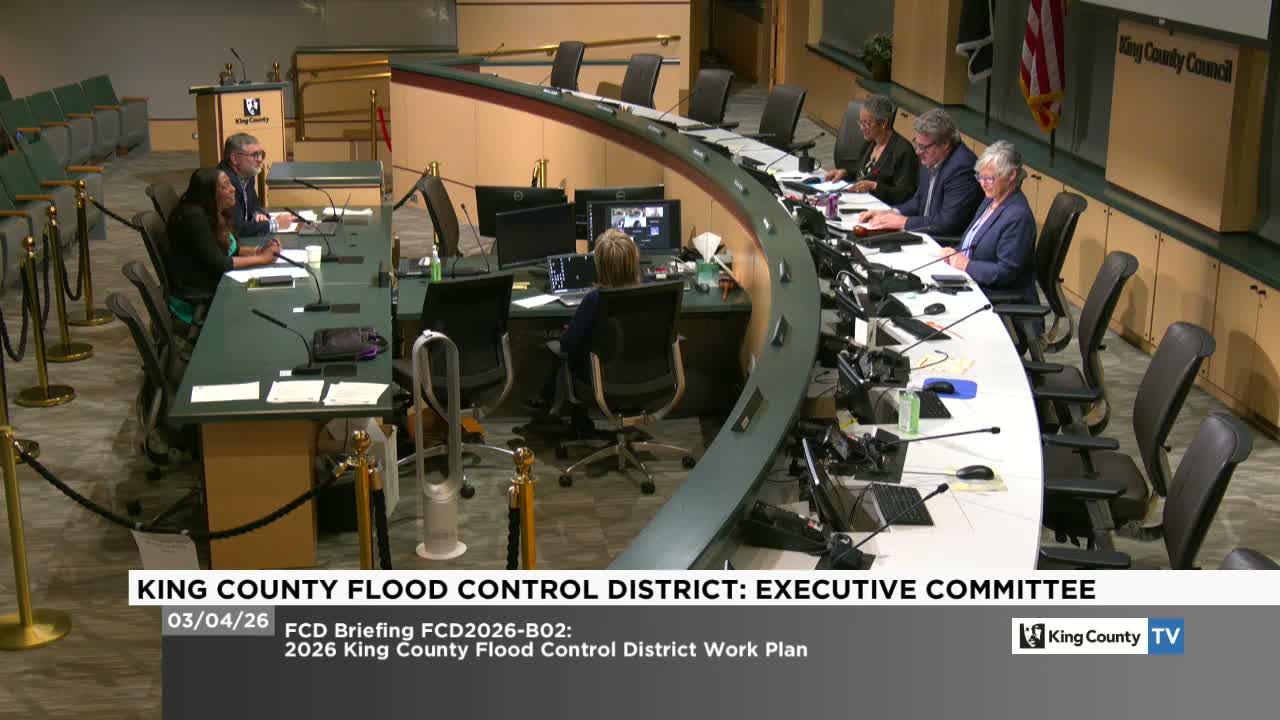
Summary
At its March 4 executive committee meeting, staff reported 386 post‑flood inspection reports finding about 163 county‑owned levee and revetment damages (≈32% of facilities) and said King County submitted a preliminary damage assessment of about $71.1 million to the state; staff will present cross‑basin reprioritization options for committee decisions.
Laura Bradstreet, King County’s river and floodplain management section manager and flood emergency director, told the Flood Control District executive committee on March 4 that the December 2025 flood was “unusual in its scale, intensity, and duration” and prompted an intensive, multiweek county response.
Bradstreet said the county deployed 46 inspection teams and produced 386 post‑flood inspection reports that identified about 163 damaged county‑owned levees and revetments, or roughly 32% of the county’s facilities. She said staff modeled a per‑linear‑foot in‑kind repair cost of $3,750 and used that figure in a preliminary damage assessment (PDA) submitted to the state of about $71,100,000; the river and floodplain management program accounts for roughly $47,000,000 (about 66%) of that total.
“We had 46 teams who went out on inspection…and as of January we had 386 post‑flood inspection reports, which revealed that about 163 of our facilities…were damaged,” Bradstreet said, adding that the flood‑warning center’s activation was “the longest activation of the flood warning center in at least 40 years.”
Staff described how damages were sorted in compressed workshops into response categories: urgent repairs that should be completed before the next flood season; new CIP repairs for facilities not previously on the six‑year capital improvement program; repairs to sites already on the CIP; sites recommended for decommissioning (particularly in severe channel migration zones); and lower‑risk monitoring/maintenance items. Bradstreet said some damaged sites raise policy questions that will require additional district discussion.
Bradstreet said staff are conducting a cross‑basin prioritization effort to integrate newly identified damages with projects already prioritized for the year. She said the findings from post‑flood inspections are being entered into the River Facilities Inventory (RFI) and that staff will present options for committee decisions in upcoming briefings.
Committee members praised staff for the scope of the response and the district’s prior investments in flood risk reduction. Chair Reagan Dunn and others noted that some projects are far enough along that stopping construction would be impractical; staff identified two projects slated for 2026 construction as part of the presentation.
The presentation also covered related planning work: staff will develop an updated strategic plan (replacing the 2006 plan), pursue capital investment strategies for multiple basins (including Sammamish and the Lower Green Corridor), and examine flood‑warning systems and possible technology augmentations.
Next steps: staff will continue cross‑basin prioritization and return to the committee with proposals that the board can act on; the committee adjourned without taking further action at the March 4 meeting.