Get Full Government Meeting Transcripts, Videos, & Alerts Forever!
Get email alerts on the Governance topic
No spam. Unsubscribe anytime.
Board reviews abstention, voting and Open Meetings guidance in governance refresher
Summary
Legal counsel reviewed how Robert's Rules and local policy interact on abstentions, the district uty to record votes, and how Open Meetings Act rules affect quorums and public comment. Board members asked staff to bring policy wording updates for future agenda consideration.
Legal counsel provided the Las Cruces Public Schools Board a detailed refresher on parliamentary practice, conflicts of interest and state open-meeting obligations during the board—xtended work session on Feb. 27.
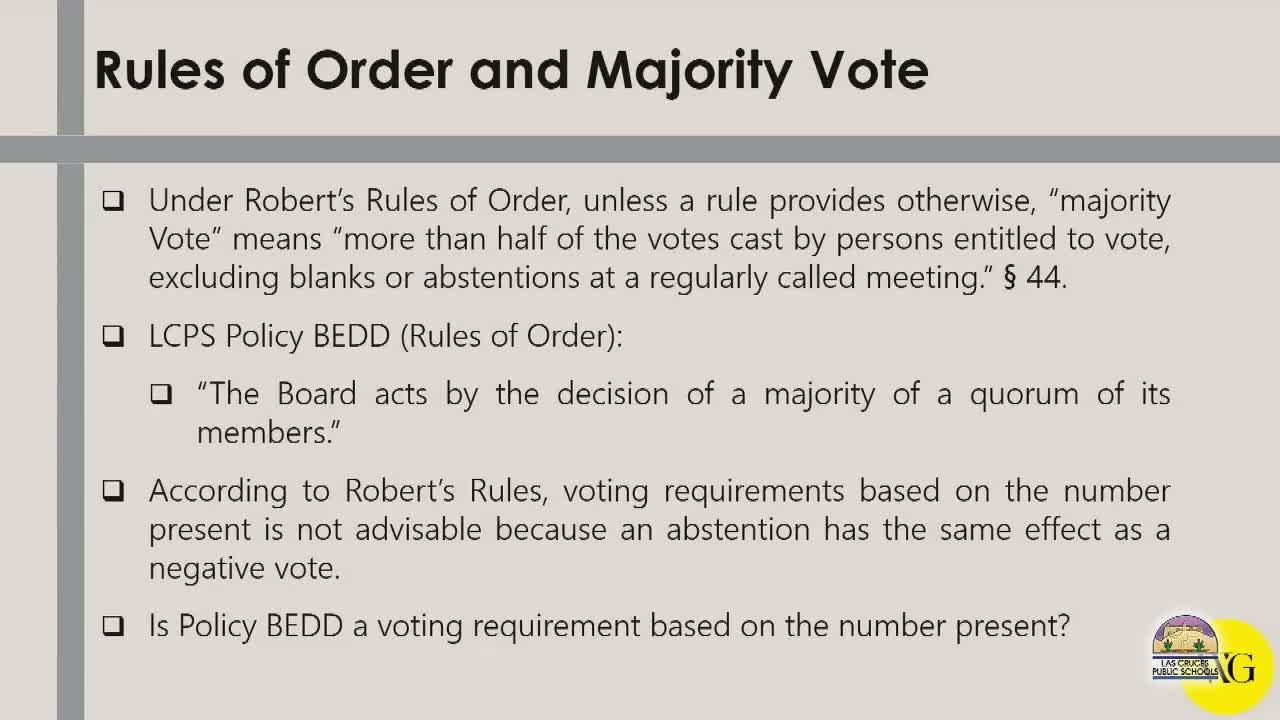
The presentation focused on two persistent governance questions: how abstentions affect whether a motion passes under Robert's Rules and how local policy language should reflect the board's intent. Counsel noted that under Robert's Rules a majority is calculated from votes actually cast, excluding abstentions, while the board's policy BEDD currently reads that the board acts by the "decision of a majority of a quorum," language that could be read to require a majority of members present even when someone abstains. "So I think then fundamentally the question is . . . do you think there is a conflict between Robert's Rules . . . versus your policy?" the attorney said.
Members raised practical examples. A board member asked whether two votes could carry an item when four members are present and one abstains; counsel replied that boards of this size should consider clarifying their policy and possibly aligning it with Robert's Rules as guidance. Counsel recommended bringing proposed wording changes back to an agenda-setting meeting for formal consideration rather than deciding today.
The attorney also reviewed the Governmental Conduct Act and the duty to disclose and recuse when a board member has a direct personal or pecuniary interest not common to other members. "Full disclosure of real or potential conflicts of interest shall be a guiding principle," she said, adding that recusal and public explanation can preserve public trust.
On transparency, counsel reiterated New Mexico Open Meetings Act obligations: meetings must be open, the public may record proceedings, and agenda descriptions should not be so broad as to mislead the public when action is contemplated. She cautioned that a so-called "quorum notice" is not a substitute for notices and agendas required by law and described the district's approach to OMA resolutions that notify the public when a quorum may attend an outside event while committing not to deliberate school business there.
Board members supported a staff-led follow-up to review BEDD and related policy language and recommended that any proposed edits be brought forward on a future agenda so the public can review them in advance. The meeting's governance segment concluded with the board agreeing to consider policy language changes rather than adopt them on the spot.