Get Full Government Meeting Transcripts, Videos, & Alerts Forever!
Get email alerts on the Land Use Site Plan topic
No spam. Unsubscribe anytime.
Hamden wetlands commissioners review New Haven Country Club plan, press for tree-replacement, medallions and environmental survey
Summary
The Town of Hamden Inland Wetlands Commission reviewed Application 25-127160 from the New Haven Country Club for renovations at 160 Hartford Turnpike including demolition of a pool-house, a new pool house and cart barn, parking repairs and upgraded stormwater controls; commissioners proposed conditions on medallions, erosion controls, a 1-for-1 native-tree replacement plan and filing of environmental-survey results prior to demolition.
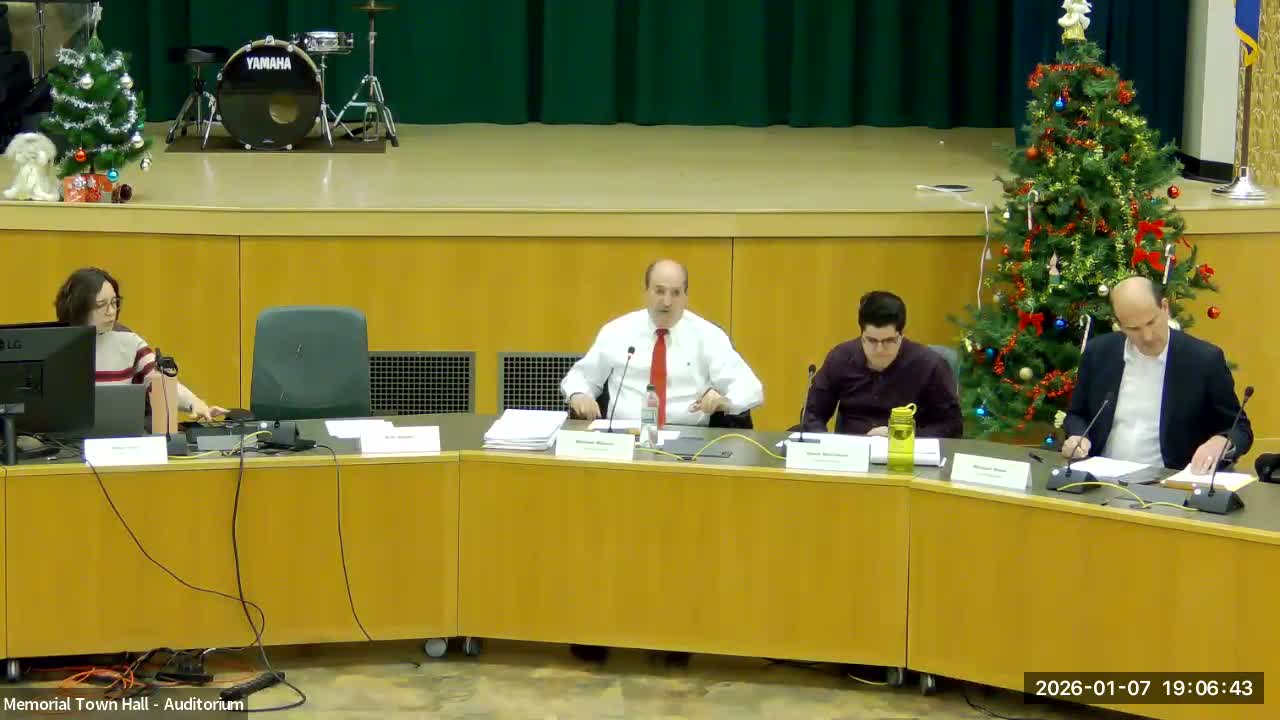
The Town of Hamden Inland Wetlands Commission on Jan. 6 reviewed a site plan from the New Haven Country Club to demolish an existing pool-house and storage building and build a new pool house and a cart barn at 160 Hartford Turnpike, while renovating parking and upgrading stormwater controls to reduce runoff to Lake Whitney.
Marcus Puddock, a civil engineer and land surveyor with Godfrey Hoffman Hodge, told the commission the project would retain the existing pool, add a cart barn and a walking path, renovate paved and gravel parking, and replace a single existing catch basin system that drains roughly 11 acres with a set of improved catch basins, a hydrodynamic separator and an armored outfall. "This is a huge upgrade," Puddock said of the stormwater work, which he said will capture wash water from electric golf carts and route it through treatment before it reaches the stream.
Commissioners focused on construction limits and wetland protection. Puddock estimated tree removal would be "25 to 30" trees in the disturbed zone but said he did not have an exact count; he described a localized disturbance of about 20–34 feet where clearing is needed for footings and access but said the cart-barn foundation uses posts to limit clearing. In reply to commissioners, he said the carts are electric and there is no permanent refueling planned on site.
Commissioners proposed a set of conditions to make the approval contingent on detailed erosion controls and plan clarifications. The read-in conditions included requiring silt fencing reinforced by hay bales, depiction of a stockpile location on final plans, permanent placement of Inland Wetland Conservation Area medallions along the project tree line, depiction of the conservation boundary and Lake Whitney on site plans, incorporation of the Jan. 2, 2026 Regional Water Authority recommendations, use of clean fill only, weekly inspection and repair of sediment and erosion controls (and after rain events), and silt-sacks in new and existing catch basins for the duration of the project.
On tree replacement, commissioners debated whether replacement trees must be planted exactly where removals occur or elsewhere on the property. Dave McCollum asked whether the applicant would agree to replace removed trees with a similar number on-site; Michael Deacon, vice president of the New Haven Country Club, said the club recently planted disease-resistant elms and "we would never be opposed to adding additional elm trees," though he would not commit the board that night to a firm count. Commissioners refined draft language to require any trees removed be replaced with an identical (later amended to 'similar') number of native trees planted on-site, and to require a report to the wetlands enforcement officer showing the location, species and diameter of replacement trees. The commission set a deadline: replacement trees must be planted within 18 months of the decision.
Commissioners also addressed hazardous-materials and demolition concerns raised in a review letter from the Regional Water Authority. David Thompson of David Thompson Architects said a hazardous-materials consultant is part of the project team, that surveys and abatement plans will be prepared and included in bid and permit documents, and that an on-call abatement consultant will handle any concealed materials discovered during demolition.
Members discussed requiring that environmental-survey results for any building proposed for demolition be filed with the Hamden Wetland Enforcement Officer and the Regional Water Authority prior to demolition activity, and that any required mitigation plans be submitted for review and approval by the wetlands enforcement officer before mitigation or demolition occurs. Commissioners agreed to change draft wording from "hazardous testing results" to "environmental survey results" to reflect that process.
The commission read proposed conditions into the record and a motion to adopt the revised conditions was made and seconded. The transcript records voices saying "Aye" and "No" on the record during the roll call for the motion, but the excerpt does not include a detailed final tally or a written outcome. The minutes require the final revised plan to be approved by the wetlands agent or by the commission chair prior to issuance of a zoning permit on the town's permitting portal.
What happens next: the applicant will submit revised plans (sheet C3.1 revised to 01/06/2026 was referenced) incorporating the requested information — stockpile location, medallion placement, stormwater operation and maintenance language, and tree-replacement reporting — and the wetlands enforcement officer will review the environmental-survey results and the replacement-tree report prior to permitting.