Get Full Government Meeting Transcripts, Videos, & Alerts Forever!
Get email alerts on the Downtown Development topic
No spam. Unsubscribe anytime.
Board authorizes negotiations with Grama Properties for 942/1050 Main Street redevelopment amid parking dispute
Summary
The Manchester Board of Directors voted March 3 to authorize the town manager to negotiate a development agreement with Grama Properties for 942 and 1050 Main Street, after a presentation describing 116 housing units, retail, 40 public parking spaces and a 19‑year tax assessment schedule prompted sustained public comment about veteran and business parking needs.
The Manchester Board of Directors voted to authorize the town manager to negotiate terms of a development agreement with Grama Properties for redevelopment of 942 and 1050 Main Street, a proposal developers say will deliver mixed‑use housing, retail and public space to downtown.
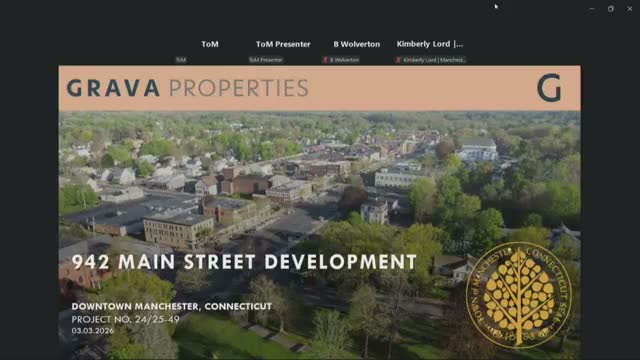
Grama’s presentation described 116 residential units (including a 20 percent workforce set‑aside), artists’ flats and ground‑floor retail fronting a new public plaza. Developer Greg Vaca said the plan includes 78 on‑site parking spaces for residents, 40 public parking stalls intended for downtown patrons (no overnight parking), and 60 bicycle parking spaces. Grama proposed acquiring the site for $100,000, a 19‑year fixed tax assessment schedule that phases in payments, and an estimated $40 million overall investment.
"We took the RFP and tailor‑made the project to what the town and its people have said that they want," Greg Vaca said during the presentation.
The proposal prompted extended public comment and director questioning focused on parking and financial terms. Peter Miller, a board member of the Army and Navy Club, warned the board that removing free nearby parking would harm the veterans’ club: "1050 Main Street is the only parking lot on Main Street," he said, urging the board to preserve spaces that serve veterans and several downtown businesses.
Town staff and members of the steering committee urged the board to consider tradeoffs. Gary Anderson, the town’s director of planning and economic development, showed a quarter‑mile analysis that staff said contains roughly 600 off‑street public parking spaces within walking distance of the library and downtown; he and other staff noted a planned new lot south of Bennett Housing would add roughly 60–68 spaces to the inventory. "When you add it all up, it’s possible to close the same amount," the town manager said, pointing to a combined total of sites that staff argue would replace lost stalls while enabling a denser streetscape.
Directors pressed Grama on several financial details: the firm said financing would be a mix of a construction loan, a new CMDA loan program (of which Manchester is a member), grant funding and private investor equity. Grama said it has applied for a state Community Investment Fund grant and expects to pursue historic tax credits where applicable.
Concerns about visitor parking, overnight use, and whether 40 public stalls would be sufficient for event nights at the Army and Navy Club proved central during debate. Director Conyers, who said she is a longtime member of the Army and Navy Club, urged a firm commitment that the Bennett lot or other compensatory parking be built before final approvals. Other board members emphasized long‑term downtown vibrancy and walkability as goals of the plan.
After deliberation, Director Lentini moved to authorize the town manager to negotiate a development agreement with Grama Properties; the motion passed with five directors voting yes, two voting no and one abstention (Director Frey).
Next steps outlined by staff include entering negotiations with the developer, continuing public outreach and holding a public hearing before any final transfer of property or agreement is approved.
Action taken: The board authorized the town manager to negotiate a development agreement with Grama Properties for 942 and 1050 Main Street (motion passed 5‑2‑1).