Get Full Government Meeting Transcripts, Videos, & Alerts Forever!
Get email alerts on the HR1 Impact topic
No spam. Unsubscribe anytime.
HHS warns Board that HR 1 and state changes could raise recurring county costs by $6–$10M and increase homelessness
Summary
Health and Human Services briefed supervisors on phased federal HR 1 changes (work requirements, tightened immigrant eligibility, reduced retroactive coverage and SNAP match shifts) that will increase administrative workload and create recurring county exposure estimated at $6–$10 million annually by FY28 without mitigations.
Health and Human Services Director Dr. Lisa Varhoes and senior staff presented a detailed briefing on federal HR 1 changes and state policy shifts that are expected to increase county-level fiscal risk and operational workload. Carrie Buhrman (Social Services) summarized HR 1 provisions: broader work requirements for Medi‑Cal (expansion population and ages 19–64 requiring 80 hours/month), expanded Able-Bodied Adults Without Dependents (ABAWD) work rules for CalFresh (20 hours/week), tightened immigrant eligibility for full-scope Medi‑Cal, reduced retroactive coverage for the expansion population and policy changes to provider-tax mechanisms that fund Medi‑Cal state shares.
HHS estimated these changes will increase churn, eligibility reviews, and administrative tasks as early as late 2026 and into FY27–28. Buhrman reported the county’s expansion Medi‑Cal population includes about 21,000 individuals and that the administrative burden (more frequent eligibility reviews, shorter retroactive coverage) will increase case management needs. Dr. Varhoes summarized that the net fiscal exposure to the County—combining administrative cost shifts, benefit-error-risk exposure, and CMSP growth—could range from $6 million to $10 million annually by FY28 without state or federal remediation.
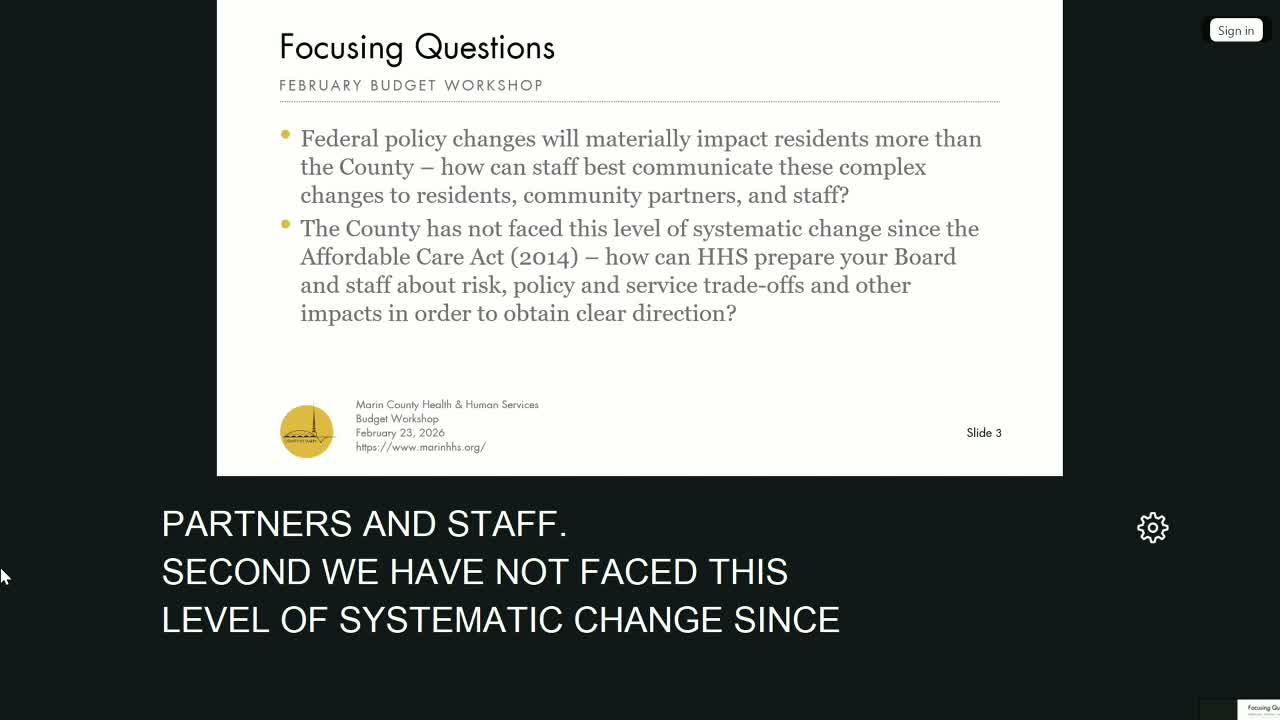
HHS outlined mitigation measures the department is already implementing: expanding eligibility-staff cohorts and training, automating eligibility workflows where possible, strengthening partnerships with community clinics and schools, launching employment-assistance options to help clients meet new work requirements, and standing up a coordinated county-level HR1 preparedness group. Staff emphasized the county cannot fully backfill federal reductions at scale and will return with specific budget trade-offs and options after federal guidance and the state May revise clarify final impacts.
Supervisors asked for scenario analyses, communications strategies for residents (especially those at risk of losing benefits), and legislative coordination. Staff committed to continuing cross-departmental planning and to reporting back with options and requests for Board direction as the federal and state rules evolve.