Get Full Government Meeting Transcripts, Videos, & Alerts Forever!
Get email alerts on the Enrollment topic
No spam. Unsubscribe anytime.
District consultant warns of possible long‑term enrollment decline; board told to plan for 800–2,000 fewer students over 10 years
Summary
An Applied Economics presentation at the Flagstaff Unified School District board meeting flagged shifting population age structure, rising choice programs and housing patterns as drivers that could shrink enrollment substantially over a decade; staff said the analysis will guide next year’s staffing and budget planning.
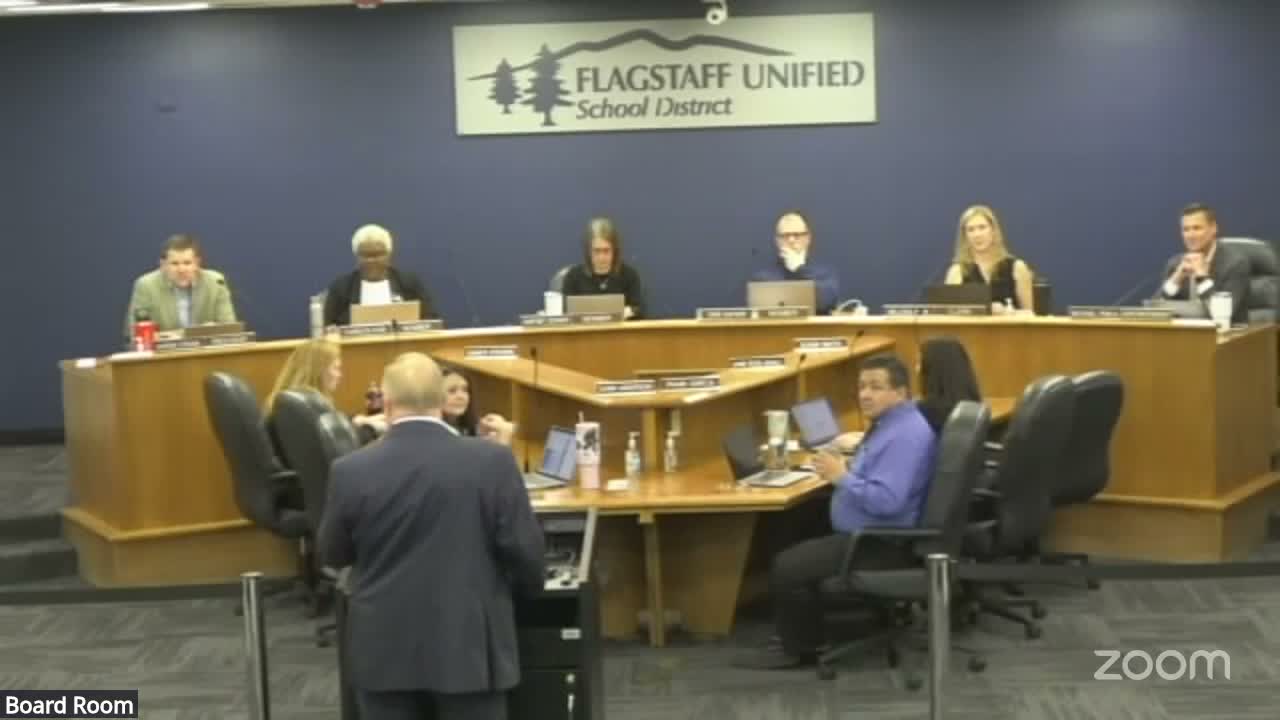
Rick Brammer of Applied Economics presented the Flagstaff Unified School District board with a demographic and enrollment analysis on Feb. 24 that outlined scenarios showing a possible sustained decline in district enrollment.
Brammer told the board the district’s school‑age share of the population has fallen to historically low levels and that national and state birth‑rate declines, combined with expanded school‑choice options, make future enrollment uncertain. “If we keep sliding how we've been sliding the last five years, then enrollment could drop from 8,000 students today to around 6,000 students 10 years from now,” he said, noting the figure represents a worst‑case scenario and that a reasonable range was about 800 to 2,000 students lost over the next decade.
The consultant said the district’s service‑rate — the share of resident school‑age children attending district schools — has declined in recent years and that program options such as charter schools and Education Savings Accounts (ESAs) have accelerated parental choice. He also described how local housing development patterns and changes in household age structure (an increase in households over age 55) reduce the likely number of school‑age residents per new housing unit.
Superintendent Penza said the district will use the report alongside its own projections to inform staffing and budgeting under Arizona’s current‑year funding rules, and to model possible boundary or grade‑configuration changes. “We wish the numbers were telling us a different story,” Penza said, adding the district’s internal projection was within seven students of Applied Economics’ figures.
Brammer emphasized uncertainty in the estimates and presented two modeling approaches — a district‑level, top‑down scenario and a subdistrict, neighborhood‑level analysis — that the district can use to test “what if” attendance‑area changes.
Board members asked about timing for a potential recovery if birth rates or migration changed. Brammer said demographic shifts tend to play out over years and cautioned that policy changes to ESAs or other state programs could alter family decisions about schooling.
The board did not take action on the report but directed staff to use the analysis in budget and staffing planning for the coming year.