Get Full Government Meeting Transcripts, Videos, & Alerts Forever!
Get email alerts on the AIPP Ordinance topic
No spam. Unsubscribe anytime.
Arts Commission presses city on public‑art ordinance and murals; approves $1.8M art call for Northeast Service Center garage
Summary
Commissioners urged city leadership to preserve the intended 2% for art after staff reported cross‑department disagreements about calculating the percent base; staff also described a TxDOT memo requiring removal of nonstandard roadway markings and said the city has requested exceptions. The commission approved an invitational art call for a $1.8 million garage façade at the Northeast Service Center.
Commissioners used the Arts Commission meeting to press for clarity and protection of the Art in Public Places (AIPP) program while staff briefed the body on a TxDOT memo about roadway markings and presented an invitational art call for a major service‑center project.
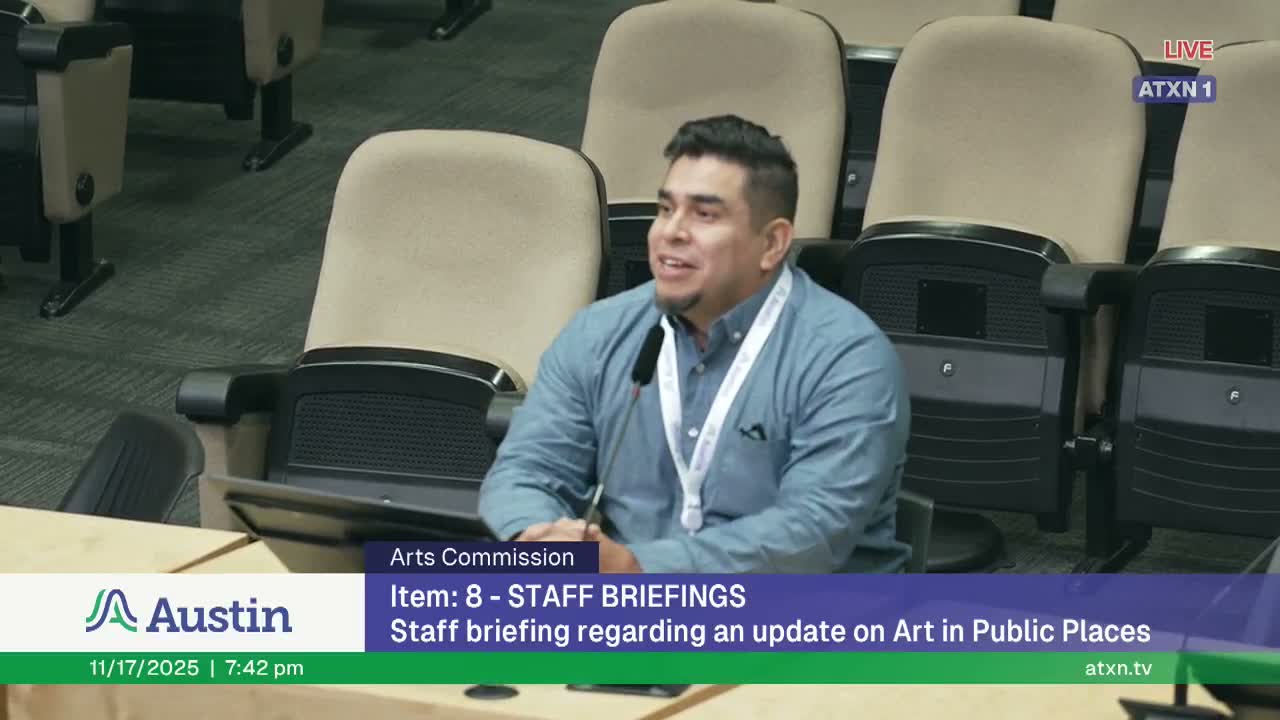
Jaime Castillo, AIPP manager, told the commission that Texas Department of Transportation guidance identified nonstandard roadway markings and that Austin Transportation & Public Works had flagged about 16 artworks; the city sought exceptions for AIPP projects and a public spaces task force was convened. "ATPW did submit that exception on behalf of the city of Austin for all that point, all 6 15 murals," Castillo said, noting the task force has met and AIPP is supporting the effort to identify solutions and alternatives.
The meeting then turned to a long‑running ordinance revision. Staff presented red‑lined changes to the AIPP ordinance, acquisition/deaccession policies and bylaws; commissioners raised a central dispute over how to calculate the ordinance's 2% percent‑for‑art allocation. Historically, the ordinance language has been interpreted in different ways — either against construction cost (labor and materials) or total project cost (including planning and soft costs). Several commissioners, including Heidi Schmalbach, said a narrow construction‑cost interpretation would substantially reduce available AIPP dollars. "It feels like we're getting once again shortchanged and we already have an ordinance that says 2% of costs... now we're going back on that to shortchange the program," Schmalbach said.
Staff said the Law Department viewed the precise interpretation as a policy question and referred the matter to city leadership; assistant director Morgan Messick said staff are holding the line on the ordinance’s enumerated deductions while continuing cross‑department conversations. Messick reiterated the department aims to bring the ordinance update to council in December once the city’s leadership provides a policy decision.
Against that backdrop, Jaime Castillo presented agenda item 10: an invitational art call for a site‑specific, permanent work on a 7,500‑square‑foot garage façade at the Northeast Service Center in East Austin (Council District 1). He said the garage‑façade opportunity carries a project budget of $1,800,000 and that the broader campus has roughly $3,000,000 in allocated art commissions. Because the project is an alternative delivery (P3) with an expedited schedule and no active prequalified artist pool, staff recommended an invitational selection and asked the Arts Commission to nominate panelists and a commission member to serve on interviews. "This is the first P3 delivery model project that we're dealing with," Castillo said, and staff emphasized an expedited timeline to meet construction schedules. Commissioner Garza moved to approve the call; Asia Gray seconded and the motion passed.
Commissioners repeatedly urged the city and council offices for transparency and clarity on the ordinance's intent before a new interpretation takes effect, and they encouraged commissioners to contact their council members about the 2% calculation and the importance of AIPP funding.
Next steps: staff will continue cross‑departmental negotiations, seek a policy decision from city leadership about the 2% calculation, take final designs for Tempo and other projects through technical review and proceed with artist selection, contracting and council approvals for P3 projects as required.