Get Full Government Meeting Transcripts, Videos, & Alerts Forever!
Get email alerts on the Water Management topic
No spam. Unsubscribe anytime.
Austin Water reports lower summer per‑person use, launches community conservation grants and rebates
Summary
At a Resource Management Commission meeting, Austin Water staff reported that third‑quarter per‑person water use fell to 141 GPCD, announced community conservation mini‑grants of up to $3,000, expanded water‑loss work funded by a $45,000,000 loan, and outlined new laundry‑to‑landscape rebates.
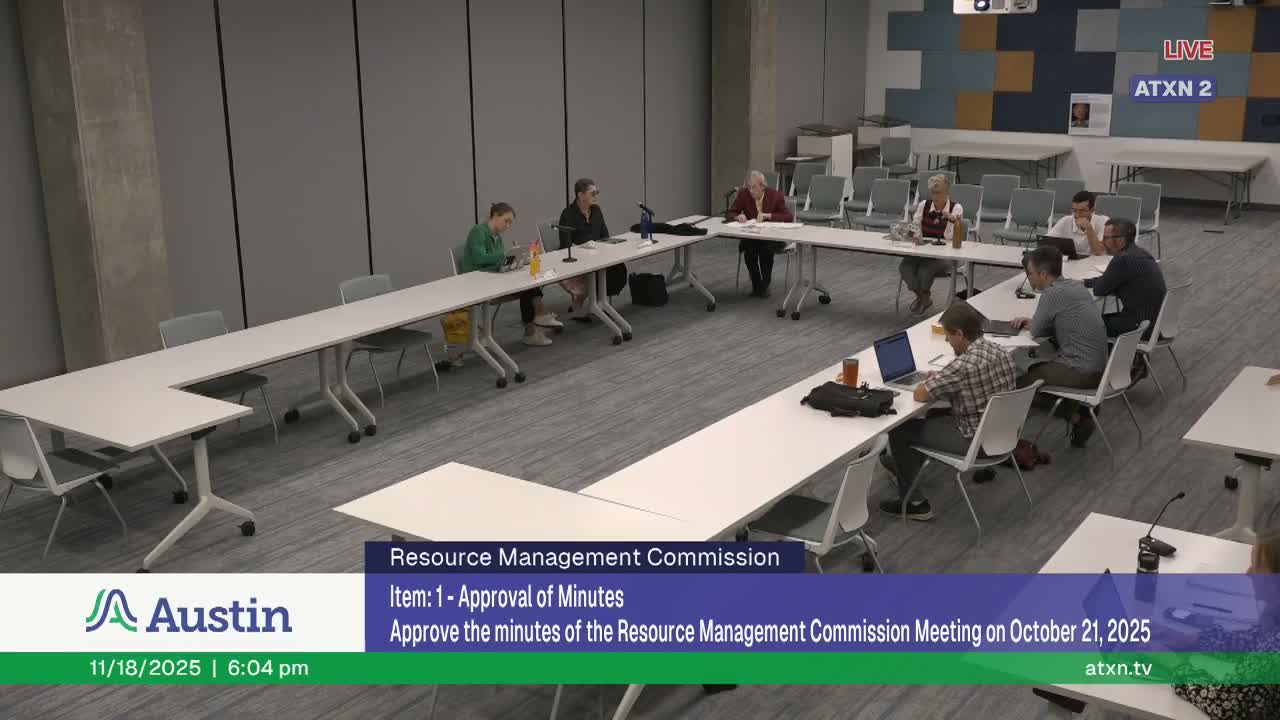
Kevin Kluge, water conservation division manager at Austin Water, told the Resource Management Commission that the utility’s third‑quarter implementation report — covering July through September — shows a drop in per‑person water use and several new programs aimed at reducing demand and losses.
"By July 1 we were looking at lakes being 50% full and possibly moving into stage 3 restrictions," Kluge said. "Then heavy rains in the hill country raised Lake Buchanan and Lake Travis to about 90% full, and that changed the quarter dramatically." He said the city recorded 141 gallons per capita daily (GPCD) in Q3, down from 147 in Q3 2024 and well below earlier summers of 160 and 163.
The presentation highlighted several implementation items. Austin Water launched a conservation community mini‑grant program offering awards of up to $3,000 to nonprofit neighborhood groups; applications are open through November 30 with award decisions targeted for roughly February so recipients can plan spring and summer activities. Kluge said the program is modeled after the Office of Sustainability’s Bright Green Future mini‑grants and is intended for small, local organizations.
Kluge also described commercial rebate activity: four commercial (multifamily) rebates in the quarter that together are estimated to save about 14,000,000 gallons per year. He reiterated that while commercial rebates are fewer, they represent large savings volumes.
On water loss, Kluge said Austin Water increased the number of staff certified to perform water‑loss audits from one to four and is hiring a water‑loss engineer to focus on detection and tracking. He said the utility identified service lines (the lines from mains to homes) as a significant component of loss and expects a $45,000,000 loan from the Water Development Board to fund large‑scale service‑line replacements.
"We are leaning into replacing service lines," Kluge said. "That is what the $45,000,000 loan from the Water Development Board will address." He added that a contract is in development for large‑diameter main leak detection, with about 32,000 feet of large‑main detection expected in December, and that the annual linear‑feet goal for small‑diameter leak detection remains about 4,000,000 feet.
The briefing covered reclaimed water and on‑site reuse efforts: staff added a Creek Fields Reclamation Waterline Restoration project to the reclaimed CIP list and noted that the reclaimed system is roughly 70 miles long compared with about 4,000 miles of potable distribution. Kluge said one reclaimed project on the list is expected to complete in 2026. Council reauthorization of the Go Purple incentive program was highlighted; staff is promoting stronger incentives for deeply affordable housing developments and reported one completed application for fee‑in‑lieu on‑site reuse systems (up from zero last quarter).
Kluge described outreach shifts after the July rains. The Public Information Office generated roughly 28,000,000 impressions for conservation messaging in Q3 (versus about 23,000,000 in Q2 and 15,000,000 in Q1). He reported pilot notifications through the myATX water portal — including a "rainy‑day" email to irrigators and homework‑style home‑water‑use reports — that staff are analyzing for effectiveness and plan to refine in 2026 with more targeted district metering and AMI data.
Commissioners asked about technical items and program details. Commissioner Silverstein asked how leaks are found; Kluge described acoustic detection, contractor work and plans for more proactive technologies. Commissioner Cook asked about the composition of non‑revenue water and how district metering could help localize losses; Kluge said district metering pilots are planned for 2026. Commissioners also asked about brackish groundwater desalination; staff characterized desalination as a long‑term option likely decades out and said the Water Forward plan references it.
The utility described Laundry‑to‑Landscape implementation tied to a local amendment to the Uniform Plumbing Code approved by the council on April 10. That amendment requires plumbing in qualifying new homes to allow clothes‑washer discharge to be diverted outside; city plumbing inspectors are expected to begin enforcing the local amendment in early spring next year. To encourage adoption, Austin Water doubled the materials rebate to $300 and is offering an additional $300 reimbursement for professional installation. Kluge said the utility has seen just one taker of the laundry‑to‑landscape rebate during his four years but hopes the higher incentives and library resources will increase uptake.
Commissioner Silverstein asked that the next quarterly report include Austin Water’s energy usage and whether staff are coordinating with Austin Energy about energy efficiency and solar for pumping and storage; Kluge said staff would include that information in a future report.
The commission did not take a formal vote on policy items in the briefing; Kluge closed by offering to return with additional detail on district metering, irrigation inspections and laundry‑to‑landscape outreach materials.