Get Full Government Meeting Transcripts, Videos, & Alerts Forever!
Get email alerts on the Therapeutic Recreation topic
No spam. Unsubscribe anytime.
Austin Parks and Recreation says therapeutic programs serve 472 youth and 867 adults as wait lists grow
Summary
At the Nov. 14 Mayor's Committee meeting, Parks and Recreation staff reported 472 youth and 867 adults enrolled in therapeutic recreation programs, said demand is outpacing capacity and urged committee support as the department eyes bond funding for new or expanded facilities.
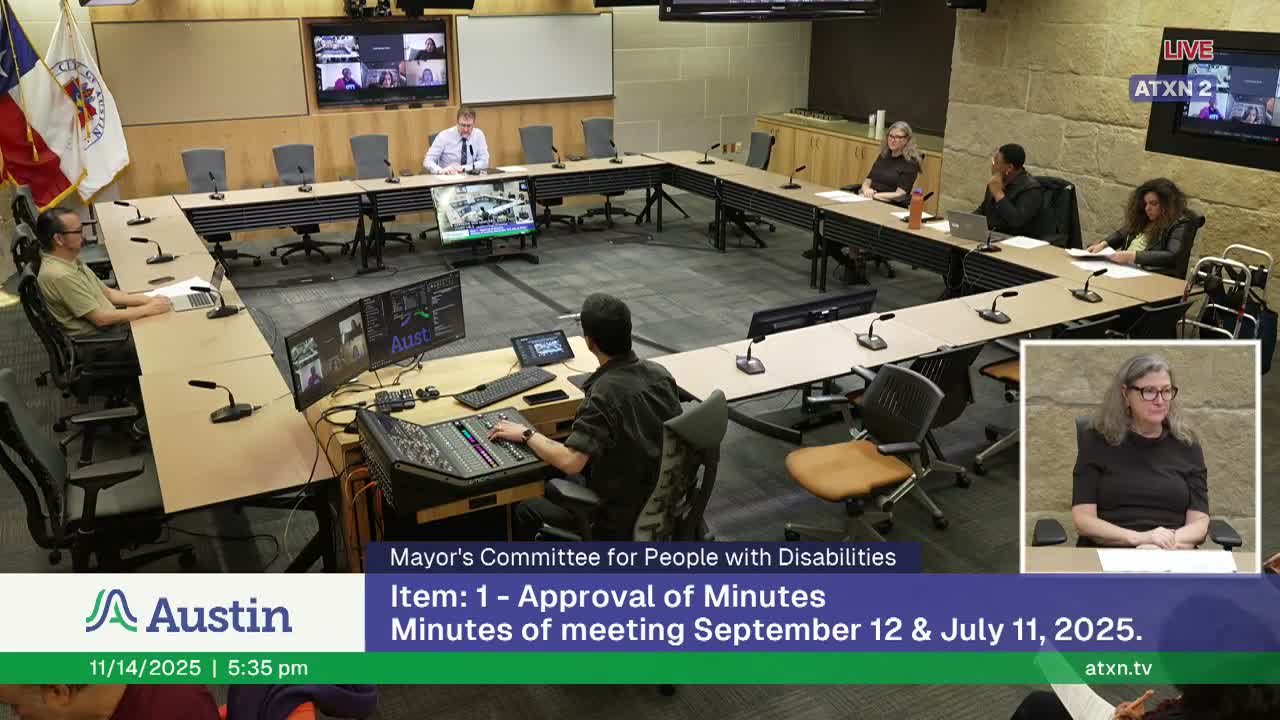
At the Mayor's Committee for People with Disabilities meeting on Nov. 14, Austin Parks and Recreation staff reported that therapeutic recreation programs currently serve 472 youth participants and 867 adults across multiple city sites, but demand for services is outpacing available capacity.
Sarah Carlson, district manager for therapeutic recreation, told the committee the department operates programs at several recreation centers and support sites and relies on a mix of staff that includes certified recreation therapists. "We currently provide programs for 472 youth individuals and 867 adults," Carlson said, noting the program also uses approximately 47 temporary employees and about 18 full‑time staff (16 of whom are certified recreation therapists).
Jody Jay, assistant director for Austin Parks and Recreation, and Evan Kessler, recreation supervisor, described the department's existing services, which include day programs, Special Olympics, adult enrichment, job skills training, youth therapies and therapeutic summer camps. Staff also maintain a modification and support team that conducts assessments, crafts modification plans, provides ASL interpreters and places support staff in camps and programs.
"Therapeutic recreation is growing rapidly and the demand is outpacing our ability to meet it," Kessler said, urging additional investment to expand programming and adaptive equipment. Staff said expansion could include adding sites or enlarging services at current facilities depending on available resources.
Committee members pressed staff on geography and capacity. Carlson said the program is distributed across the city but does not reach every neighborhood and that some sites on the east side and other areas are at capacity. When asked about wait lists, staff reported most are for youth camps and modification/support services and highlighted a transition gap for young people aging out of school programs: "What do they do next? ... we don't have the space for them," Carlson said.
Jay described a recent city gap analysis that identified five parts of town—far Northeast, East, South and Southeast Austin—where recreation services lag demand. Jay said the department will prioritize a new or expanded facility in far Northeast Austin during the next bond cycle and noted that building a new, full recreation center is costly. "To build a new recreation center, the estimate at today's dollars is $50,000,000," Jay said, adding that that figure does not include land acquisition.
Committee members discussed coordination with school transition programs and community partners; staff said they already attend transition fairs and partner with programs such as the GO Project. Carlson and Jay said staff would provide follow‑up materials to the committee, including the presentation and a link to the department's gap analysis, and invited committee input on budget and bond priorities.
Next steps: staff will post the presentation and remediation tracker, and committee members said they will follow up with district council members and the Parks Department as the city plans bond priorities and program expansions.