Get Full Government Meeting Transcripts, Videos, & Alerts Forever!
Get email alerts on the Vision Zero topic
No spam. Unsubscribe anytime.
Vision Zero: Austin reports decade of declines in serious injuries and unveils citywide lighting plan
Summary
Transportation staff told the commission Vision 0 has cut serious injuries and fatalities overall and will use bond and federal grant funding to accelerate seven major intersection projects, a multimodal Cameron-Dessau corridor, an updated high-injury network and a city lighting plan to target crash and crime hot spots.
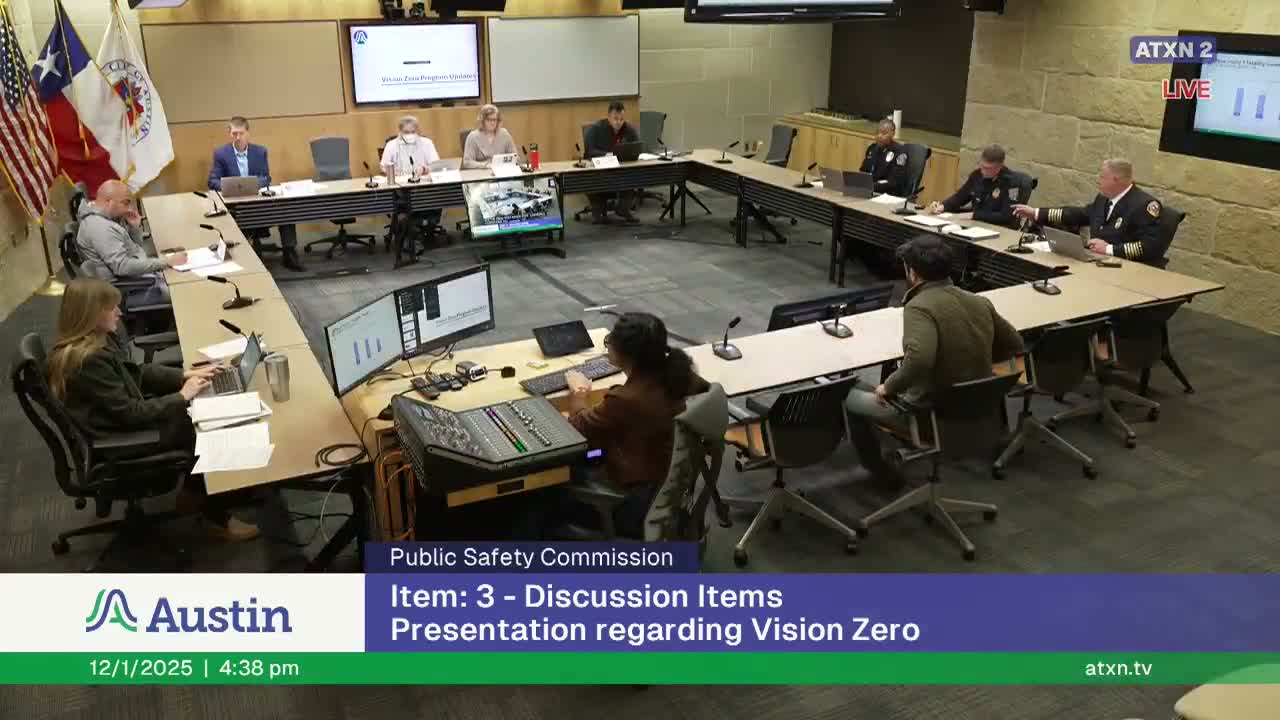
Transportation Public Works presented a 10-year Vision 0 progress report to the Public Safety Commission on Dec. 1 and described an expanded citywide lighting plan funded in part by a federal Safe Streets and Roads for All grant.
"Vision 0 is our city's goal, our policy to eliminate traffic fatalities and serious injuries," said Joel Meyer, transportation safety officer, who said that through Oct. 10, 2025 the city was down about 40% in combined serious injuries and fatalities compared with the same point last year. He cautioned that fatality counts can fluctuate year to year but highlighted longer-term reductions, particularly in serious injuries.
Meyer credited design investments funded by the 2016, 2018 and 2020 mobility bonds and said the city has leveraged about $9 million in local bond funds to secure $35 million in federal grants for safety projects. He listed planned near-term construction on seven major intersections and a multimodal corridor project on Cameron-Dessau (a 6.5-mile high-crash corridor).
The presentation also previewed a citywide lighting plan to be completed in 2026 in partnership with Austin Energy and Parks and Recreation. Meyer said the plan will map existing lighting levels, correlate lighting deficiencies with crash and crime hot spots, and produce context-dependent design guidelines for streets, trails and parks, plus a prioritization framework to move beyond customer-request-driven installations.
Commissioners asked whether lighting is an ADA accessibility issue and whether the plan will consider bird migration; Meyer said ADA typically addresses traversability and surface accessibility, while the lighting plan incorporates stakeholder input including Audubon Society and Dark Skies Texas and will evaluate shielding, dimming schedules and other bird-friendly techniques.
Meyer also described work to integrate EMS data into the city's crash database to improve undercounted modes like e-scooters and to update the high-injury network in 2026. He said recent outreach and enforcement campaigns focus on distracted driving and year-round DWI 'no refusal' enforcement that has expanded availability of drug-recognition experts.
Staff invited the commission to request further briefings and noted public requests for lighting continue to route through 3-1-1 and Austin Energy's lighting unit; the Vision 0 10-year report and open crash data are available on the city's data portal.