Get Full Government Meeting Transcripts, Videos, & Alerts Forever!
Get email alerts on the Bird Friendly Design topic
No spam. Unsubscribe anytime.
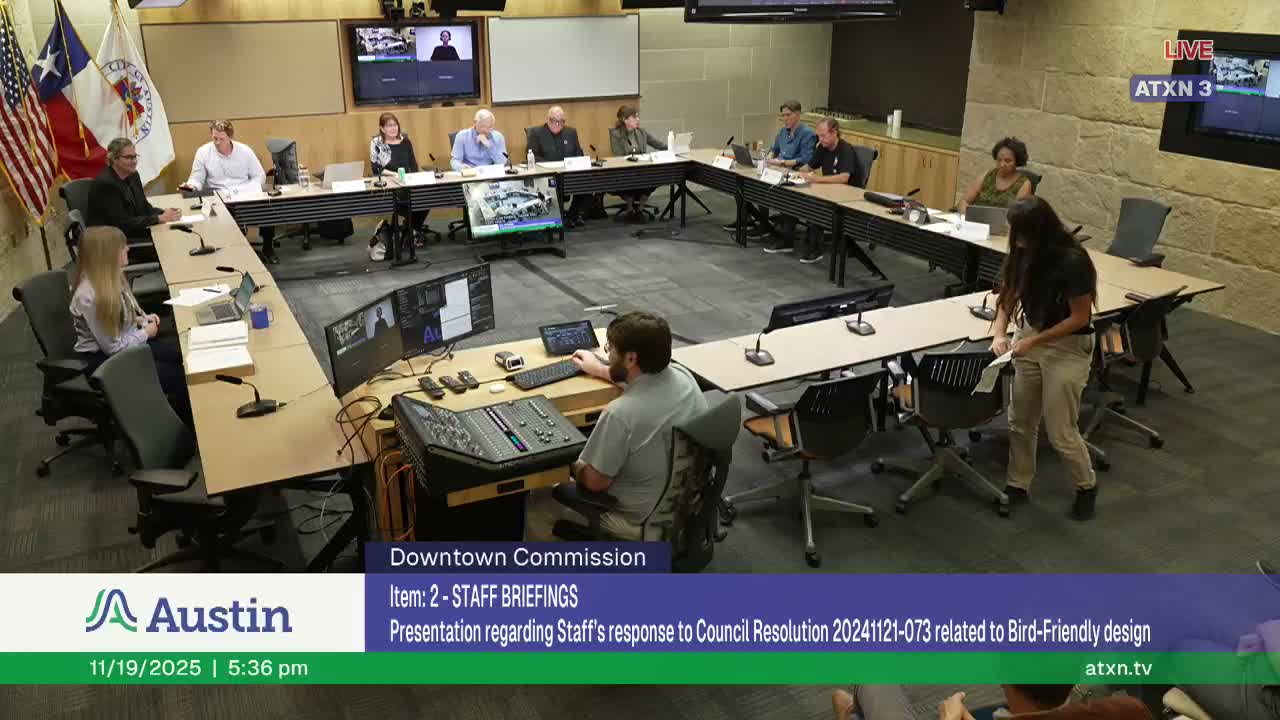
Austin staff outline bird‑friendly design recommendation, commissioners press for cost data and affordability protections
Summary
Watershed Protection staff presented options for a bird‑friendly design code update — proposing performance standards for large commercial and multifamily buildings and dark‑sky lighting — while commissioners asked for local data, cost modeling and a clear exemption for deeply affordable housing.
Leslie Lilly, environmental conservation program manager with Austin Watershed Protection, presented staff's response to a city council resolution directing an analysis of bird‑friendly design measures and a feasibility study. Lilly told the Downtown Commission the work grew from a year‑long, cross‑departmental effort that considered lighting, façade treatments and monitoring approaches and drew on precedents in other cities.
"Austin sits in the middle of the Central Flyway," Lilly said, explaining the city funnels "hundreds of thousands of birds through Central Texas every year" and noting the local diversity: "within 60 miles of our city limits, you can see over 400 species of birds." She described a technical approach the American Bird Conservancy uses — threat‑factor testing in wind tunnels — and highlighted two models staff researched: New York City's ordinance and Arlington County's voluntary incentive program.
Lilly summarized staff's emerging recommendation: require commercial and multifamily buildings exceeding 10,000 square feet to meet a bird‑safe performance standard, measured by a threat‑factor rating of 20 or lower for façade surfaces up to 100 feet, and to incorporate dark‑sky lighting controls on new construction, while exploring a formal exemption for deeply affordable housing. "This is not draft language," she said, but noted the proposal reflects the feasibility analysis and stakeholder input.
Commissioners pressed for local data and cost detail. Several asked whether Austin has neighborhood‑level monitoring; Lilly said centralized, reliable collision monitoring in Central Texas is limited and staff are talking with the University of Texas and St. Edward's to develop targeted studies. On cost, Lilly told the commission commercial glass treatments vary widely and provided staff's back‑of‑the‑envelope examples: standard non‑custom commercial glass runs roughly $12–$15 per square foot; some fritted or treated options may add about $10 per square foot, while custom or UV‑treated glass is higher. For a hypothetical 10,000 square‑foot, three‑story building she estimated roughly $12,000 in incremental treatment cost on top of baseline glazing, and cited other feasibility studies that ranged from negligible to a 2–3% project cost increase depending on context.
On equity, commissioners urged stronger protections for affordable housing. One commissioner said an exemption, not just a waiver, is needed to avoid creating barriers for projects under development; Lilly said staff are aligned with that feedback and are planning code language that would include an exemption for deeply affordable projects.
Public commenters supported the recommendations. Lily Verasich, who testified before the presentation, said bird‑friendly options can "be beautiful for humans and birds" and called the measures "reasonable and essential." Remote commenter Eric Plow shared personal observations of Austin's bird diversity and urged support for the initiative.
Staff said the next step is to refine a written recommendation to council that could initiate a formal code amendment; the presentation and backup materials include a feasibility report and additional references. Commissioners asked staff for follow‑up cost modeling, localized monitoring plans, and proposed draft code language earlier in the process.