Get Full Government Meeting Transcripts, Videos, & Alerts Forever!
Get email alerts on the Ro Sedale School topic
No spam. Unsubscribe anytime.
Historic‑landmark panel postpones Rosedale School demolition case after heated neighborhood opposition
Summary
The Austin Historic Landmark Commission voted 8–2 on Dec. 3 to postpone consideration of a partial demolition at the former Rosedale School until January following extensive public comment from neighbors, preservation advocates and the applicant team.
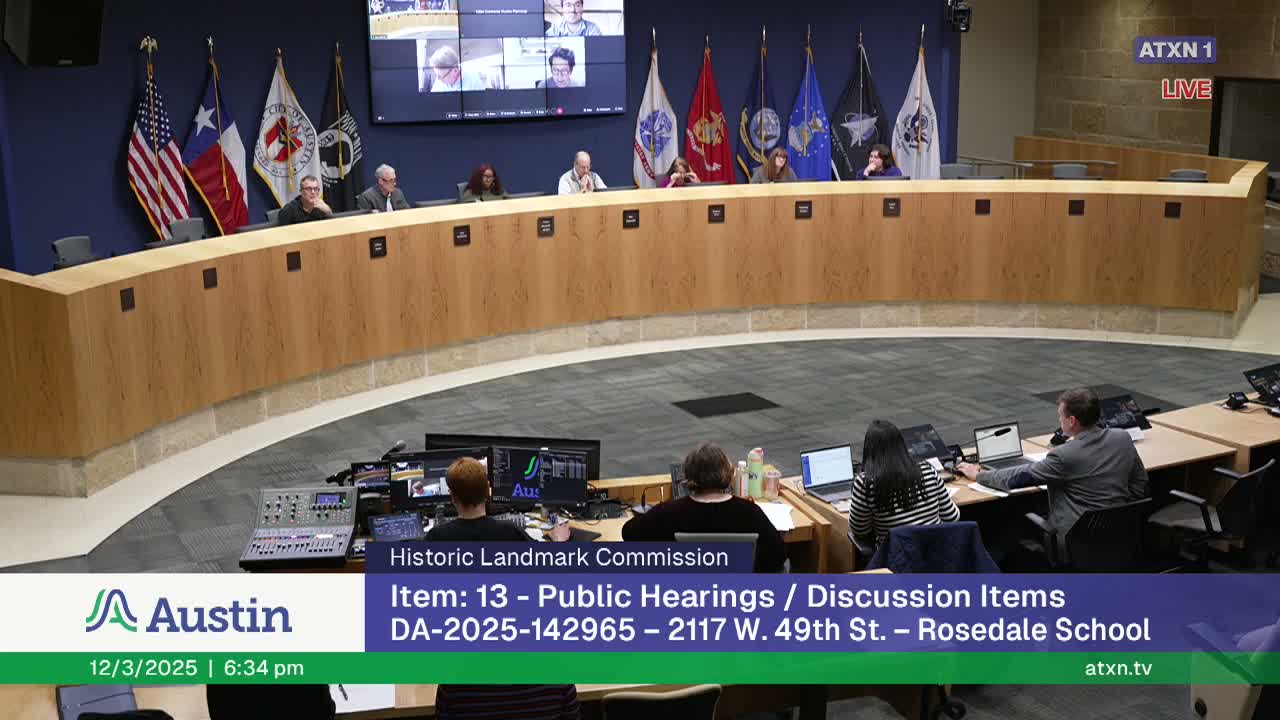
The Austin Historic Landmark Commission on Dec. 3 voted 8–2 to postpone consideration of a partial demolition application for the former Rosedale School at 2117 West 49th Street until the commission’s January meeting.
Leah Vojeau, of the Drenner Group, speaking for the applicant and Austin Independent School District, asked the commission not to delay and said staff and the district had negotiated a compromise for the project. "We are opposed to the postponement of the case tonight," Vojeau said, adding that delays would hurt AISD as "stewards of the public money."
Neighborhood residents and preservation advocates urged the opposite. Chris Allen, an architect representing the Rosedale neighborhood association, said neighbors had been "blindsided by this process" and lacked adequate opportunity to examine proposed plans or the compromise staff referenced. "We weren't invited into the room," he said, and asked the commission to postpone the hearing so the community could respond.
Other speakers cited litigation and deed‑restriction questions they said made it premature to consider demolition or preservation details now. Darryl Azar, a longtime neighbor, called the school "the heart and soul of the community" and urged more time for reflection and engagement. "We need more time to have that conversation," he said.
Commissioners framed the decision in procedural terms: the commission’s legal purview is limited to the merits of the historic building, not deed restrictions or rezoning. Chair Heimseff said the commission must weigh whether to hear the case now or take additional time, and several commissioners said they wanted more documentation about what would be preserved, what would be reconstructed and a conceptual site plan.
A number of commissioners supported postponement to allow further review and outreach. Commissioner Grogan said the case had been heard by the Architectural Review Committee and that additional materials (including a conceptual site plan) would help the commission evaluate what was proposed to be preserved and reconstructed. Commissioner LaRoche and others also supported delay to let neighbors and the applicant consult further.
Staff reminded the commission that under local procedures the body has 75 days from the date the case first appears to act; commissioners agreed postponing to January would leave the item on schedule and preserve statutory timing. The motion to postpone carried 8–2.
The commission kept the public hearing open; the item will return on the January agenda with requested supplemental materials and, if applicable, additional ARC review. The commission limited its comments to historic merits and clarified that other legal or zoning matters would be considered in their respective forums.