Get Full Government Meeting Transcripts, Videos, & Alerts Forever!
Get email alerts on the Emergency Communications topic
No spam. Unsubscribe anytime.
Volunteer amateur radio groups describe role as resilient backup for disasters and local events
Summary
A Travis County Amateur Radio Service representative described how licensed amateur operators and regional radio systems provide redundancy when phones and internet fail, support hospitals and shelters, maintain repeaters across Austin and requested help recruiting diverse volunteers and promoting outreach.
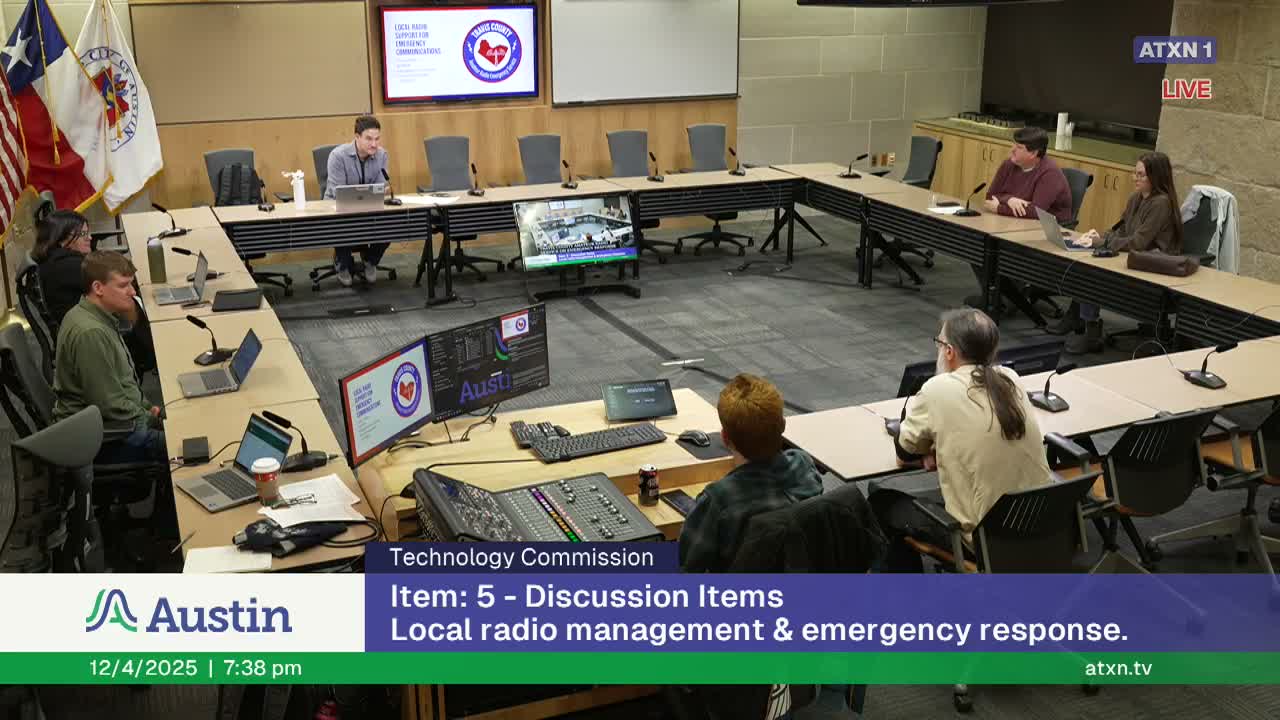
Glenn, representing the Travis County Amateur Radio Service, briefed the commission on how volunteer radio organizations support emergency communications when conventional networks degrade.
Glenn described three volunteer organizations — ARES, RACES and MARS — that support nongovernmental agencies, government continuity and Department of Defense links, respectively. He explained technical capabilities including VHF/UHF repeaters (roughly 30–60 mile radii), HF bands that bounce off the ionosphere for long‑range links, a radio trailer with onboard repeater and generator, and radio rooms at local facilities and the state operations center.
"Radios work without Internet and phones," Glenn said. "When all else fails, we provide a party line that multiple people can monitor and a way to get critical messages out." He described recent local deployments and exercises (flood response, eclipse planning, a July 4 flood) and noted partners such as the National Weather Service, hospitals and the Red Cross.
Glenn asked the commission to help spread awareness and increase volunteer diversity, noting underrepresentation in parts of East and South Austin. Commissioners expressed interest in tours and outreach partnerships, and Glenn offered to coordinate events and field‑day demonstrations.
What happens next: Commissioners will explore outreach, possible tours of radio infrastructure and ways to involve community organizations in preparedness events.