Get Full Government Meeting Transcripts, Videos, & Alerts Forever!
Get email alerts on the Surveillance Policy topic
No spam. Unsubscribe anytime.
UT researcher says context, transparency determine public acceptability of cameras and drones
Summary
Sharon Strober of UT Austin summarized a local survey showing residents most accept camera use for emergency response (especially by fire) and least accept routine continuous monitoring; respondents prefer sharing camera data with government rather than private companies and express concern about ALPRs and vendor additions like facial recognition.
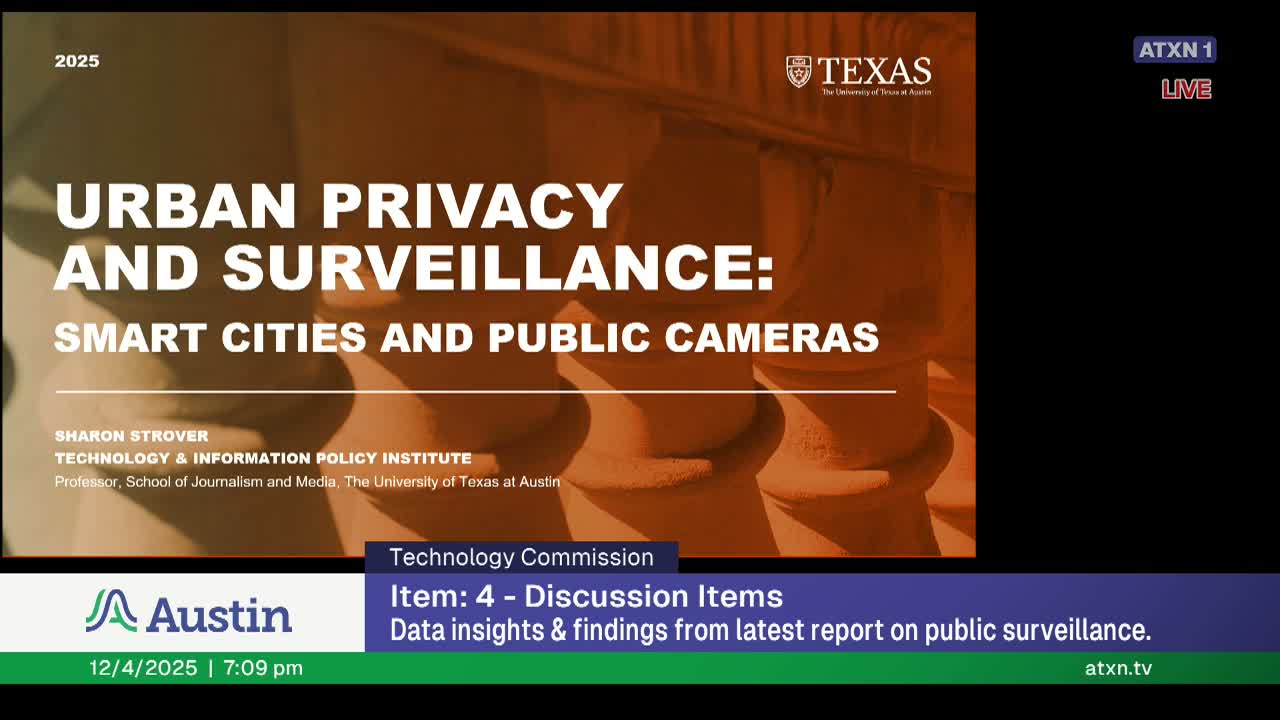
Sharon Strober, a professor at the University of Texas at Austin and a member of Good Systems Ethical AI, presented findings from an Austin‑focused study on public attitudes toward cameras, drones and automated license plate readers (ALPRs).
Strober said the study tested acceptability across five public‑sector contexts (transportation, police, fire, schools/ISD and Austin Energy) and five use‑case scenarios that included routine monitoring, emergency response and crowd control. "Emergencies are ways to increase the acceptability of using these technologies no matter who is using them," she said, noting that the highest acceptability rating was for the fire department using cameras for emergency response and the lowest was for undifferentiated routine monitoring.
Key takeaways: familiarity with the technology correlated with higher acceptance; respondents preferred sharing camera‑derived data with government entities over private companies; and people viewed ALPR and drone data handling similarly. Strober warned that some vendors now bundle facial‑recognition and other biometric capabilities with ALPRs, which raises novel privacy concerns for cities.
Commissioners asked about drone types, AI use in drones, and which departments are operating them. Strober said the city had formed an internal drone working group and that use cases range from infrastructure inspection to crowd monitoring; she recommended emphasizing "contextual legitimacy" in policy — that is, evaluating each specific use case and clarifying data‑sharing and retention practices.
What happens next: Strober offered to share slides and collaborate with the commission’s working group on surveillance and AI; commissioners flagged the topic for a Jan. 8 working‑group meeting and asked staff to include the UT researcher as an invitee.