Music Commission unanimously approves FY26–27 budget recommendations to shore up grants, add a nighttime music liaison and address AI protections
Loading...
Summary
The Austin Music Commission voted unanimously to approve a broad FY26–27 recommendations package urging stronger Live Music Fund evaluation, a push to fund ACME staff from the general fund, a dedicated nighttime music office role, support for production workers and artist education about AI and copyright protections.
The Austin Music Commission approved a set of FY26–27 budget recommendations intended to strengthen city support for live music and the broader creative economy.
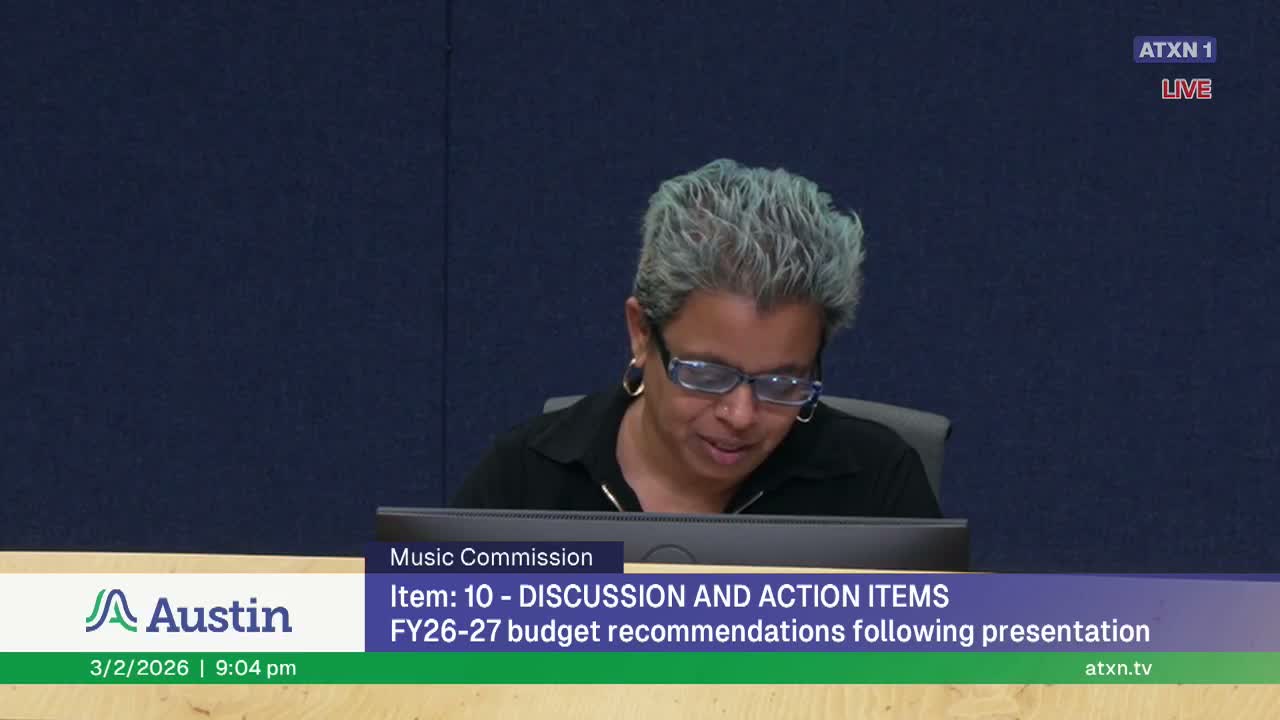
Chair Nagavalli read an extensive recommendation package that covered measures to stabilize grant programs, increase outreach and inclusion, pilot alternative funding sources and preserve dedicated investments in music heritage and venues. The package urged that ACME staff salaries be funded from the general fund rather than hotel‑occupancy tax (HOT) and recommended a dedicated nighttime music office liaison to assist venues and nightlife businesses.
Commissioner Silva moved the recommendation package; Commissioner Carvalho seconded. The motion carried unanimously.
Key elected items in the approved package include:
- Strengthen the Austin Live Music Fund and HOT investments by allocating funds for program evaluation, community outreach and impact measurement; explore risk mitigation and alternative funding reserves.
- Direct that ACME staff salaries be funded from the general fund (not HOT), and seek pilot partnerships, sponsorship frameworks and public‑private collaborations as new revenue streams.
- Create or fund a dedicated nighttime music office role (liaison) to help the live music and nightlife industry navigate permitting and city processes.
- Increase visibility for music venues with a citywide marketing and wayfinding program and digital mapping of venues by council district.
- Establish a Music Heritage Markers program and expand Art in Public Places connections to local music history.
- Invest in workforce and industry development (apprenticeships, business technical assistance, music technology and production training) with an explicit addition to include education on emerging technologies, AI and copyright/legal protections for artists.
- Prioritize affordable rehearsal and performance spaces by identifying capital and operating subsidy options and co‑location models in city facilities.
- Support venue safety programs and consider insurance assistance or risk‑pooling strategies for independent venues.
Commissioners also added explicit language to prioritize support for underserved and underrepresented music industry professionals and production workers, citing the need for resources such as mental health access and other supports.
Commissioner Silva noted an emerging issue at the National Association of Music (NAM): "We spoke a lot about AI...artists need navigation and protection around legal issues," and commissioners asked ACME to consider education and legal resources. ACME staff said they have begun policy work on AI and that the commission's recommendation to include AI education in workforce development is timely.
The vote: The motion to adopt the FY26–27 recommendations passed unanimously. Commissioners and ACME staff agreed the package will be shared with council members and used to inform department budget planning and future council advocacy.