Get Full Government Meeting Transcripts, Videos, & Alerts Forever!
Get email alerts on the Broadband Deployment topic
No spam. Unsubscribe anytime.
Charter/Spectrum presents low‑cost plans and urges permitting coordination to speed builds
Summary
Charter’s government‑affairs VP said Spectrum offers two income‑qualified options (Spectrum Internet Assist $25/month; Spectrum Internet Advantage $50/month), described recent Texas investments and asked for better city‑provider permitting coordination; he agreed to follow up with service‑area footprint details for Austin.
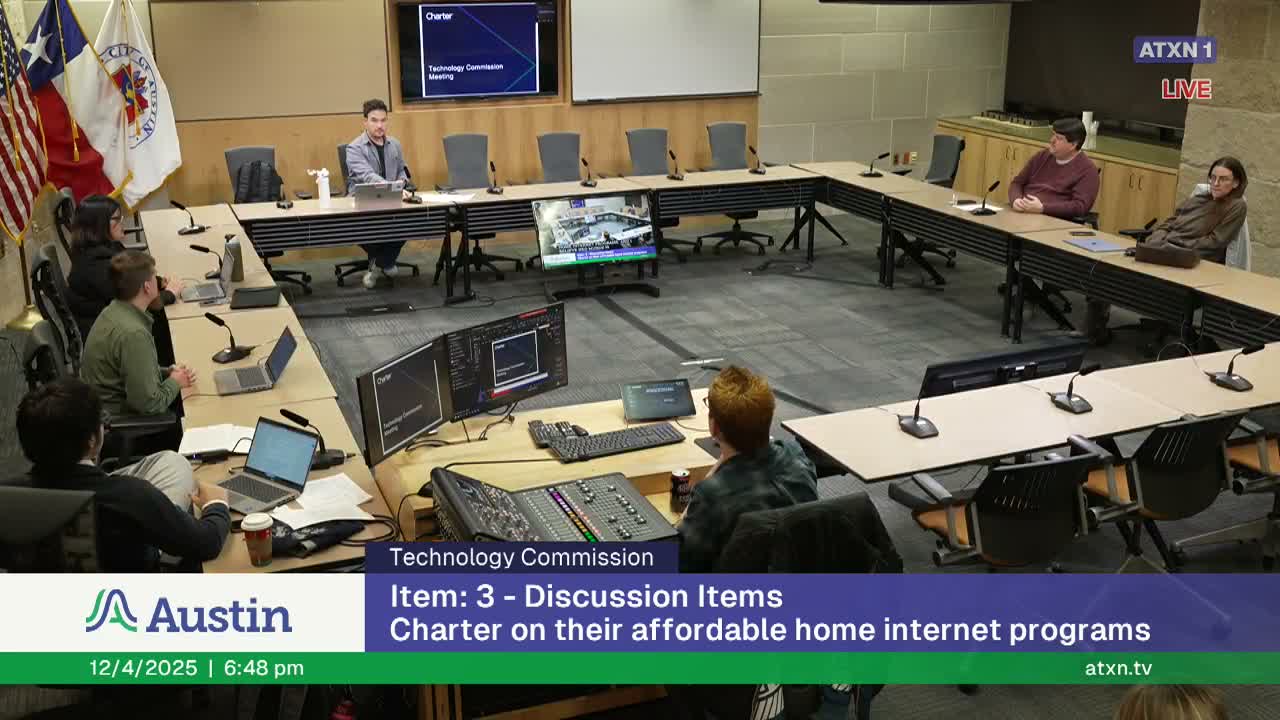
Ned Muñoz, vice president for government affairs at Charter Communications (Spectrum), told the Austin Technology Commission that Spectrum offers two income‑qualified plans and has continued large network investments in Texas.
"Currently, we offer two income‑qualified low‑cost options — Spectrum Internet Assist for $25 a month and Spectrum Internet Advantage for $50 a month," Muñoz said, adding that Charter serves roughly 3.5 million customers in Texas and invested close to $1,800,000,000 in the state in 2024.
Muñoz described product features such as no modem fees, no data caps and no contracts, and highlighted Spectrum’s deployment of Wi‑Fi 7 and other next‑generation technologies. He said Charter has focused on multi‑gigabit network evolution and that many neighborhood builds are fully Charter‑funded.
Commissioners asked whether Charter, AT&T and others share granular service‑area maps to identify truly unserved neighborhoods — especially in East Austin and other areas outside the downtown core. Muñoz said he would find out what maps and level of footprint detail Charter can share. He also flagged permitting as a major challenge: the Austin utility‑location and coordination review can span roughly 4–8 months, increasing uncertainty for project schedules.
Muñoz suggested potential fixes such as earlier project notifications, milestone checkpoints during reviews, and clearer coordinated timelines for multi‑utility approvals so providers can better align resources and schedules.
What happens next: Charter will follow up with the commission on what service‑area and coverage footprint details it can provide and will coordinate with the city’s Julia Zinsmeister on local outreach and events.