Get Full Government Meeting Transcripts, Videos, & Alerts Forever!
Get email alerts on the 911 Restructuring topic
No spam. Unsubscribe anytime.
Advocates urge moving 911 out of APD; commissioners note council resolution and budget follow‑up
Summary
Several speakers during public comment urged the commission and city to move 911 dispatch out from under the Austin Police Department, citing dispatch bias toward enforcement, budget timing and past audit findings; the commission noted a council resolution directing study of a unified emergency communications department and said budget office figures are pending.
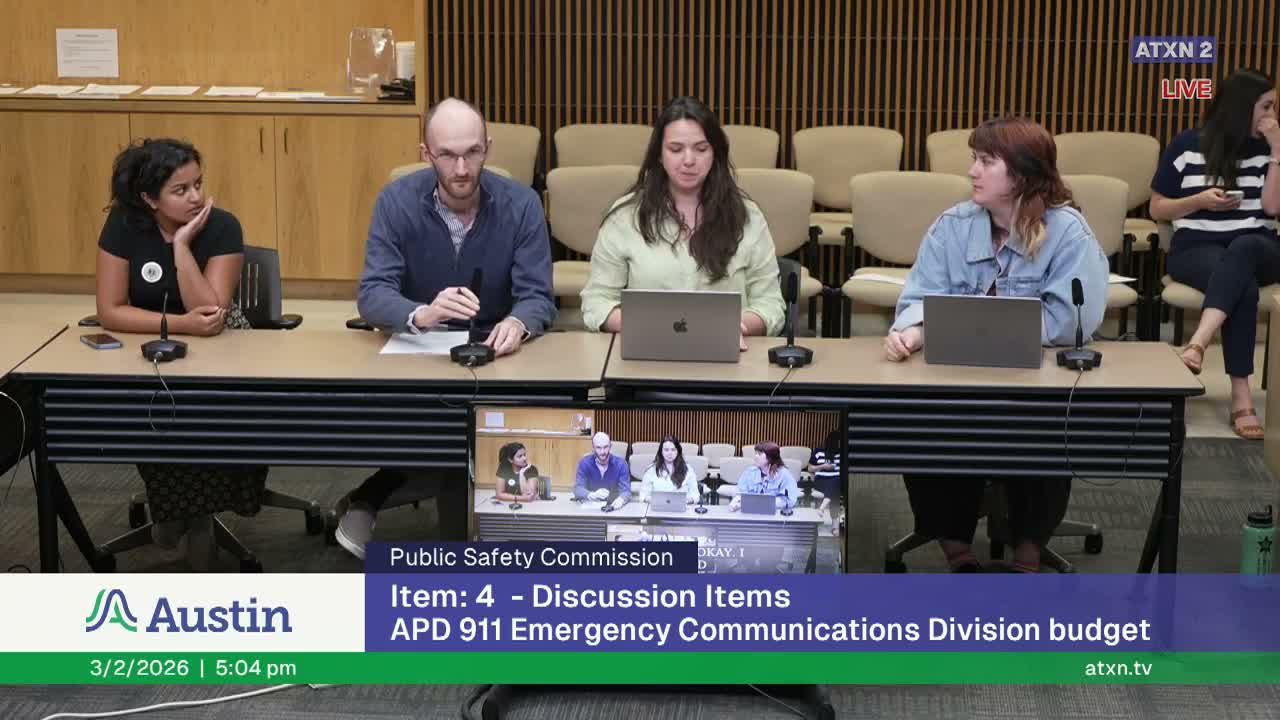
Multiple community speakers told the Public Safety Commission on March 2 they support relocating Austin’s 911 call center from the Austin Police Department to a civilian‑led joint emergency communications structure.
Peter Hunt of the Austin Justice Coalition argued the move could be timed with budget changes to avoid violating state restrictions and would make it easier to prioritize health‑oriented responses to mental‑health and substance‑use incidents. "Moving the 911 call center out of the police budget would need to grapple with that in some way…this is actually a pretty opportune time to make some changes," he said.
Speakers from advocacy groups echoed that dispatch under a law‑enforcement agency encourages enforcement responses. Dana of Equity Action cited the city’s 2018 audit of police responses to mental‑health incidents and said the structure contributed to harmful outcomes, including the killing of Marisa Silva during a mental‑health crisis, which she described as a reminder of the risks when armed officers are the default response.
Representatives from Vocal Texas and a workers’ organization described how people experiencing homelessness and people who use drugs may avoid calling 911 when a police response is likely, and urged a civilian communications model with trauma‑informed call‑taking and consistent routing to crisis teams.
Commissioners noted a prior council resolution (passed in late summer) directing the city manager to study a joint emergency communications department and said they expect follow‑up materials from the budget office. Chair Ramirez said the commission will track the work and requested that staff provide requested budget figures when available.
What’s next: advocates called for concrete dispatch‑protocol reforms and for the commission and council to consider the operational and budgetary pathway for restructuring. The commission signaled it will follow council and city manager work and seek additional data from the budget office.
Ending: public comment concluded and the commission moved on to other agenda items.