Panel updates commission on ‘Austin First’ pilot, EMCOT and 24/7 mobile crisis expansion
Loading...
Summary
City EMS and Integral Care told the Public Safety Commission that the Austin First pilot (a clinician‑paramedic‑officer unit) is ending its pilot phase for evaluation; EMCOT and C3 clinicians continue to expand, a recent budget increase will scale mobile crisis capacity and agencies said they are working to align triage and data across systems.
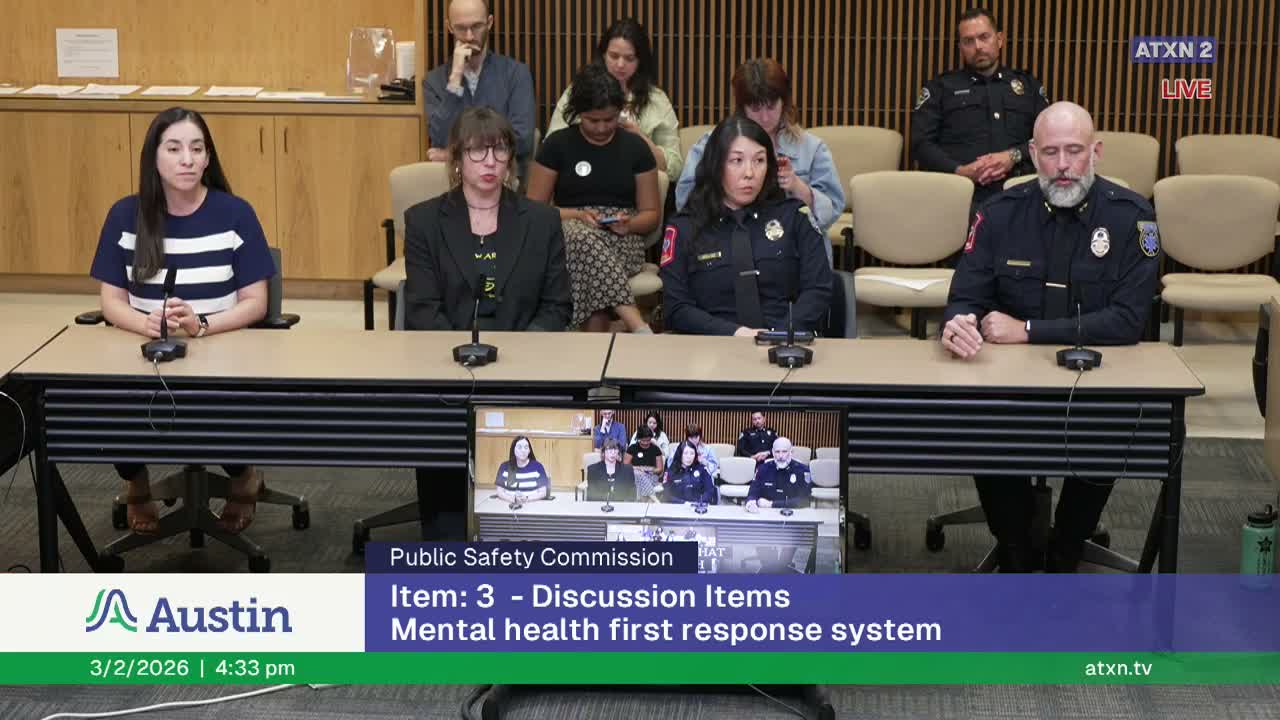
Representatives from Austin Travis County EMS and Integral Care briefed the Public Safety Commission on March 2 about ongoing mental‑health first‑response initiatives, including the Austin First pilot, EMCOT mobile crisis teams and C3 clinicians embedded in the 911 call center.
A lead presenter described Austin First as a six‑month pilot that places a clinician, a paramedic and a police officer together in one vehicle for high‑acuity mental‑health calls so responders arrive on scene with combined clinical, medical and security capabilities. "The first thing that we did with Austin First is we put a clinician, a paramedic, and a police officer in 1 vehicle together," the presenter said, adding the pilot is being evaluated and recommendations will follow.
Speakers summarized EMCOT (a mobile crisis team model operating since 2013) and C3 clinicians embedded in the 911 call center who triage many calls by phone. Presenters reported that C3 handles a large share of calls on the phone and that pairing clinicians with community health paramedics supports appropriate in‑person responses. One presenter said EMCOT expansion was approved in a recent budget action and will increase peer support services, enable 24/7 field response and provide up to 90 days of community‑based follow‑up for some clients.
Commissioners pressed agencies on scale and triage. Staff said they typically have multiple community health paramedics on duty (roughly five for a 24‑hour period) and that clinician pairings vary by schedule. They emphasized that different agencies use different triage and CAD systems and that aligning call triage and data across APD, EMS, Travis County and partner agencies remains a priority.
On response times, EMS described city EMS targets (noting city interior responses aim to be under roughly 10 minutes) and Integral Care said EMCOT’s contractual ETA goal was 30 minutes while their current average for first‑responder referrals is about 20 minutes.
Presenters stressed that the majority of mental‑health calls they encounter are low acuity, and that the system’s longer‑term success depends on data sharing and clear dispatch protocols. Commissioners asked for lessons learned from the Austin First pilot and for the forthcoming efficacy study; agencies said they will provide findings to the commission and city council when available.
Ending: The commission thanked presenters and asked staff to follow up with pilot data and any analyses that inform scale and budget decisions.