Get Full Government Meeting Transcripts, Videos, & Alerts Forever!
Get email alerts on the Transit Service topic
No spam. Unsubscribe anytime.
Morrisville council retreat: staff urge phased microtransit upgrades, conversion to vans to cut wait times
Summary
Staff presented the town's 2025 alternative transit study, citing rising Smart Shuttle wait times and recommending phased microtransit improvements (more vehicles, additional nodes, and a shift to minivans), targeted advanced-booking for seniors and people with disabilities, and a Feb. 24 decision window to meet Wake Transit funding timelines. Council generally supported near-term microtransit changes and asked staff for a refined package.
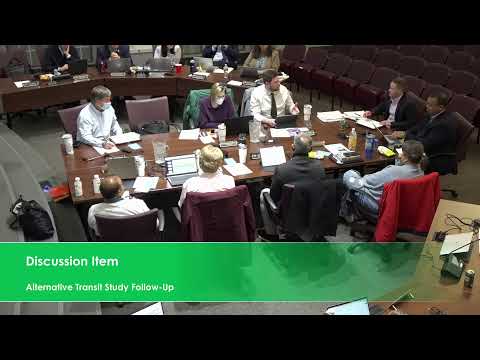
Brett Martin, Morrisville's transportation project manager, presented the town's 2025 alternative transit study at a winter retreat, telling the council the Smart Shuttle's average onboard travel time remains competitive but that growing wait times and falling acceptance of trip proposals threaten the service's usefulness. "Our average travel times during which users are on the shuttle have generally stayed in the 13 to 14 minute range since initial launch," Martin said, but he warned wait times have crossed a critical 30-minute threshold in 2025 and are the main driver of cancellations and complaints.
Martin laid out the study's recommendation for short-term, phased improvements: increase the number of vehicles in service, add priority pick-up nodes in underserved neighborhoods, and transition from light-transit vehicles to smaller minivans to better match demand and reduce capital costs. He also recommended piloting an advanced-booking option targeted at seniors and people with disabilities to improve reliability for riders who need guaranteed trips.
The presentation emphasized timing constraints tied to Wake Transit's Community Funding Area Program (CFAP). Martin said the council must accept a final report and direct staff on short-term changes by the Feb. 24 meeting if it wants improvements reflected in the FY27 budget cycle and to meet contractor-notice deadlines required for an October/November 2026 service change. He cautioned that pursuing a fixed-route system would require much larger capital and operating investments, trigger extensive ADA paratransit obligations within a 3/4-mile service radius, and likely take three or more years to implement.
Council members pressed staff for more demographic and operational data and for assurances the town would meet Title VI and ADA requirements. "The ability to get additional funding through the Community Funding Area Program is really desirable," said Council member Johnson, who urged the town to align any request with CFAP planning requirements. Several members supported converting to minivans and adding vehicles, while also asking staff to model how many additional vehicles and nodes would be needed to bring average wait times into a target range (the presentation suggested a 10—15 minute goal and flagged 30 minutes as a critical failure point).
Council Member Scroggins Johnson called the presentation "incredibly informative" and urged that the final study include a clear appendix explaining which concepts were considered and why some were discarded, to provide better public transparency. Mayor Collie said he favored keeping the service free to riders where possible and endorsed the short-term microtransit approach rather than an immediate shift to fixed routes.
On vendor questions, staff told the council that turnkey arrangements (the current arrangement with GoCarry/GoCary) make implementation administratively easier because operational procurement and staffing are already handled; however, staff also said the town could seek a lower-cost turnkey vendor if the service level and system management needs (Title VI/ADA compliance, node prioritization, reporting) were equivalent. Martin recommended hiring or designating at least one dedicated transit planner or equivalent staff resource to handle system-level management as the town scales service.
Council members broadly coalesced around directing staff to return with a refined package and cost estimates in February that would: (1) accept the final study with added documentation on discarded alternatives; (2) propose a phased microtransit rollout (more vehicles, initial node additions, minivan conversion); and (3) model options for an advanced-booking pilot for priority riders. At the meeting's close the council made and seconded a motion to recess to continue the retreat the following day; the motion and amendment specifying the reconvene time and location were recorded in the transcript but no roll-call tally is captured in the provided segments.
Next procedural step: staff will prepare an updated report and implementation package for the Feb. 24 council meeting that maps proposed short-term improvements to CFAP timing and budget requirements.