Get Full Government Meeting Transcripts, Videos, & Alerts Forever!
Get email alerts on the Roads Funding topic
No spam. Unsubscribe anytime.
King County roads division warns capital program endangered as recent storms and long-term shortfalls strain maintenance
Summary
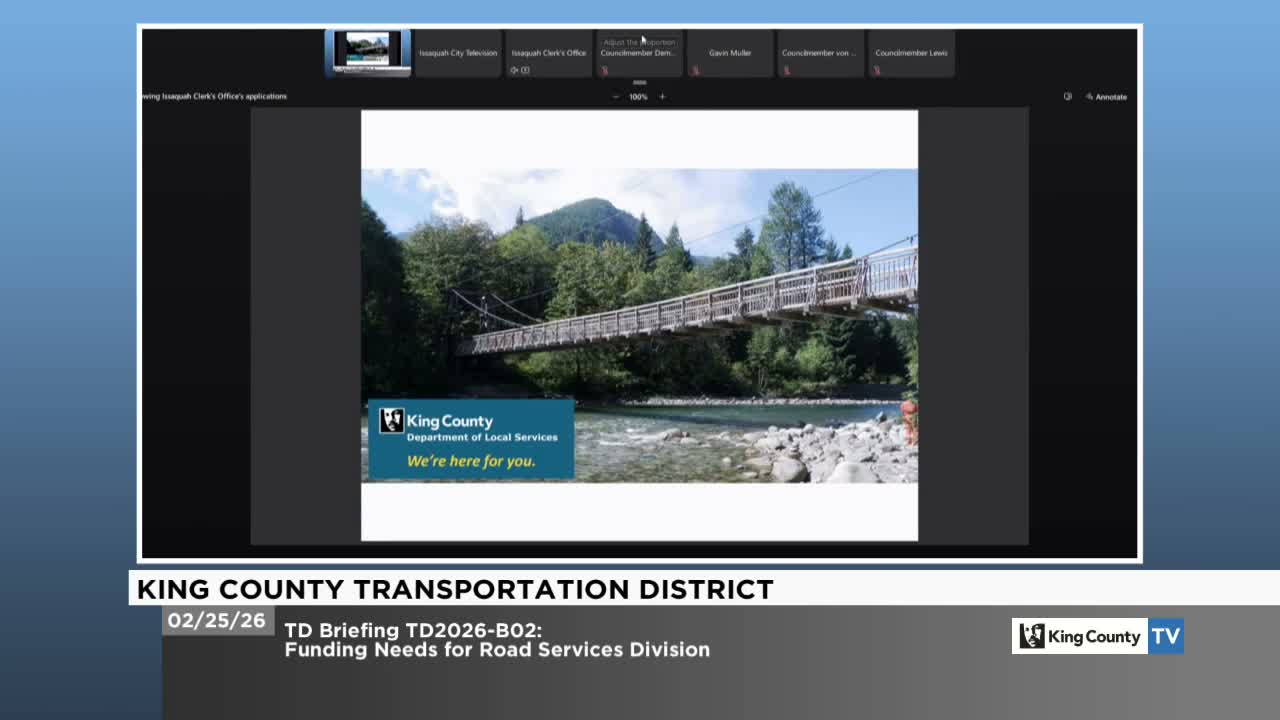
Road Services Division Director Tricia Davis told the KCTD the county's unincorporated road network (about 1,500 miles and 193 bridges) faces a chronic funding shortfall—an updated annual gap of about $200 million and an overall need around $2.5 billion—and that storm damage this past December adds immediate unfunded repairs that could exhaust capital funds by 2028.
Tricia Davis, director of the King County Road Services Division, told the Transportation District board in Issaquah that unincorporated county roads and bridges are aging, storm-damaged and underfunded.
Davis said the division maintains roughly 1,500 miles of unincorporated roads and 193 bridges, with about 400 employees. "We have about 1,500 miles in our unincorporated road system, 193 bridges," she said. She described a long-running funding problem driven by growth-management limits, flat gas tax revenues and rising construction costs.
Davis summarized a series of program cuts and deferrals made to preserve a shrinking capital program and to protect emergency response capacity: reductions in fleet purchases, training, high-risk paving and some collision-safety projects. She said capital revenues are projected to be exhausted by 2028 and that, without new sustainable funds, the county would have to eliminate its capital improvement program.
On storm impacts Davis cited specific damage from December's flooding and slides, including a load-limited temporary repair to the Bering Bridge that "we estimate it will take about $5,000,000 for a temporary replacement," and tens of millions in other damages. She said the county had only about $6 million available in quick-response funding and that the executive proposed a one-time realignment of real-estate excise tax (REET) revenue for immediate repairs, but that would not restore the long-term capital program.
Davis also pointed to safety and accessibility backlogs: average timber-bridge age is about 69 years (with a 50-year service life), and ADA-related curb, crosswalk and sidewalk needs were estimated at more than $550 million while available local funds were modest. "Our average age of our timber bridges is 69 years old," she said.
Board members pressed for clarification on priorities and how projects would be selected. Davis said the county has a transportation needs report listing projects and uses criteria-based priority arrays (for safety or bridge needs) to determine sequencing. She told supervisors that without capital funds the county's ability to respond to emergencies and to match grant opportunities would be severely limited.
Davis's presentation framed the roads funding crisis as the most urgent near-term fiscal risk to county infrastructure; supervisors asked staff to develop concrete funding proposals to bring back to the KCTD.
The board did not adopt any funding measure during the meeting; follow-up KCTD sessions were scheduled to develop options.