Get Full Government Meeting Transcripts, Videos, & Alerts Forever!
Get email alerts on the Kctd Funding Options topic
No spam. Unsubscribe anytime.
King County Transportation District weighs countywide sales tax and car-tab fees to shore up roads and transit
Summary
At a special meeting in Issaquah, the King County Transportation District received briefings showing acute roads and transit shortfalls and discussed a split approach: a councilmanic 0.1% sales-tax allocation for roads and a voter-approved sales-tax or vehicle-license fee for transit. Staff highlighted April and July deadlines for collections and legal constraints on stacking and revenue sharing.
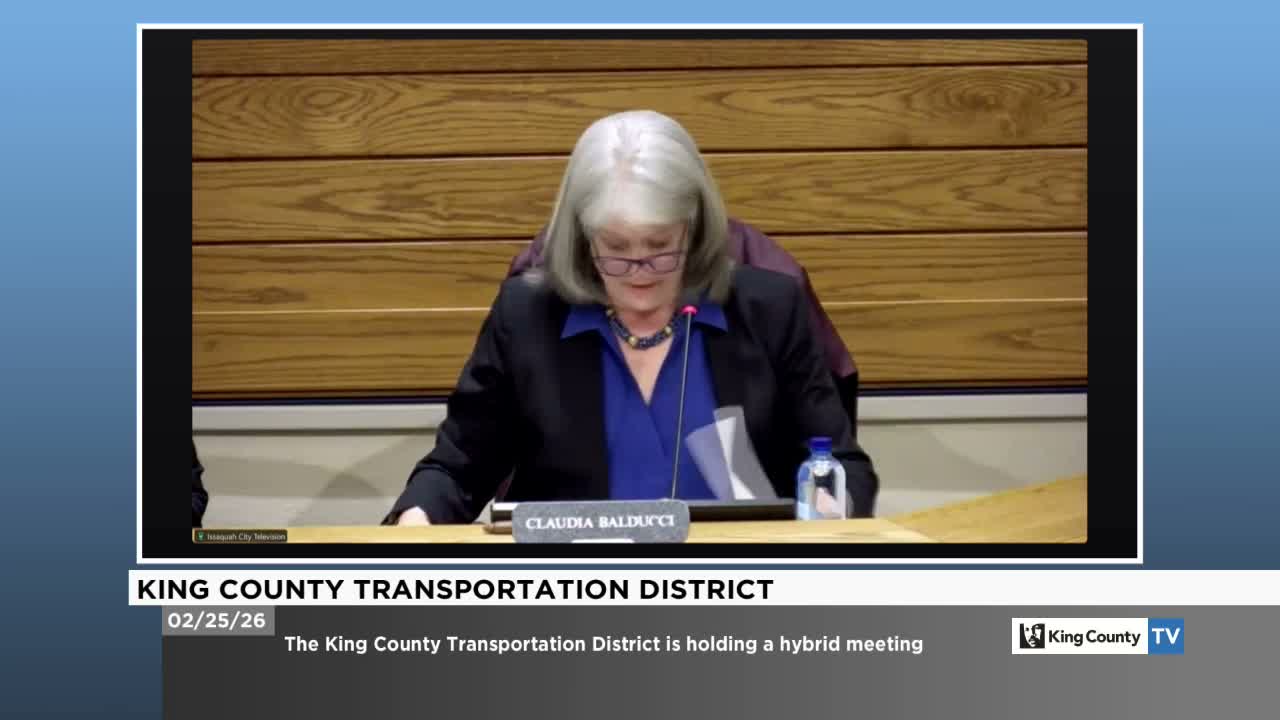
Chair Claudia Balducci convened the King County Transportation District in Issaquah to review options for raising new, dedicated revenue after staff presentations showed large funding shortfalls for both Road Services and Metro.
Balducci outlined a two-part approach she said would balance urgent needs: she proposed the board consider adopting the councilmanic portion of a 0.1% sales tax to direct to roads now while pursuing a separate voter-approved sales tax or vehicle-license fee for transit. "I personally would like to propose that we consider adopting the councilmanic portion of the sales tax... and apply that to roads because that is the section of the county's budget that is in the most dire straits," Balducci said.
Why it matters: staff told supervisors the Road Services Division faces an updated annual funding gap of roughly $200 million and a long-term capital needs inventory approaching $2.5 billion. Metro officials said their 10-year plan projects a structural deficit that could reach about $1.75 billion by 2035 absent new revenues or legislative changes.
What the law allows: Mary Berginan, a KCTD staff presenter, summarized the district's statutory funding tools under state law: councilmanic sales-tax authority up to 0.1% and voter-approved sales-tax authority up to 0.2%; voter-approved vehicle license fees up to $100 and councilmanic vehicle license fees up to $50 with limits and required revenue-sharing with cities. Berginan explained that some taxes are "stackable" (can exist alongside other local levies) while councilmanic vehicle fees are not.
Timing and process: Berginan walked the board through Department of Revenue notice windows. To begin collections July 1, the county must provide notice to the Department of Revenue by April 17. To place a measure on the ballot, a resolution must be adopted by May 1 to meet an August election or by August 4 for November. Leon Richardson, director of Local Services, said that without additional revenue the county would begin planning staffing reductions and program cuts that would materialize in the 2028-29 biennium.
Public reaction at the meeting was mixed: transit advocates and labor unions urged a countywide, voter-approved funding measure for Metro to expand service and preserve gains in ridership; rural residents and property owners stressed that unincorporated roads shoulder a disproportionate burden and urged either careful revenue-sharing with cities or alternative district boundaries.
Next steps: Balducci said the KCTD will hold two additional meetings (March 19 and April 6) and asked members and staff to bring concrete proposals so the board can consider a councilmanic vote before the April 17 DOR notice deadline or prepare a voted measure if necessary. She emphasized the board's role in developing options, not that it had already taken a position.
The board did approve routine minutes at the start of the meeting; no other formal votes were taken on funding measures during the session.