Get Full Government Meeting Transcripts, Videos, & Alerts Forever!
Get email alerts on the Land Use Development topic
No spam. Unsubscribe anytime.
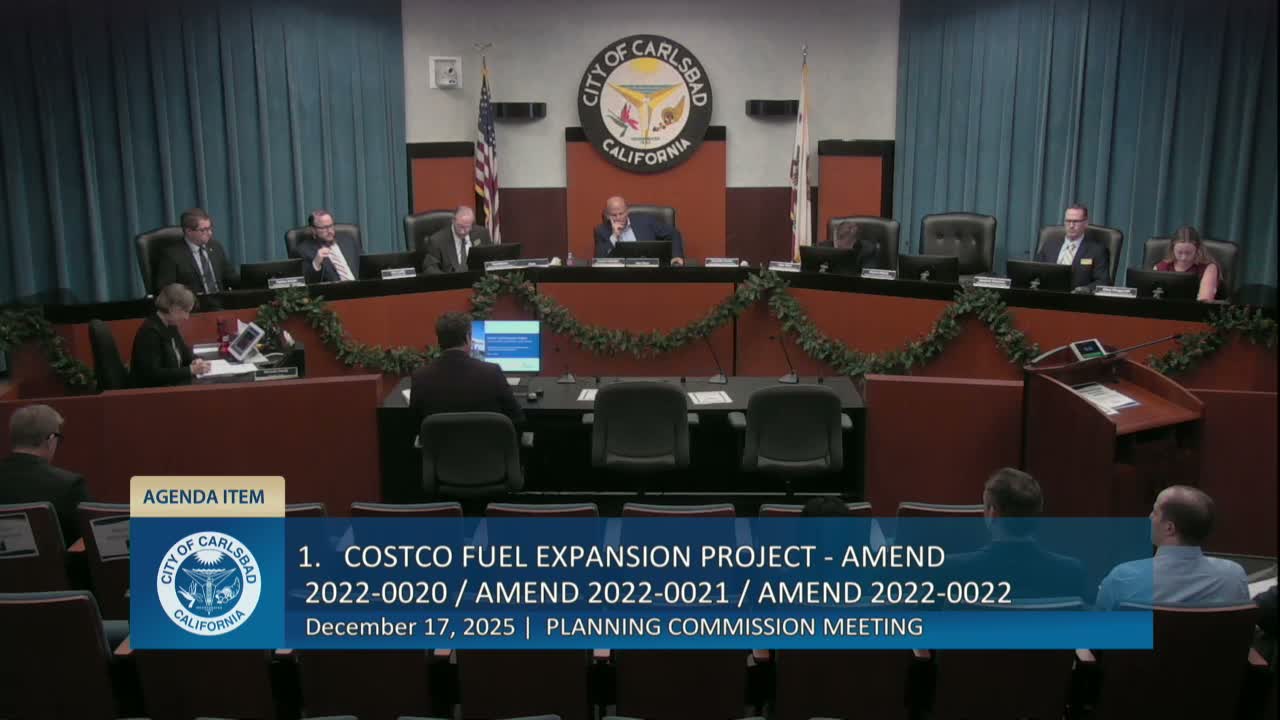
Carlsbad planning commissioners approve Costco fueling expansion, after debate over delivery timing language
Summary
The City of Carlsbad Planning Commission voted 5–0 on Dec. 17 to approve permits allowing Costco to add pumps, an expanded canopy and a larger underground storage tank at 941 Palomar Airport Road. Commissioners debated whether to soften a delivery‑timing condition by adding the word “typically,” but staff cautioned that change could weaken enforceability.
Carlsbad planning commissioners voted 5–0 on Dec. 17 to approve a proposal to expand the Costco fueling facility at 941 Palomar Airport Road, adopting a CEQA determination and associated site development, conditional use and coastal development permits as recommended by city staff.
Mike Strong, assistant director of community development, told the commission the application would add four new fuel pump locations (eight vehicle positions), a new underground storage tank and an expanded canopy while reconciling earlier permits for the 14.8‑acre site. "Staff's recommendation is to adopt the resolution and would approve all the permits associated with the project and then provide the CEQA determination clearance," Strong said.
The commission spent significant time on traffic and operational details. The applicant, Riley Johnson of Coors Gates Group (formerly Barghausen Consulting Engineers), said the expansion is intended to "improve the queuing wait times for fueling vehicles and provide a more efficient flow of vehicles through the facility, for Costco members," and requested a minor wording change to condition 24 that would add the word "typically" to soften defined delivery‑time restrictions.
Fernando Sotelo, the project's licensed traffic engineer, described Costco's queue management plan — a set of operational measures such as signs, cones and staffing — as a routine tool used at expanded fueling facilities to keep vehicle queues on‑site. "The queue management plan is like a... backup plan really, if it needs to be implemented so Costco is ready to address the problem when needed," Sotelo said.
Commissioners asked for specific design clarifications. Staff and the applicant said the south retaining wall adjacent to the pumps would be removed and replaced with curb, gutter and landscaping, and that the future configuration will provide a bypass lane where none exists today. The applicant stated the project would add about 11 feet of additional width at a specified lane to improve passability.
The commission also discussed storage capacity and regulatory compliance. The applicant reported the existing site uses three 20,000‑gallon underground tanks and proposed a new 40,000‑gallon underground storage tank. Strong said state and federal regulations govern underground storage tank installation and that a condition requires the applicant to provide required certifications before building permits are issued.
A central point of debate was whether to insert the word "typically" into condition 24, which references peak demand windows (as described in the staff report) and asks that fuel deliveries occur outside those peak periods "to the greatest extent possible." Several commissioners said they would support adding the word to provide operational flexibility; others, and staff, warned that the change could make the condition harder to enforce or effectively nullify a time‑window restriction. Staff told the commission the condition's timing language was drafted to align with the traffic analysis and that the change is at the commission's discretion.
After discussion, Commissioner Fitzgerald moved to adopt the Planning Commission resolution approving CEQA clearance and the permits as recommended by staff; Commissioner Mertz seconded. The motion passed 5–0.
The commission also recorded that certain off‑site improvements — including expanding the westbound left‑turn movement into the shopping center to about 400 linear feet and installation of two bus stops along Palomar Airport Road — would be paid for by the applicant and would need to be completed before final project approval. Staff said those improvements and the queue management plan are intended to prevent spillover queues onto Palomar Airport Road and to ensure compliance with the commercial visitor‑serving overlay standards.
The commission closed the public hearing, heard holiday remarks and adjourned at 5:44 p.m. The record does not show an explicit amendment being adopted to the motion to insert the word "typically" into condition 24; staff's recommendation and the permits as presented were adopted by the commission.