Get Full Government Meeting Transcripts, Videos, & Alerts Forever!
Get email alerts on the Bond And Solar Recommendations topic
No spam. Unsubscribe anytime.
Joint Sustainability Committee backs $15M farmland preservation ask and endorses preserving two climate staff positions, expedited city solar procurement
Summary
The committee voted to support a Food Policy Board recommendation to seek a $15 million initial bond investment for farmland acquisition and to recommend preserving two climate‑related FY‑26 staff positions; it also endorsed staff’s expedited solar RFP plan to capture federal tax credits with a 2026 construction‑commence deadline.
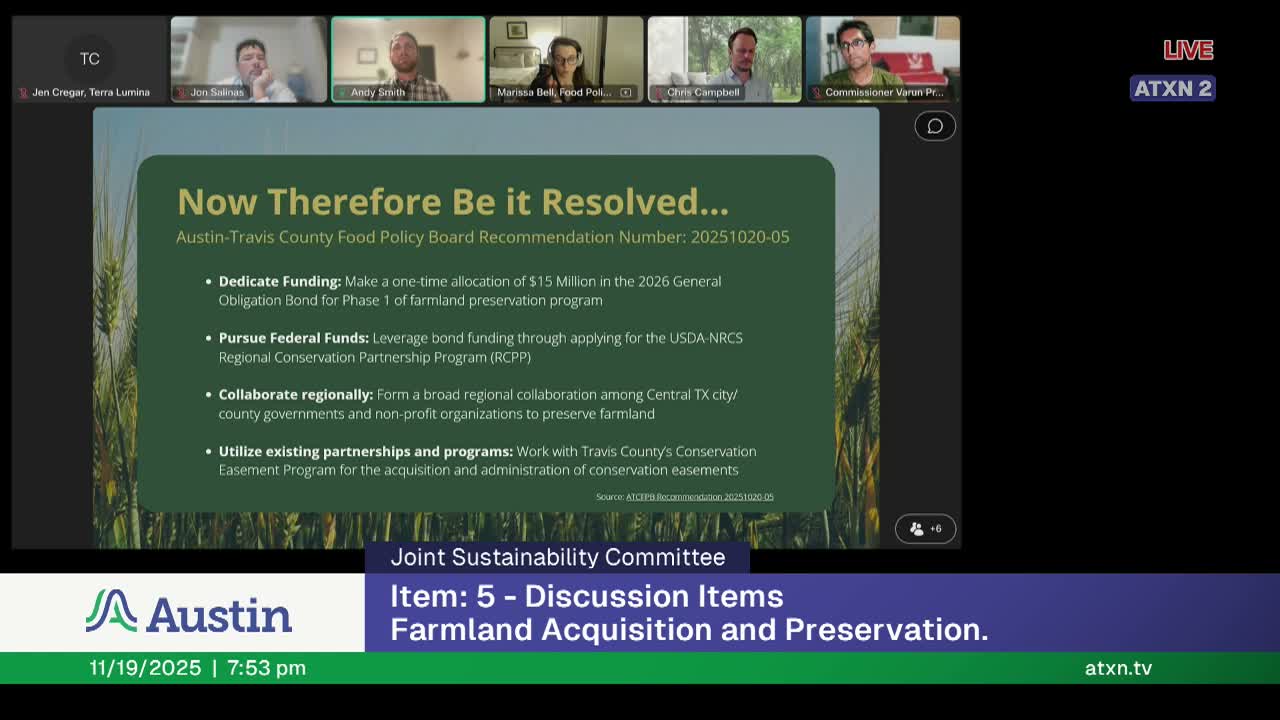
At its meeting, Austin’s Joint Sustainability Committee voted to endorse a recommendation from the Austin‑Travis County Food Policy Board that the FY‑26 bond include a one‑time $15,000,000 initial investment to acquire and preserve farmland in the region and to pursue regional partnerships and conservation easements.
The committee’s motion — which passed by voice/hand raise under committee rules (record cited 9 in favor, 1 abstention) — asked staff to explore leveraging that initial seed with federal and private funds and to coordinate with existing programs such as the Travis County conservation easement program. Presenters argued farmland preservation yields co‑benefits for water recharge, soil carbon sequestration and local food resilience, and listed a case study (3 Creeks Farm, Elgin area) where an NRCS program plus local match protected 315 acres and enabled multiple leased farms producing food for local school programs.
Personnel and solar recommendations: The committee also adopted a recommendation to preserve two positions (an Energy Program Manager and a Sustainable Program Manager) that were included in prior budget materials but slated for removal; members said those positions are important to coordinate solar, energy efficiency and sustainable purchasing work regardless of immediate capital availability. Separately, staff presented an accelerated solar procurement plan that screens about 120 candidate city sites (from an initial ~250) and aims to commence construction by July 4, 2026, to access federal tax‑credit safe harbors; staff recommended a two‑step RFP and allowed both city‑owned and third‑party ownership models.
Why it matters: Committee members framed the farmland recommendation as protecting production capacity and ecosystem services at a time of rapid land loss in the region; speakers cited an estimated $21,000 per acre cost example and a target that $15 million could help conserve roughly 700 acres using a mix of fee purchase and easements (figures are illustrative from the presentation). Staff said the solar project is time‑sensitive because federal clean energy tax credits may phase down and projects must commence construction by 2026‑07‑04 to qualify under safe harbor provisions.
Votes and next steps: The committee approved the farmland recommendation (9 yes, 1 abstention) and the staff recommendations on solar procurement and personnel preservation. Staff were asked to provide follow‑up materials and expedite written recommendations to council, with a December follow‑up committee update on the solar RFP approach.