Get Full Government Meeting Transcripts, Videos, & Alerts Forever!
Get email alerts on the Landscaping Electrification topic
No spam. Unsubscribe anytime.
City study finds many commercial electric landscaping tools are ready; recommends phased pilots, vendor training and incentives
Summary
A market study commissioned by Austin Climate Action & Resilience and Parks & Recreation found electric handheld tools and small mowers generally market‑ready, while larger riding mowers and heavy‑duty saws face battery and charging constraints; it recommends phased pilots, vendor training in procurement, life‑cycle cost analysis, and potential rebate/trade‑in programs.
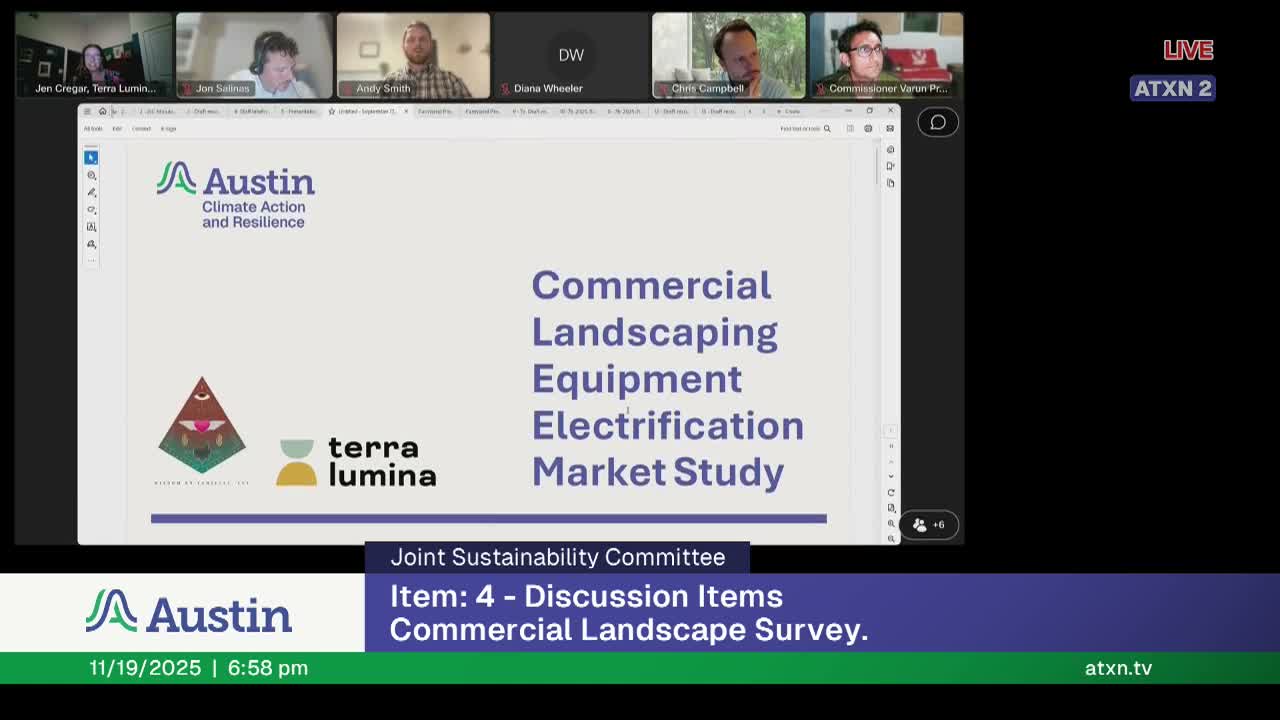
Consultants for the city told the Joint Sustainability Committee that electrifying commercial‑grade landscaping equipment could reduce noise, localized air pollution and maintenance burdens for operators, but that readiness varies by equipment type.
Jen Krieger of Terra Lumina Consulting said her team interviewed roughly 85 people from 38 organizations and found strong user enthusiasm for electric handheld tools (string trimmers, smaller leaf blowers) and many smaller mowers, while larger riding mowers, heavy chainsaws and sustained heavy‑duty applications still face battery life and power‑output limits. The analysis included site tours of local distributors and interviews with other U.S. jurisdictions that are further along in adoption.
Why it matters: The report flags worker health and local air quality as immediate co‑benefits and suggests the city can use procurement, rebate/voucher programs and targeted pilots to accelerate adoption without requiring a rapid, department‑wide transition. The consultants recommended a phased approach: convert market‑ready equipment at end‑of‑life, pilot automated mowers at flagship parks, and pursue rebate or voucher programs (typical program costs cited at $150,000–$300,000 per year) to reduce upfront costs for small businesses.
Key details: Vendors and operators reported that electric commercial equipment often costs 1.5–3x the purchase price of internal‑combustion equivalents when including batteries and starter chargers; other factors include proprietary chargers, the need for multiple batteries per operator, building electrical upgrades for charging and concerns about battery end‑of‑life disposal. The study proposed procurement language that requires vendor training and noted some programs pair equipment lending libraries with mobile solar charging for field trials.
Questions and limits: Committee members pressed for more data on the local share of electric equipment among businesses; consultants said raw survey response appendices are available to city staff but not published with identifying information. They also recommended specifying who would administer any rebate — Austin Energy or another city partner — and highlighted workforce‑development and on‑site training in procurement contracts to reduce resistance to change.
Next steps: The consultants offered to share the full report (English and Spanish) and an appendix of survey results with city staff; the committee asked staff to consider pilot programs, procurement language, and potential partnerships with regional air quality agencies for incentive administration.