Get Full Government Meeting Transcripts, Videos, & Alerts Forever!
Get email alerts on the Living Streets topic
No spam. Unsubscribe anytime.
Austin’s Living Streets program reports record activations; staff plans equipment upgrades and a 100‑street goal
Summary
City staff reported 114 Living Streets activations in the past year and outlined plans to pilot more durable equipment, improve aesthetics and reach roughly 100 ongoing Healthy/Play Street activations at capacity. Staff emphasized equity outreach and partnerships for longer‑term shared‑street conversions.
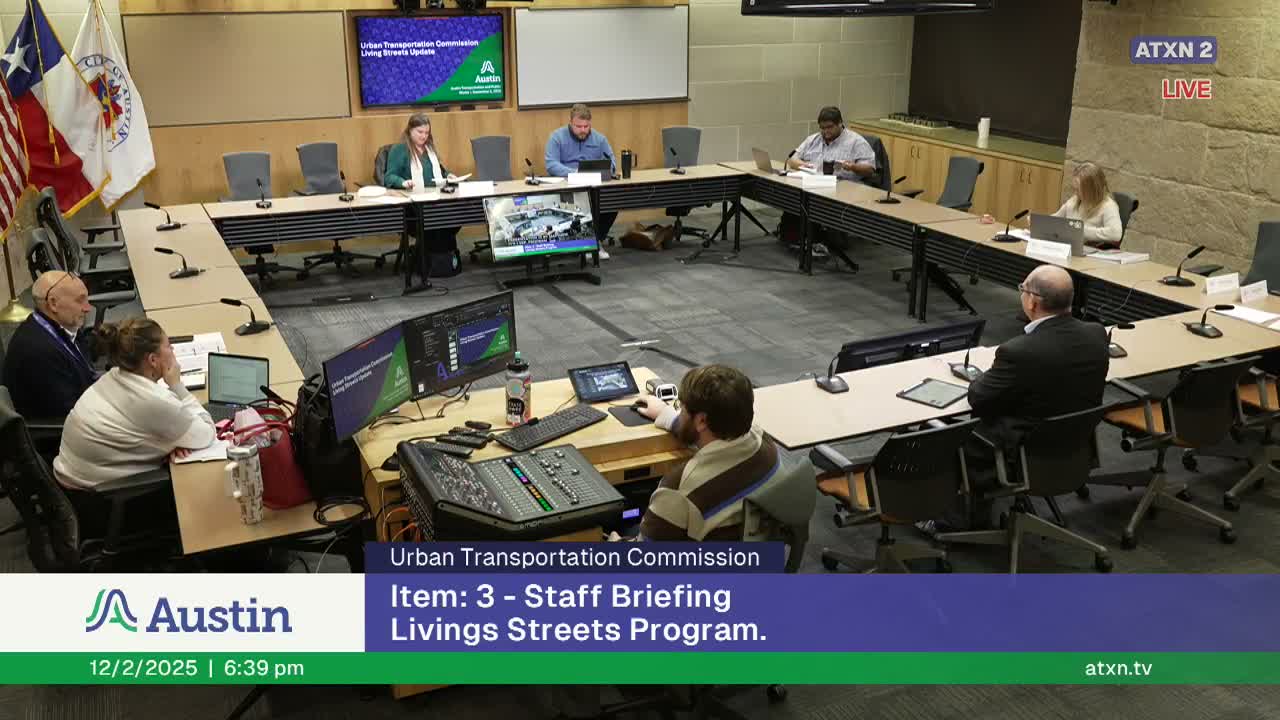
Matthew Majaj, program consultant for Austin Transportation and Public Works, told the Urban Transportation Commission the Living Streets program completed 114 activations in the past year (74 Play/Healthy Streets plus 40 neighborhood block parties), serving 40 unique locations and reaching a high rate of repeat applicants.
Majaj described three activations — Neighborhood Block Parties, Play Streets and Healthy Streets — and outlined recent improvements: simplified online applications, delivery of equipment to sites, and design changes to reduce the footprint and improve the look of installations. He said the program achieved measurable safety benefits in a nine‑street study (incidents fell from three to one) and recorded a roughly 9% reduction in vehicle speed and a 10% decrease in vehicular volume on studied streets.
Staff proposed improvements to equipment and a pilot of more permanent‑looking elements (curb blocks, planters and other heavier devices) to replace a predominance of orange cones and barrels. Majaj said council provided $250,000 to procure permanent equipment and the program is awaiting federal Safe Streets and Roads for All (SS4A) demonstration grant funding expected in early 2026; the goal is to roll out upgraded equipment in fiscal year 2026 and scale to about 100 Living Streets at capacity.
Commissioners asked about equity, prioritization and whether Healthy Streets pilots would feed into the city’s shared‑streets and sidewalk priorities. Majaj said the programs are complementary: healthy streets are community driven (bottom‑up) and shared streets are a separate, city‑prioritized effort (top‑down), and the Living Streets pilot is intended as a pathway to permanent shared‑street conversions where appropriate. Staff said neighborhood partnering and PTMD funds can support complementary local investments but stressed that administering external funds for right‑of‑way work requires city procedures and oversight.
The commission did not take formal action but encouraged follow up and asked for written cost breakdowns and a timeline for pilot upgrades.