Get Full Government Meeting Transcripts, Videos, & Alerts Forever!
Get email alerts on the Vision Zero topic
No spam. Unsubscribe anytime.
City reports drop in serious injuries in Vision Zero review; staff outline next steps
Summary
Austin Transportation presented Vision Zero's 10‑year report showing reductions in serious injuries and outlined ongoing projects, federal grant leverage and plans to integrate EMS incident data. Commissioners asked for construction‑zone crash analysis and continued coordination with APD.
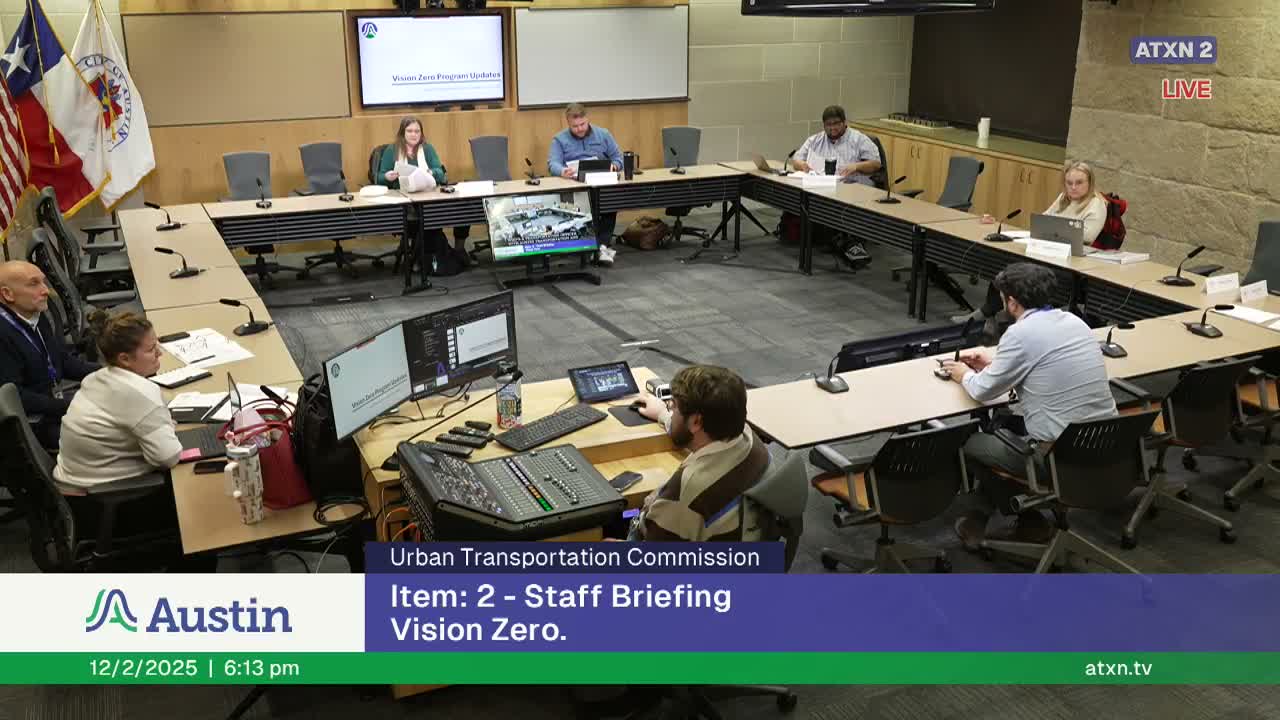
Joel Meyer, transportation safety officer for Austin Transportation Public Works, presented Vision Zero’s 10‑year report to the Urban Transportation Commission on Dec. 2, showing declines in serious injuries citywide and describing program accomplishments and outstanding challenges.
Meyer said the city has seen reductions in serious injuries compared with the five‑year average and flagged that pedestrian serious injuries are down year‑to‑date through early October. He credited a combination of infrastructure investments, including projects funded by voter‑approved bonds, design changes to lower speeds and targeted enforcement partnerships with APD.
Meyer highlighted program milestones and new analytics work, including a methodology paper tied to the 10‑year report, efforts to integrate EMS incident data into Vision Zero tools to capture underreported crashes (especially micromobility incidents), and leveraging $9 million in local bond funding to secure an additional $35 million in federal grants. He described current and upcoming work such as a citywide lighting plan, a roundabout design guide, and several major intersection and corridor projects slated for construction in 2026.
Commissioners asked about construction‑zone crash trends and potential safety impacts during major projects such as I‑35 reconstruction and Project Connect. Meyer said crash data flags construction zones and staff can analyze trends; he also emphasized collaboration with state agencies and TxDOT about traffic‑control standards. Several commissioners praised visible declines and encouraged further analysis of what interventions produced the improvements.
Meyer also outlined Vision Zero enforcement partnerships — including expanded no‑refusal DWI program support and joint data sharing with APD command analysts — and said enforcement is one component among design and culture work. The commission did not take formal action but asked staff to return with more data on construction‑zone safety when available.