Get Full Government Meeting Transcripts, Videos, & Alerts Forever!
Get email alerts on the Mopac South topic
No spam. Unsubscribe anytime.
CTRMA presents MoPac South express‑lane build; residents and commissioners press for fuller review
Summary
CTRMA briefed the Urban Transportation Commission on the MoPac South draft Environmental Assessment and recommended express lanes. Public commenters and commissioners called for stronger review and alternatives analysis, with several urging a full Environmental Impact Statement and clearer mitigation for water quality and nearby schools.
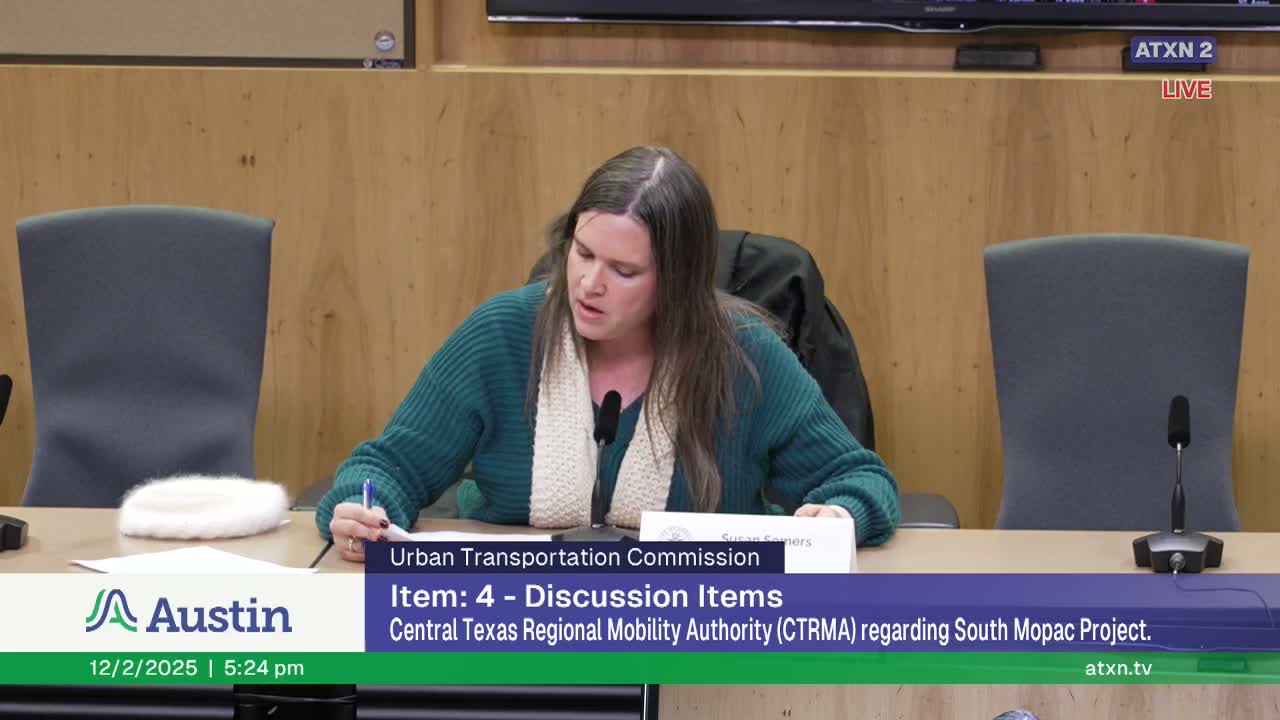
Charlotte Gilpin, project manager for the Central Texas Regional Mobility Authority (CTRMA), presented the MoPac South study at the Urban Transportation Commission’s Dec. 2 meeting, outlining an approximately eight‑mile corridor from the Cesar Chavez downtown interchange to Slaughter Lane and the agency’s recommendation of express lanes (operational configuration 2C).
The presentation described a draft Environmental Assessment (EA) the agency plans to publish before a public hearing expected in the first quarter of 2026, with a public comment period CTRMA said it intends to extend beyond the 15‑day minimum. CTRMA said the build alternative includes two express lanes with braided (elevated) ramps at key interchanges, expanded shared‑use paths, improved pedestrian crossings and a commitment to remove 100% of total suspended solids (TSS) for the project’s net increase in impervious cover — a level CTRMA said exceeds Texas Commission on Environmental Quality requirements.
Public commenters pressed the commission to oppose highway expansion plans that they said would increase vehicle miles traveled and worsen congestion through induced demand. Jonathan Sosby of Rethink35 told commissioners highway widening ‘‘often increases rather than reduces congestion’’ and urged the city to favor projects that reduce vehicle miles traveled and bolster transit, biking and walking. Bobby Levinsky, an attorney for Save Our Springs Alliance, said the project previously stalled in 2015 and cautioned that CTRMA’s current environmental review could use mitigation measures to avoid an Environmental Impact Statement (EIS). Brandon Nideh of the advocacy group Aura warned the project would increase pollution near Austin High School and run counter to local climate and mobility objectives.
Commissioners questioned CTRMA about the difference between an EA and an EIS, whether the EA will include a robust ‘‘no‑build’’ baseline and how CTRMA plans to analyze cumulative impacts with concurrent projects such as I‑35 construction. CTRMA staff said an EA can lead to a Finding of No Significant Impact (FONSI) if impacts are mitigated, but acknowledged that if significant impacts are identified an EIS would be required. CTRMA staff said the EA will include the no‑build alternative and noted that, under recent NEPA guidance, an EIS can take about two years.
CTRMA also described coordination with CapMetro and said transit vehicles would be allowed to use express lanes at no cost, which the agency said improves transit reliability. Commissioners pressed CTRMA on schedule and public‑engagement details; CTRMA said the draft EA will be made available for public review and that staff will post updates and signups on the project website.
The commission did not take formal action on the presentation (the item was posted for discussion only) but members signaled interest in preparing a formal comment during the EA public comment window and requested staff watch the project schedule closely so the commission can coordinate any official response.