Get Full Government Meeting Transcripts, Videos, & Alerts Forever!
Get email alerts on the Public Safety topic
No spam. Unsubscribe anytime.
Auditor's Office says King County 9-1-1 center underuses behavioral-health alternatives and relies on overtime; sheriff agrees to act
Summary
An Auditor's Office report found the Sheriff's 9-1-1 Communications Center makes limited use of behavioral-health alternatives (no transfers to 988/Crisis Connections in the audit sample), relies on overtime to meet timeliness standards, and faces staffing and language-access challenges; the sheriff concurred with recommendations.
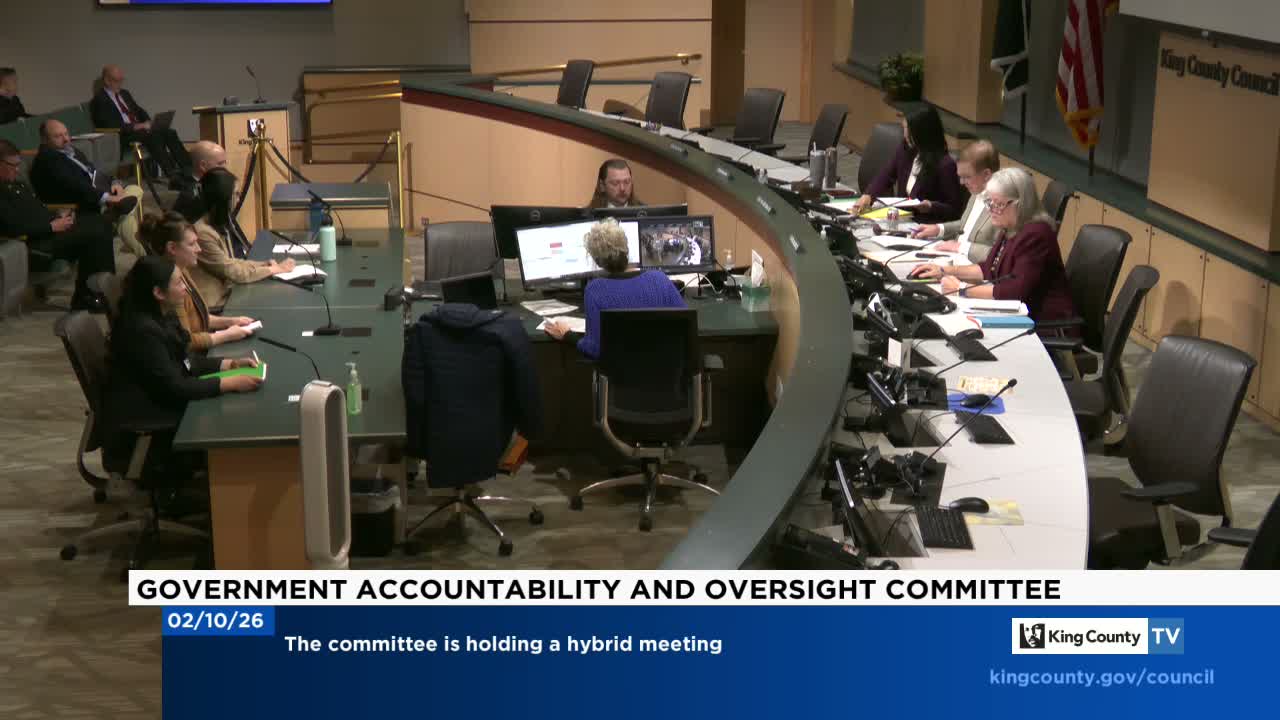
The King County Auditor's Office told the Government Accountability and Oversight Committee on Feb. 10 that the Sheriff's Office 9-1-1 Communications Center underuses behavioral-health alternatives, is understaffed relative to its budgeted positions, and meets call-answer timeliness standards by relying heavily on overtime.
Brooke Leary, audit director, introduced the report and said the comm center fields more than 300,000 emergency calls and 200,000 non-emergency calls per year. Luke from the Auditor's Office said auditors reviewed audio and records tied to 153 incidents coded as mental-health related; 46% of those incidents resulted in police dispatch and auditors found none in the sample were transferred to 988 or Crisis Connections. —So a little less than half, or 46%, resulted in a police dispatch,— Luke said. He added a majority of sampled calls did not involve audible dangerous conditions and therefore could have been eligible for a behavioral-health referral.
The audit recommended the sheriff's office work with subject-matter experts to create standard operating procedures and training so call receivers can transfer appropriate calls to behavioral-health resources and suggested the sheriff's office consider a contract partnership with Crisis Connections' 9-1-1 diversion program to provide a warm handoff to clinicians.
Peter Hynexius (Auditor's Office) highlighted language-access delays and staffing pressures. He said the comm center is budgeted for 69 communication specialist positions and had been fully staffed in February 2020, but since mid-2023 has had roughly 12 vacancies. The audit found that in 2024 about 13% of working hours were overtime (10% voluntary, 3% mandatory), and that a large share of mandatory overtime results from supervisors backfilling comp-time leave; the auditors recommended the sheriff's office consider modifying comp-time provisions in bargaining agreements to reduce mandatory overtime.
Ian Jury, support services division chief for the sheriff's office, thanked auditors and said the office concurs with recommendations and is already taking steps to implement several of them, including evaluating bilingual certification for call receivers and assessing service-provider timeliness for interpretation. Councilmembers asked whether Crisis Connections has capacity for countywide expansion and pressed for better CAD data flags; auditors recommended ensuring the CAD refresh (expected in 2028) includes an independent behavioral-health flag to improve data capture.
The audit report and the sheriff's response emphasize changes the county can make to increase 9-1-1 diversion to behavioral-health clinicians, improve language access, and reduce reliance on mandatory overtime. The auditors said the sheriff and executive concurred with all recommendations and will begin implementation planning.