Get Full Government Meeting Transcripts, Videos, & Alerts Forever!
Get email alerts on the Housing Adus topic
No spam. Unsubscribe anytime.
Carlsbad planning commission recommends 2025 ADU code amendments to align local rules with state law
Summary
Staff presented nine zoning changes aimed at aligning Carlsbad’s code with state ADU law effective Jan. 1, 2025; the commission voted unanimously to recommend a CEQA exemption and the zone‑code and local coastal program amendments to City Council.
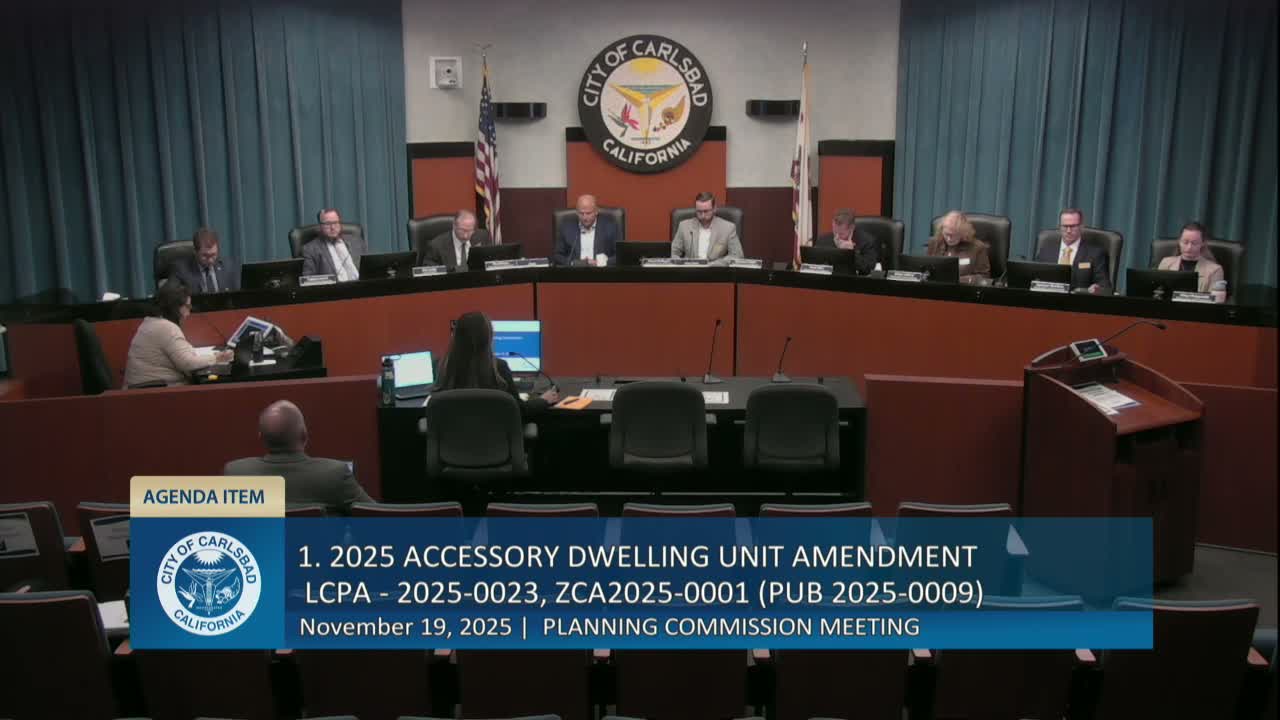
Shelley Glennon, an associate planner for the City of Carlsbad, told the Planning Commission on Nov. 19 that the city is proposing nine primary zoning amendments to update local rules for accessory dwelling units (ADUs) and junior accessory dwelling units (JADUs) to reflect state law changes that went into effect Jan. 1, 2025.
"The state of California currently has regulations in place intended to encourage the production of accessory dwelling units, also known as ADUs, and junior accessory dwelling units, or JADUs," Glennon said during her presentation. She described the amendments as a mix of clarifying edits and substantive updates to size, parking, height and design provisions and said staff worked with the Department of Housing and Community Development (HCD) to ensure consistency with current state law, including changes made pursuant to Senate Bill 457, Senate Bill 1211 and Assembly Bill 2533.
Why it matters: The amendments are intended to ensure Carlsbad’s zoning code does not conflict with state ADU requirements and to remove unnecessary local barriers to building smaller, more affordable housing units. Staff recommended the Planning Commission recommend approval of a CEQA exemption, a zone‑code amendment and a local coastal program amendment.
Key points from staff presentation included: an updated clarification of size limits distinguishing attached, detached and conversion ADUs; an expanded parking replacement exemption that explicitly covers uncovered parking spaces (driveways and similar spaces) rather than only spaces serving the primary dwelling; a revised height standard allowing up to 18 feet for detached ADUs within a half‑mile walking distance of a high‑quality transit corridor (the city currently has no corridor meeting that definition); removal of a one‑story limit for detached ADUs consistent with Government Code section 66323; clarification that certain state‑mandated ADUs are exempt from local design standards; and replacement of a local notice‑of‑restriction requirement with a deed restriction for JADUs to align with state ADU rules.
Commissioner questions and staff responses: Commissioner Fitzgerald asked whether changing the phrase "single family" to "1 family" was required by state law or was a cleanup; Glennon said it was a cleanup to match the city's zoning terminology. Fitzgerald also asked whether the parking exemption for uncovered spaces included street parking; Glennon replied it did not and that the exemption applies to uncovered parking spaces that serve the development (for example driveways), not public on‑street spaces.
Commissioner Lafferty and others pressed staff on unit counts and height. Glennon said, referencing Government Code section 66323, that a qualifying single‑family property could include combinations such as one JADU, one attached ADU and one detached ADU (and in some configurations applicants could propose up to four total units on a parcel if all requirements are met). On height, staff explained an attached ADU may conform to a 25‑foot maximum or the zone height, whichever is higher.
Public input and action: No members of the public spoke on the item during the hearing. After discussion, Commissioner Burrows moved to adopt staff recommendations to find a CEQA exemption and recommend approval of the zone‑code and local coastal program amendments; the motion was seconded and the Planning Commission voted unanimously to recommend approval to City Council.
What happens next: Staff will transmit the commission’s recommendation to City Council; if the council adopts the ordinance, it will become effective outside the coastal zone 30 days after adoption and staff will submit required materials to HCD and the California Coastal Commission for their reviews. In the coastal zone the amendments will not take effect until the Coastal Commission approves the local coastal program amendment.