Lifetime Citizen Portal Access — AI Briefings, Alerts & Unlimited Follows
Marin County unveils $700 million five‑year capital plan and proposes $8 million annual boost for paving
Loading...
Summary
County staff presented a draft five‑year Capital Improvement Program totaling about $700 million, much of it tied to special revenues and grants, and recommended an $8 million annual general‑fund increase to pavement maintenance; board members sought more transparency on scoring and financing plans for fire facilities.
Marin County staff on Monday presented a draft five‑year Capital Improvement Program (CIP) that lists about 286 active and proposed projects totaling roughly $700 million through 2031, and proposed an $8 million annual increase in general‑fund paving allocations intended to raise the countywide pavement condition index (PCI) modestly over the next five years.
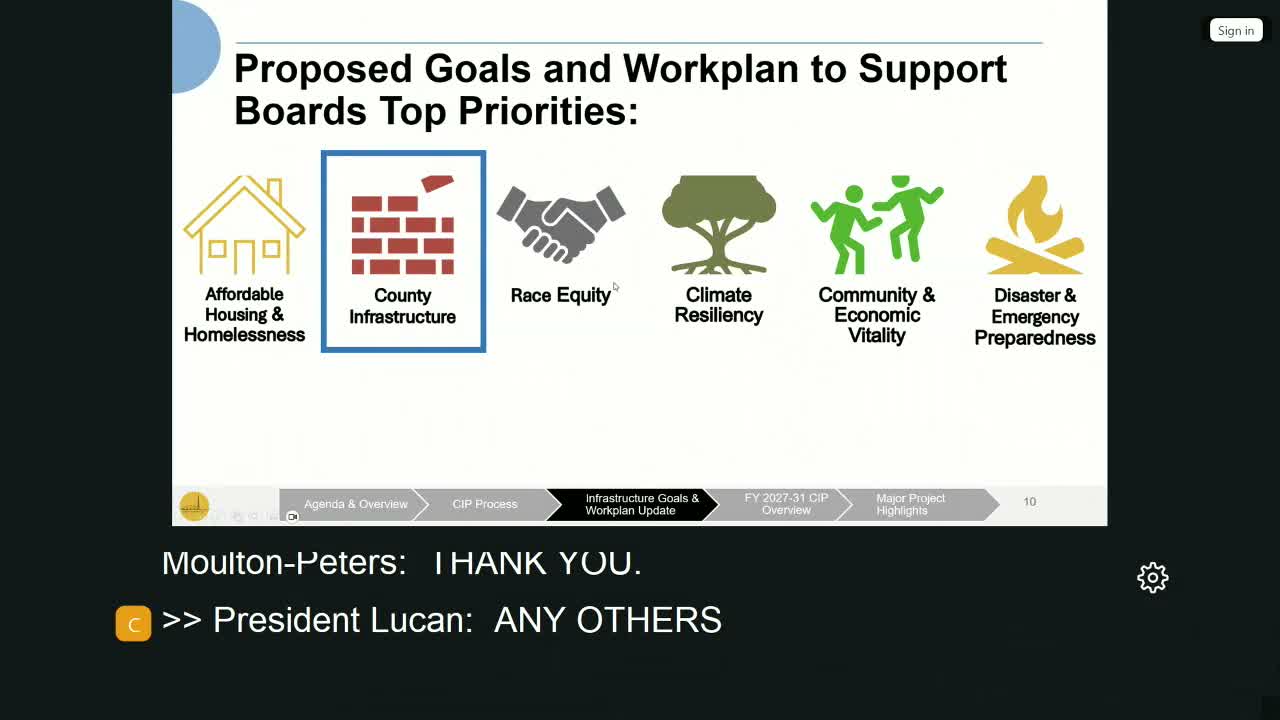
County Executive Derek Johnson told the Board of Supervisors the consolidated CIP is intended to give the county a clearer inventory of assets and a single planning framework so officials can “preserve what we’ve got, replace what we’ve got, and then build new.” Director of Public Works Chris Blanc, who led the presentation, said the program bundles projects across departments and is scored using criteria that include public safety, regulatory compliance, asset preservation, equity and funding readiness.
Blanc said the $700 million figure includes large amounts of special revenue and grant funding that are not discretionary — for example, gas taxes dedicated to roads and park and library funds restricted to those uses — and that there is “north of $72,000,000 in grants just within the road and bridge projects alone.” He also highlighted line items such as $12 million for Civic Center skylight replacement and roughly $2.5 million programmed for Civic Center security and emergency preparedness.
On paving, Blanc described the $8 million annual proposal as part of a strategy to raise the countywide PCI from about 70 toward 72–73 by 2031. “We base that off of a pavement condition report that we do every few years,” Blanc said, adding that the recommended funding is intended to balance preservation work with other deferred maintenance needs.
Supervisors pressed staff for more detail on how projects were scored and prioritized. “What I’m looking for…is what is it that each project was — was it mandatory, safety, grant‑driven, community benefit?” Supervisor Walton Peters said, requesting an added column to the CIP spreadsheet to explain funding drivers. Blanc agreed to provide additional documentation and said staff will return in April with more information.
Financing questions focused on certificates of participation (COPs) to spread large fire facility costs over time. Board members asked whether proposed COPs for the Marin County Fire Headquarters, the fire foundry, and Hicks Valley would create timing pressure for delivery. Josh (staff) and County Executive Johnson said the financing would likely be issued in tranches tied to project readiness and that the county has new debt capacity after paying down prior pension obligation bonds.
Blanc reviewed several major projects in the draft CIP: ongoing demolition and rebuild work at the Veterans Memorial Auditorium (targeted reopening early 2027), streetscape and parking elements tied to an Ames Farmers Market project, library branch refreshes, multiple fire station upgrades, and an expedited Marin County Fire Headquarters project for which the board approved a project labor agreement in January and staff are moving to progressive design‑build procurement.
Public commenters during the meeting urged the board to weigh capital investments against urgent housing needs. Sarah McAvoy said postponing some nonurgent capital upgrades could free funds to keep families housed, and other speakers asked the county to prioritize tenant protections, legal services for immigrants and investments in homelessness prevention.
Staff will return with additional CIP detail and a governance framework that includes project scoring, an executive review, and a departmental CIP review committee to recommend annual programs to the board. The CIP and its funding assumptions will be integrated with the annual budget adoption process later this spring.
The board did not take formal votes on CIP adoption during the workshop; staff characterized the materials as a first draft and sought feedback for revisions.