
East Hartford residents urge council to reconsider 3.4% tax increase in mayor’s proposed budget
Get AI-powered insights, summaries, and transcripts
Subscribe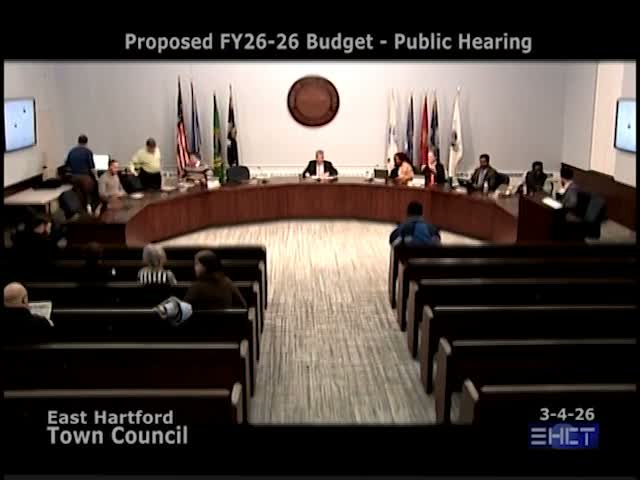
Summary
At a special Town Council meeting, residents criticized a proposed 3.4% property-tax increase tied to Mayor Martin’s FY2027 budget, urged more protections for seniors on fixed incomes and questioned town safeguards after a reported stolen tax payment; council will revisit the budget Monday.
At a special meeting, the Town of East Hartford Town Council heard more than an hour of public comment on Mayor Martin’s proposed fiscal 2026–27 budget, which the mayor submitted to the council for review. Residents and callers pressed the council to reconsider a proposed 3.4% property‑tax increase and raised questions about senior tax relief, unrecorded police follow‑up on a stolen payment and alternatives to relying on property taxes.
The proposed budget covers the fiscal year that begins July 1 and runs through June 30, 2027; the council was told the draft would raise total expenditures by about 2.9%. Chair Keogh summarized key allocations included in the plan: an additional $1.2 million for the town’s pension contribution, $600,000 for employee health funds, a roughly $500,000 reduction in planned capital expenditures and an approximate $1.9 million increase in the Board of Education allocation. The package also includes three new positions — an assistant fire marshal, a part‑time digital navigator (previously funded with federal ARPA dollars) and a senior‑center front‑desk staffer — and the chair estimated the resulting tax increase would mean roughly $20 more per month for a homeowner with about $6,000 in annual property taxes.
“Those are the figures we’re starting with,” Chair Keogh said in opening remarks, and he explained the council has already held multiple workshops and a focused session on pensions and bonding.
Longtime resident John Bazzini described the burden that an added tax would place on retirees living on fixed incomes. “When you get past 70 … your property taxes are frozen” under some local approaches, Bazzini said, and he urged the council to consider raising eligibility or otherwise expanding relief for older homeowners. Chair Keogh responded that the town currently follows a state income threshold for discounts but can be more generous and that the council will review how many residents are affected after the budget process.
Bazzini also recounted a separate incident in which a mailed property‑tax check was altered and cashed; he said the town later assessed late fees and that a police report filed three years ago has not been delivered to him. “I paid the payment the day the bill arrived,” he said. The chair acknowledged the complaint and said staff would look into the matter.
Other residents offered a mix of criticism and suggestions. Aida Ortiz told the council she strongly opposed the tax increase, saying seniors and fixed‑income households “are already struggling with high cost of living” and asking councilors to “review the budget, reduce wasteful spending, and find more efficient ways to operate.” Holly Reid thanked the council for keeping the increase modest at 2.9% but urged the town to pursue non‑tax revenue options for the future, mentioning neighborhood clean‑energy schemes as an example. Paul Willis praised steps to hold the increase down and recommended strategies to increase commercial tax base and expand affordable housing through surplus‑land development, tax abatements and partnerships with developers.
A remote caller asked about union contracts that are expiring this summer and whether the proposed budget accounts for potential raises. Chair Keogh said the town sets aside funds in a contingency account for unsettled contracts and reallocates those funds to departments after negotiations conclude.
The meeting ended with a procedural motion to adjourn that, according to the transcript, was made by John and seconded by Don; the chair called a voice vote, heard ayes and declared the motion carried. The council said it will reconvene Monday at 7:00 p.m. to consider any adjustments to the mayor’s proposal.
What happens next: the Council will continue budget review in the coming days, including refinement of relief eligibility and reallocation decisions mentioned during public comment. The council did not take final votes on budget appropriations at the special meeting.