Get Full Government Meeting Transcripts, Videos, & Alerts Forever!
Get email alerts on the Resort View Development topic
No spam. Unsubscribe anytime.
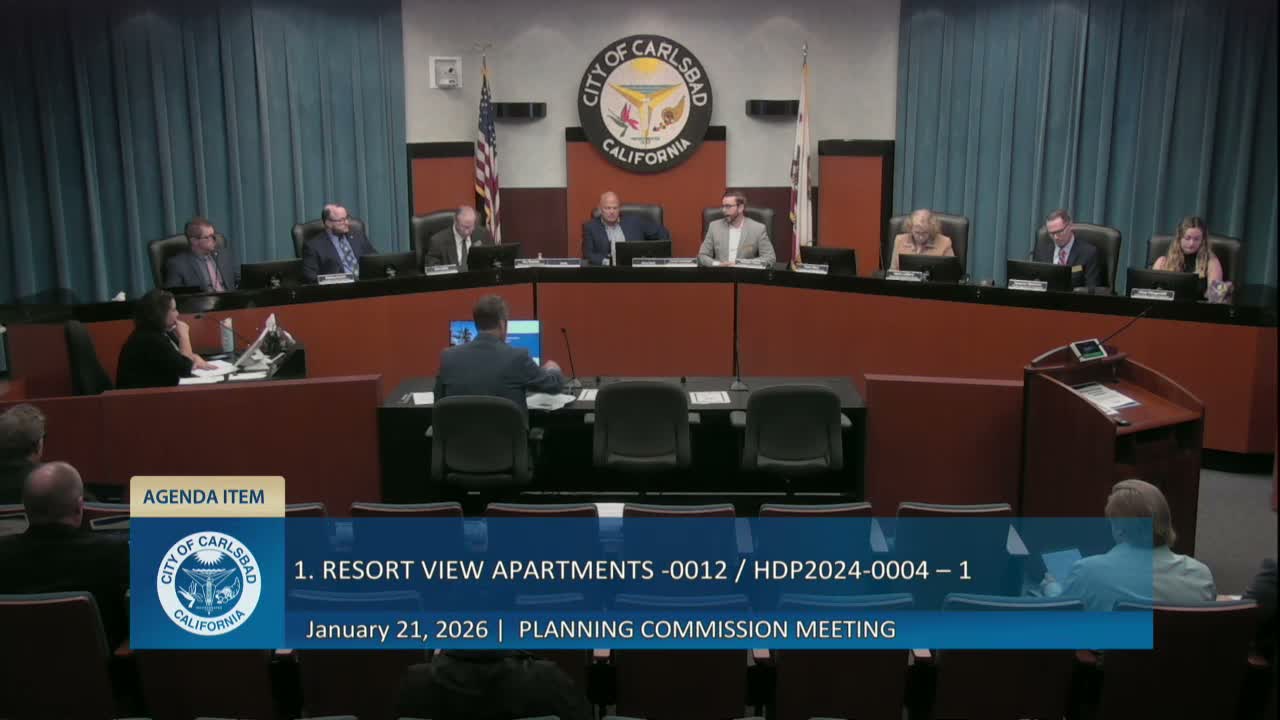
Carlsbad panel approves 26‑unit Resort View Apartments after debate over parking, height and CEQA clearances
Summary
After extended public testimony on parking, safety and environmental review, the Carlsbad Planning Commission voted to approve a 26‑unit Resort View Apartments project under state density‑bonus rules; commissioners and staff said conditions and a final TDM plan will be required.
The Carlsbad Planning Commission on Jan. 21 approved a 26‑unit apartment project on Via Castilla that will use the state density‑bonus program to add units and exceed local height rules, drawing extensive public comment about parking, safety and environmental review.
Staff introduced the Resort View Apartments proposal and recommended adoption of CEQA streamlining clearances and approval of site‑development and hillside permits. Mike Strong, the city director who presented the staff report, said the application proposes five buildings totaling about 39,000 square feet and described requested concessions under Government Code §65915. "The project provides 49 [parking] spaces which nearly meets the base requirement," Strong said, noting state density‑bonus parking ratios reduce the local base requirement to 37 spaces for this proposal.
John Allen, president of Streamline Development Group, told commissioners the project is substantially identical in unit count to a previously approved plan and described stormwater treatment and public outreach the applicant conducted. "Upon development of this project all of the rainwater that hits the site must be contained and flow to a BMP treatment facility and then discharge slowly into the storm drain system," Allen said, describing planned mitigation for runoff.
Neighbors and organized commenters pressed the commission on pedestrian safety, parking spillover and the project's scale. "This is still a 66‑bedroom project, with real world impacts," Ashley Kazi, a nearby resident and organizer of a petition, told commissioners, asking for enforceable parking and safety measures. Scott McCarthy estimated neighborhood vehicle counts and opposed the density increase for safety reasons. The Equitable Land Use Alliance urged project‑level vehicle‑miles‑traveled (VMT) analysis and mandatory mitigation measures, including limiting on‑street use by project residents.
Staff acknowledged roughly 39 written comments and explained CEQA issues: a prior 2020 entitlement benefited from a Class 32 infill exemption, but current VMT standards mean the project does not automatically qualify for that exemption today. Strong told the panel the application instead relies on a combination of CEQA Guidelines §§15183 and 15168 and on mitigation through a required final Transportation Demand Management (TDM) plan.
Commissioners wrestled with whether to seek more information or conditions before acting, including whether to strike one clearance (15168) and rely solely on §15183; some favored a short continuance, while others said the applicant and city had had months to resolve issues. Commissioner Hubinger said he would support the project, adding: "I think we need housing." Commissioner Fitzgerald emphasized public safety concerns and urged care in adding conditions. Ultimately Commissioner Foster moved to approve the project "per staff recommendation" and Commissioner Hubinger seconded. The commission recorded the motion as passing with six commissioners in favor and Commissioner Mertz absent.
The staff‑recommended resolution approves the site development and hillside permits and adopts the CEQA clearances as conditioned; staff also included TDM and parking management measures among conditions. As part of the approval staff will return final conditions and a TDM plan for implementation monitoring. The commission did not adopt any amendment that would increase the number of low‑income units in order to seek ministerial streamlining.