Get Full Government Meeting Transcripts, Videos, & Alerts Forever!
Get email alerts on the Water Safety topic
No spam. Unsubscribe anytime.
PUB reviews proposed backflow ordinance update, staff cite safety risks and device changes
Summary
City staff presented proposed updates to Denton’s cross‑connection control and backflow ordinance, focusing on nonresidential sites: requiring testable assemblies, banning non‑testable atmospheric vacuum breakers, expanding inspection access, and clarifying enforcement; staff gave differing dates for council consideration and proposed an effective date if adopted.
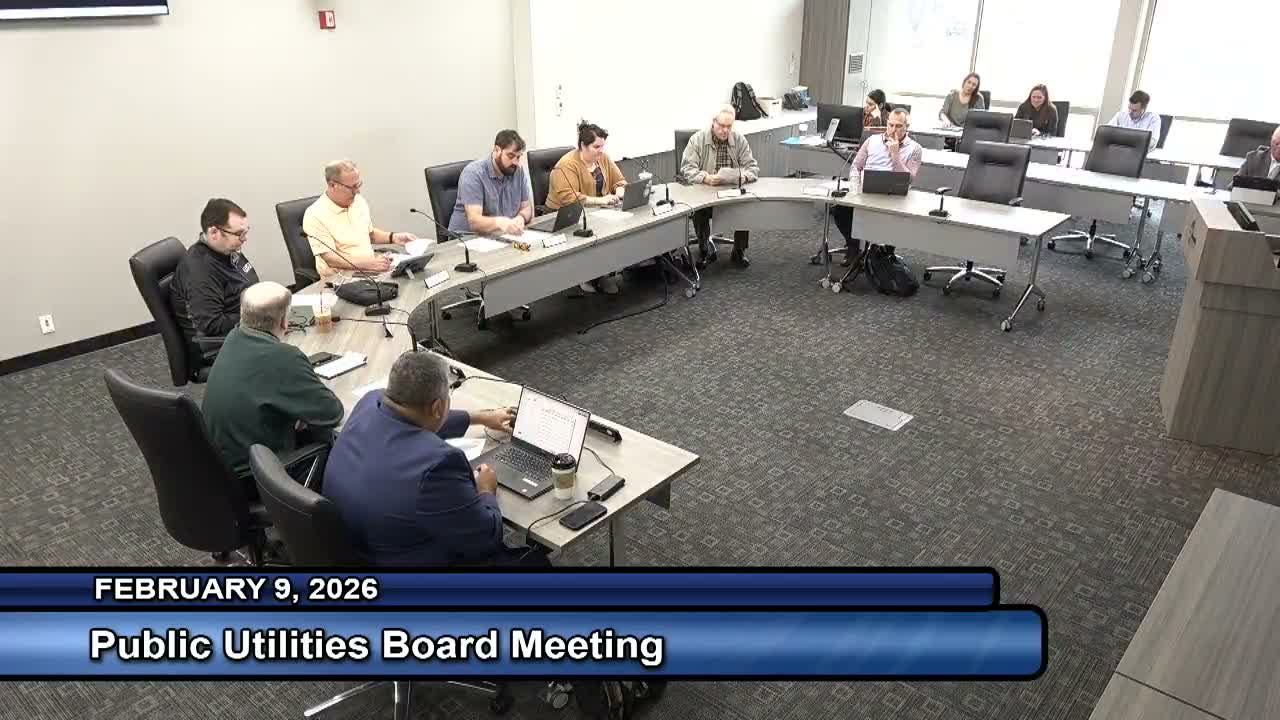
City staff presented a work‑session briefing Feb. 9 to the Denton Public Utilities Board on proposed updates to the city’s cross‑connection control and backflow ordinance, saying changes are intended to strengthen protections for the drinking‑water distribution system and clarify enforcement.
Michael Hunter, reclaimed water and cross‑connection control manager for water utilities, told the board the program — established in 1997 — currently monitors just over 6,000 commercial backflow assemblies and adds roughly 600 annually. "A backflow is in its simplest form when water flows in the opposite direction of normal flow," Hunter said, describing the risk that contaminated water can be drawn from a customer site back into the distribution main.
Hunter cited a 2024 backflow event in Grand Prairie that forced a "do not use" water notice as an example of the potential public‑health impact. He explained that in that incident the fire department connection was piped upstream of a building's backflow preventer, which allowed firefighting foam to enter the distribution system.
Key elements of the proposed update that Hunter described include:
- requiring testable backflow prevention assemblies just past the meter on all new nonresidential construction and applying updated criteria on existing nonresidential sites when they undergo major plumbing modifications and pull permits;
- prohibiting non‑testable atmospheric vacuum breakers and requiring testable devices such as pressure vacuum breakers (PVB) or reduced‑pressure zone (RPZ) assemblies in regulated situations;
- updated tester insurance and training requirements and expanded staff inspection access for cross‑connection surveys;
- defined emergency shutoff procedures and clarified service suspension for noncompliance.
Hunter and General Manager Stephen Gay both emphasized the update targets nonresidential connections; Gay added that multifamily apartments typically fall under nonresidential classification because they are multiunit/commercial connections. Hunter offered a ballpark installation cost for a robust reduced‑pressure assembly with weather protection of about $2,000–$4,000 for a typical small commercial site but said actual costs vary by device size, contractor and site conditions.
On timing and next steps, the meeting record contains differing staff statements: one staff presenter said the item would go to city council in March with an effective date proposed of March 17 if accepted; another staff reference in meeting notes said the council timeline included a March 17 council action and a later PUB appearance in late March. The transcript did not reconcile the two statements; staff indicated they are preparing public communications and will take the ordinance to city council before finalizing an effective date.
Board members asked technical and implementation questions: whether installations must be performed by a licensed plumber (Hunter confirmed yes and that permits are required), how the rule applies where properties have multiple small meters, and how residential replacements interact with building‑code triggers — Hunter and Gay said residential single‑family homes generally are not targeted by the ordinance and that building‑department rules drive residential permit triggers.
The item was provided to the PUB for discussion only; staff and a board member noted that the PUB was not being asked to take formal action on ordinance wording at this meeting. Staff said they will continue coordination with development services and communications and will publish required notice in the Denton Record‑Chronicle if council approves the ordinance.
The board did not vote on the ordinance update during the Feb. 9 session; staff will return with the item to the appropriate body as part of the city’s legislative process.