Get email alerts on the Card Processing Fees topic
No spam. Unsubscribe anytime.
Denton PUB backs 1.55% service fee on card utility payments, excluding eChecks
Summary
The Public Utilities Board on March 9 recommended implementing a service fee of about 1.55% on card payments to recover rising card-processing costs, excluding eChecks; staff estimated the fee would largely recover roughly $1.5 million in annual costs and targeted an October 1 implementation after vendor work and customer education.
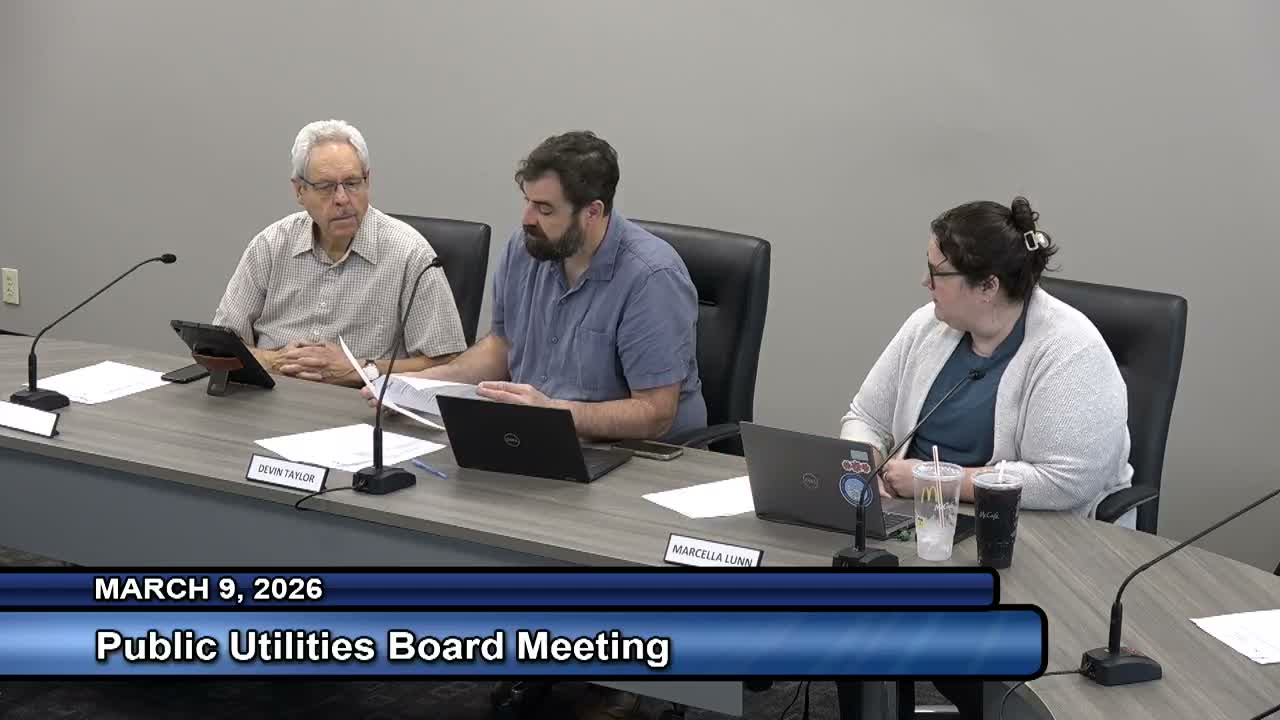
The Denton Public Utilities Board on March 9 recommended that the city recover utility card-processing costs by implementing a service fee of approximately 1.55% on card payments, excluding electronic checks (eChecks/ACH). The motion passed by voice vote with no opposition.
Matt Hamilton, the city’s chief financial officer, told the board that card-processing costs have risen largely because more customers are choosing card payments. He said processing for utility online payments accounts for about $1,570,000 annually in expense and that a recent year‑over‑year increase in fees represented roughly a 20% jump in costs driven by transaction volume. Hamilton explained that card-processing costs have three components—interchange (set by card brands), network assessment, and the payment processor fee—and that the city has little ability to negotiate brand-set interchange rates. "The city has very little, you know, input and influence in terms of card processing costs," Hamilton said.
Hamilton described three recovery options: keep recovery in utility base rates; implement a flat convenience fee for nonrecurring online payments (including eChecks); or implement a service fee (flat or percentage) that can be applied to card payments but would exclude eChecks and could include recurring payments. Staff estimated a service fee of roughly 1.55% would recover most of the $1.5 million annual cost and would be cheaper for the average residential online payment than the flat-fee option.
Board members debated fairness between flat and percentage approaches and emphasized customer education to steer people to eCheck/ACH, which carries much lower fees. Staff said implementing a service fee would require vendor configuration and an estimated six-month timeline, with a target implementation date of Oct. 1 pending further steps.
The board’s recommendation directs staff to proceed with the service-fee approach and to prepare materials for city council and for customer outreach.
AI generated
The text on this page is AI generated. Summaries, highlights, analysis, and video transcripts are all produced from the original source material.
AI can make mistakes, so if you spot one, and we will fix it for everyone.
Note: the source content is unaltered by us. Any content source we link to, be it a video, an audio recording, or a document, is presented exactly as its publisher released it. That publisher is usually a government body, sometimes an individual official or another organisation.