
Denton PUB backs 1.55% service fee on card utility payments, excluding eChecks
Get AI-powered insights, summaries, and transcripts
Subscribe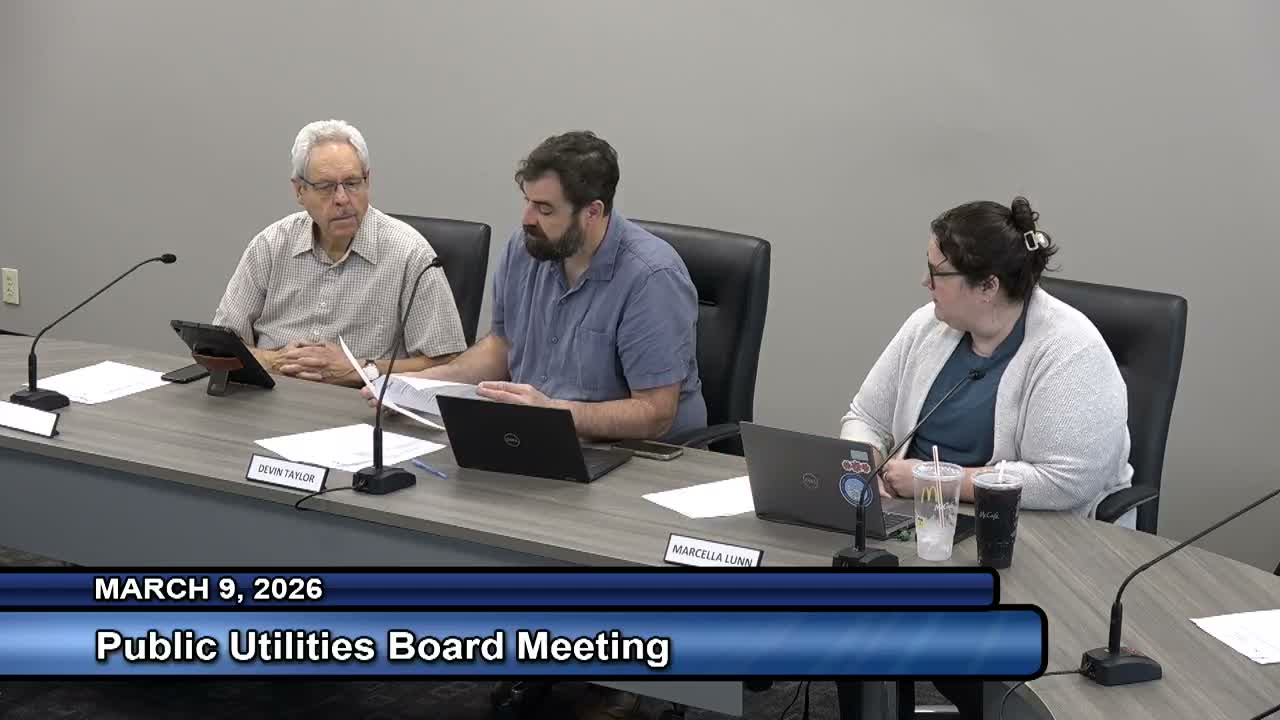
Summary
The Public Utilities Board on March 9 recommended implementing a service fee of about 1.55% on card payments to recover rising card-processing costs, excluding eChecks; staff estimated the fee would largely recover roughly $1.5 million in annual costs and targeted an October 1 implementation after vendor work and customer education.
The Denton Public Utilities Board on March 9 recommended that the city recover utility card-processing costs by implementing a service fee of approximately 1.55% on card payments, excluding electronic checks (eChecks/ACH). The motion passed by voice vote with no opposition.
Matt Hamilton, the city’s chief financial officer, told the board that card-processing costs have risen largely because more customers are choosing card payments. He said processing for utility online payments accounts for about $1,570,000 annually in expense and that a recent year‑over‑year increase in fees represented roughly a 20% jump in costs driven by transaction volume. Hamilton explained that card-processing costs have three components—interchange (set by card brands), network assessment, and the payment processor fee—and that the city has little ability to negotiate brand-set interchange rates. "The city has very little, you know, input and influence in terms of card processing costs," Hamilton said.
Hamilton described three recovery options: keep recovery in utility base rates; implement a flat convenience fee for nonrecurring online payments (including eChecks); or implement a service fee (flat or percentage) that can be applied to card payments but would exclude eChecks and could include recurring payments. Staff estimated a service fee of roughly 1.55% would recover most of the $1.5 million annual cost and would be cheaper for the average residential online payment than the flat-fee option.
Board members debated fairness between flat and percentage approaches and emphasized customer education to steer people to eCheck/ACH, which carries much lower fees. Staff said implementing a service fee would require vendor configuration and an estimated six-month timeline, with a target implementation date of Oct. 1 pending further steps.
The board’s recommendation directs staff to proceed with the service-fee approach and to prepare materials for city council and for customer outreach.