Get Full Government Meeting Transcripts, Videos, & Alerts Forever!
Get email alerts on the Hydrant Maintenance topic
No spam. Unsubscribe anytime.
Flower Mound explains hydrant inspection and maintenance plan, new asset workflow and public reporting
Summary
Town staff told council the hydrant program covers 4,676 hydrants, outlined annual flushing and flow-testing requirements tied to ISO/NFPA standards, described out-of-service marking and gave a timeline (3—2 months) for a new automated asset-workflow and public-facing status information.
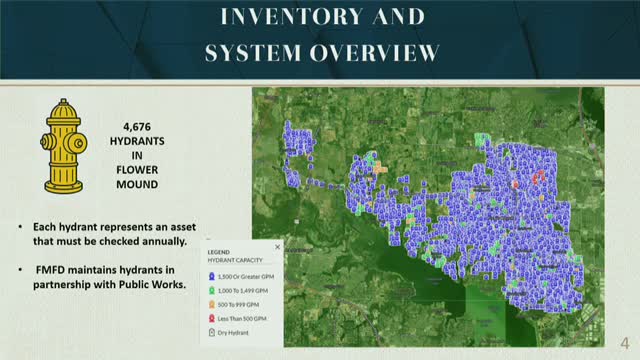
Town staff and the fire department gave a detailed presentation on the hydrant inspection and maintenance program, saying Flower Mound maintains about 4,676 hydrants and inspects each asset annually in partnership with Public Works.
"We have 4,676 hydrants in Flower Mound," Assistant Chief Baljak said as he opened the hydrant portion of the work session. He said the fire department performs inspection, flushing and flow testing while Public Works handles repair and replacement.
Staff explained the operational difference between flushing and flow testing: flushing removes sediment by opening the hydrant until the water runs clear; flow testing measures gallons per minute with gauges to verify capacity. The presenters said ISO/NFPA expectations cited in the briefing call for 100% of hydrants to be flushed annually and 20% to be flow-tested each year.
Out-of-service hydrant protocol: staff described visible cues (black bags or black rings placed over impaired hydrants) and a shared reporting workflow: firefighters enter deficiencies into the records system, Public Works creates work orders, and crews attempt basic troubleshooting before escalating repairs. "If you see a bag or out of service ... go to the fire department's website and call us," James said, urging public contact when residents have concerns.
Operations and redundancy: Staff assured the council that engines carry 800'1,000 feet of 5-inch hose and that crews can relay-pump water or connect to another nearby hydrant if one is impaired. They also described prioritization rules designed to avoid two adjacent out-of-service hydrants and to keep the percentage of impaired hydrants low.
Records and automation: presenters introduced a new RMS referenced in the transcript as "Fireworks" to replace spreadsheets for hydrant records, and described an approved automated asset-life-cycle workflow that will link inspection findings to maintenance tasks via the town's GIS. Staff estimated it will take about three to six months before the system produces useful public-facing status data.
What's next: The town plans to publish the hydrant process and a contact number on the Fire Department web page and to move inspections and repair status into the new asset workflow so residents can see estimated resolution times for an out-of-service hydrant.