Get Full Government Meeting Transcripts, Videos, & Alerts Forever!
Get email alerts on the Emergency Services topic
No spam. Unsubscribe anytime.
Chief Henley outlines staffing, EMS performance and a squad pilot to ease apparatus wear
Summary
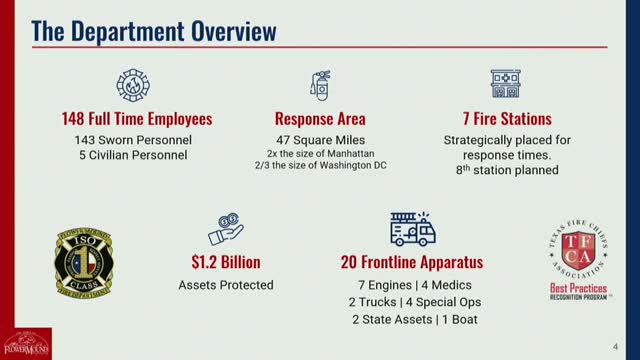
At a Flower Mound work session, Fire Chief Henley told council the department runs 148 full-time employees, holds an ISO 1 rating and handled about 7,452 calls last year; he proposed a pilot for smaller "squad" units to reduce wear on heavy apparatus and improve cost efficiency.
Chief Henley, Fire Chief, told the Flower Mound Town Council at a work session that the town's fire department is staffed with roughly 148 full-time employees, about 143 of whom are sworn firefighters, and covers roughly 47 square miles from seven active stations.
"We have 148 full time employees. 143 of those are sworn," Henley said as he opened a presentation on the department's organization and operations. He said the department maintains an ISO 1 rating and fields frontline apparatus including seven engines, two trucks and four medic units.
Why it matters: Henley framed the briefing around fiscal planning, noting the fire-related costs represent a sizable portion of the general fund and will factor into FY27 budget choices. He emphasized performance and clinical metrics as part of the department's value proposition to residents.
Henley highlighted clinical outcomes and response performance. "Because of our education of our citizenry and bystander CPR ... extraordinary, 41%," he said, referring to return of spontaneous circulation in cardiac arrest. He also cited an average STEMI alert time of about 11 minutes to get patients to a cath lab.
On ambulance billing and cost recovery, Henley and staff described the gap between charges and what the town actually collects. "Our charges were 3,600,000, and we recovered that 1.6," Henley said. He added that Medicare/Medicaid (CMS) calls typically reimburse roughly "25¢ to 33¢ on the dollar," meaning the town does not fully recover EMS operating costs.
To reduce wear on heavy engines and lower per-mile costs, Henley proposed testing smaller "squad" units that would chase ambulances and handle many non-fire calls. "We have an idea to have a pilot program using our brush truck as the guinea pig," he said, describing an east/west squad concept that would be cheaper per mile than an engine and could extend the life of heavy apparatus.
The chief also warned of procurement and market constraints for new apparatus: he and council members discussed multi-year lead times for fire engines and sharply higher prices compared with a decade ago. "It's going to be here three years," Henley said of a vehicle on order, and he described the national supply picture as a driver of local strategy.
Council members asked about certification and training: Henley said the department has about 120 paramedics and outlined training mandates, peer-support and family-oriented counseling for new hires. He said staff are exploring analytics and targeted deployment ("box" mapping) to identify repeat-run locations and improve preventive outreach.
What's next: Henley said staff will pilot the squad concept, gather operational data and return to the council with metrics before any broader change in deployment or equipment purchases.