Get Full Government Meeting Transcripts, Videos, & Alerts Forever!
Get email alerts on the Land Use topic
No spam. Unsubscribe anytime.
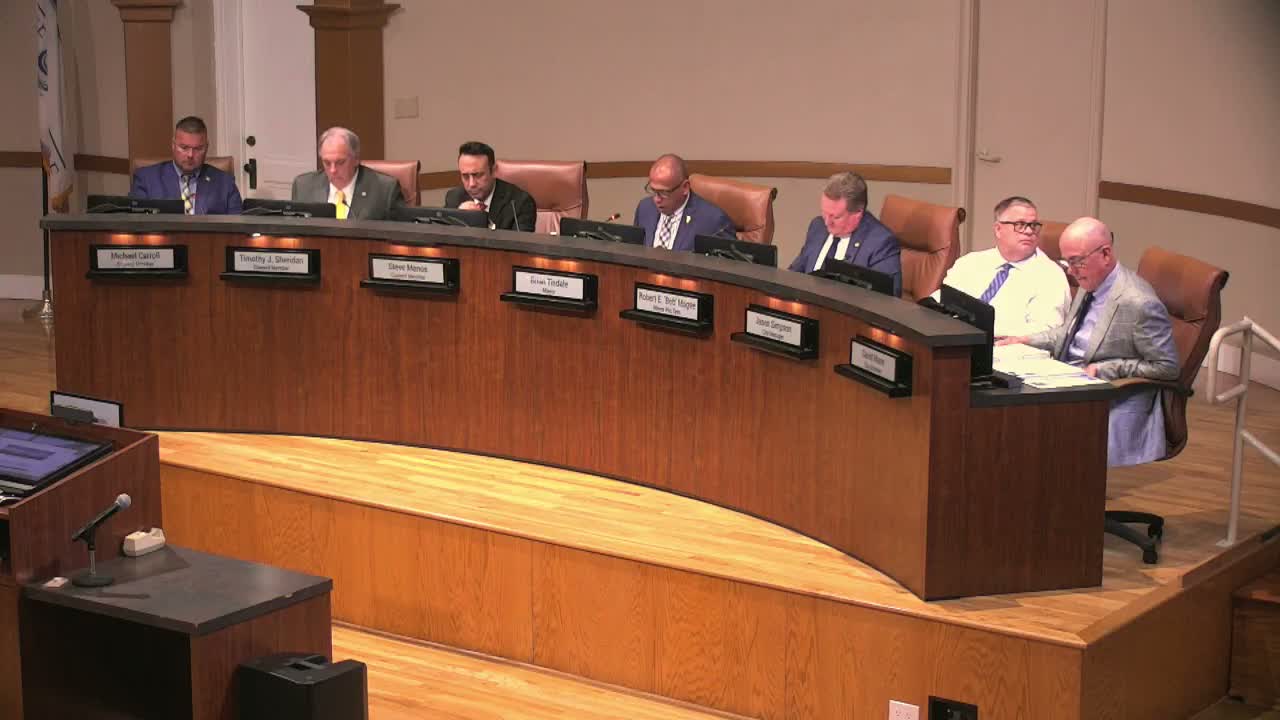
Council approves Rome Hill commercial project after debate over environmental, traffic impacts
Summary
The Lake Elsinore City Council approved the Rome Hill commercial project — two manufacturing buildings totaling 92,760 square feet on a 6.77-acre site — after hearing environmental and traffic concerns from residents and an environmental group that asked for an EIR; the council adopted related rezoning and resolutions with a 4-0 vote and one recusal.
The Lake Elsinore City Council voted to approve the Rome Hill commercial project (Planning Application 2021-119), a proposal for two commercial manufacturing buildings totaling 92,760 square feet on a 6.77-acre site along Grand Avenue and Catherine Way.
Community Development Director DeMarce Abraham presented staff’s recommendation and project details, saying the proposal includes 173 parking spaces, off-site driveway access across a County of Riverside parcel, a general plan amendment, a zone change to commercial manufacturing, a conditional use permit, design review and a variance to reduce a setback from 15 feet to 6 feet (DeMarce Abraham). The planning commission recommended approval 4-0, and staff prepared a mitigated negative declaration for the project.
The project drew sharply contrasting comments during the public hearing. Chase Preciado, speaking for the Supporters Alliance for Environmental Responsibility (SAFER), urged the council to require an environmental impact report, saying the group’s biologists observed 11 special-status species on site and that the project’s air-quality analysis omitted a health risk assessment for diesel particulate matter. “When there is a fair argument that a project may have significant unmitigated environmental impacts, an environmental impact report is required,” Preciado told the council.
Several Lakeland Village residents warned about traffic safety on Grand Avenue and nearby two-lane streets. Marsha Santos said she has “witnessed the horrors of car accidents” in the neighborhood and asked what protections would be in place for heavy trucks and chemical exposures. Jim Savage, a 40-year resident, urged the council to consider alternate locations outside the Lakeland Village area.
Applicant counsel Kelly Black disputed SAFER’s claims and defended the accuracy and credibility of the administrative record, telling the council SAFER’s experts did not walk the site and that many assertions were speculative. Black said the relocating commercial manufacturing business is not a logistics warehouse and estimated the company would bring about $200,000 a year in sales tax to the city.
Council discussion focused on traffic counts, biological protections and prior studies covering cumulative impacts. A staff estimate cited during deliberations noted up to about 200 additional truck trips could result from the development. Several council members said prior environmental work and required mitigation made the mitigated negative declaration appropriate for this application; one member who had a conflict recused from the item before the vote.
The council approved the necessary zone change and related resolutions by a 4-0 vote with one recusal. The motion to adopt the resolutions and introduce the ordinance was made by Councilman Sheridan and seconded by Mayor Pro Tem McGee. The council’s approvals allow the applicant to proceed to ministerial steps required for permits and construction; conditions, mitigation measures and permit compliance remain part of the record.
What’s next: Council action finalizes the city-level approvals; the project’s required ministerial permits and any conditions in the staff report remain in force. Opponents who raised CEQA concerns may seek additional review through administrative challenge or litigation, options Preciado outlined in his remarks.