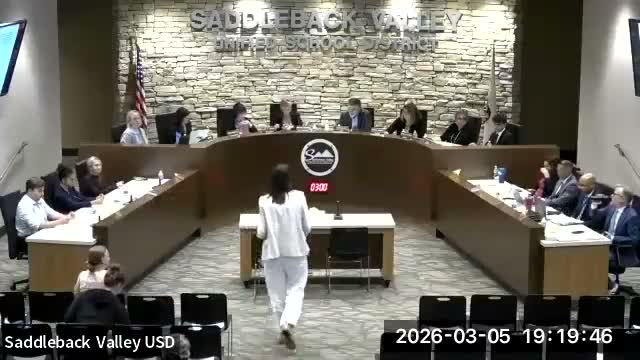
SVUSD board approves preliminary layoffs as budget shortfall grows; educators urge alternatives
Loading...
Summary
The Saddleback Valley Unified School District board approved preliminary reductions in force for certificated, classified, and classified‑management positions after receiving a second interim budget showing multi‑year deficits. Educators and parents urged the board to protect aides and special‑education staff, warning cuts could increase costs and disrupt student services.
The Saddleback Valley Unified School District Board of Education on March 5 approved preliminary reduction‑in‑force (RIF) resolutions for certificated, classified, and classified‑management positions as district staff warned of mounting multi‑year deficits and an upcoming FCMAT review.
The board heard a two‑hour budget presentation from Assistant Superintendent of Business Services Robert Craig, who said the district filed a positive second interim for 2025–26 but that multi‑year projections show continuing deficit spending, with a projected cumulative deficit reaching about $31 million in 2027–28 unless additional actions are taken. Craig said the district’s funded average daily attendance (ADA) is 22,177 and noted rising costs for special education and employer pension contributions as principal drivers of the gap. He confirmed the district has engaged the state Fiscal Crisis and Management Assistance Team (FCMAT) and expects a report in May.
Why it matters: Trustees stressed the choices before the board were difficult. Board members repeatedly said the district must balance protecting classroom services with meeting statutory fiscal obligations, and that continued reliance on one‑time funds is not sustainable.
Educators and parents urged a different path. Mandy De Groot, president of the Saddleback Valley Educators Association, told trustees that proposed cuts would hollow out school‑based services and increase reliance on higher‑cost contracted providers. “The staff you are considering cutting tonight will be replaced tomorrow by private agency contractors billing the district at triple the rate,” De Groot said, and she urged the board to reallocate recent consultant spending back into in‑house positions. The SVEA presentation included a formal resolution opposing the RIF and called on the board to vote no.
Teachers and parents recounted classroom impacts. Samantha Healy, a former teacher, described how one‑to‑one aides stabilize students with severe behaviors and warned that cutting aide hours would jeopardize student safety and instruction: “Without this aide, I would be highly challenged,” she said. Parent Nicole Trisler described multiple incidents affecting her children, including physical injury, blocked doors, and threats that contributed to anxiety and therapy needs for her son.
District response and budget detail. Craig outlined steps the district has taken to reduce expenditures, including revising technology and textbook schedules, applying a one‑time discretionary block grant (about $8.1 million) to health and welfare, and reducing staffing where vacancies arose. He said the district’s MYP (multi‑year projection) shows ongoing deficits driven by special education costs and declining enrollment, and that some reserves and assigned funds have been used to present a positive second interim this month. Craig said the district had reduced management positions and continues to evaluate program and staffing adjustments.
Board action. After discussion, trustees voted by voice to adopt a slate of delegates to the CSBA assembly and then carried three RIF resolutions: a preliminary reduction of certificated positions (resolution 13‑25‑26), a preliminary reduction of classified positions (resolution 14‑25‑26), and a preliminary reduction of classified management positions (resolution 19‑25‑26). Motions passed by voice vote; minutes and the public record show the motions carried. The board also approved the consent calendar (with one item pulled) and unanimously proclaimed March 2026 as Arts Education Month.
What remains unresolved. SVEA and several speakers alleged that the district has redirected funds to contracted services—De Groot cited a $14,000,000 increase in contracted services and warned that $24,000,000 flows to charter schools—claims the association urged trustees to address by reallocating spending. District staff described recent consultant and contracted‑services increases but did not confirm all line‑item figures during the meeting. The board directed staff to continue budget work, and trustees requested a public study session with detailed breakdowns of restricted versus unrestricted funding, reserve commitments, and program‑level expenditures before the June budget adoption.
Next steps. The district expects the FCMAT report in May. Because the resolutions adopted are preliminary steps required by law when reductions are contemplated, additional notifications and hearings may follow before any layoffs become final. Trustees said they will schedule a study session to present more detailed budget breakdowns and to answer community questions.
Reported by the meeting record, not independently verified. The board’s motions and staff presentation are documented in the meeting materials and on the district website.