Get Full Government Meeting Transcripts, Videos, & Alerts Forever!
Get email alerts on the Housing Development topic
No spam. Unsubscribe anytime.
Lake Elsinore planning commission continues Dexter Village project amid traffic and soil‑testing questions
Summary
The commission continued a 451‑unit Dexter Village housing project to Jan. 20, 2026, after residents and commissioners raised concerns about traffic impacts, gate‑stacking and a state recommendation for soil testing; staff and the applicant were asked to return with detailed traffic and queuing analyses and a response to the toxic‑substances letter.
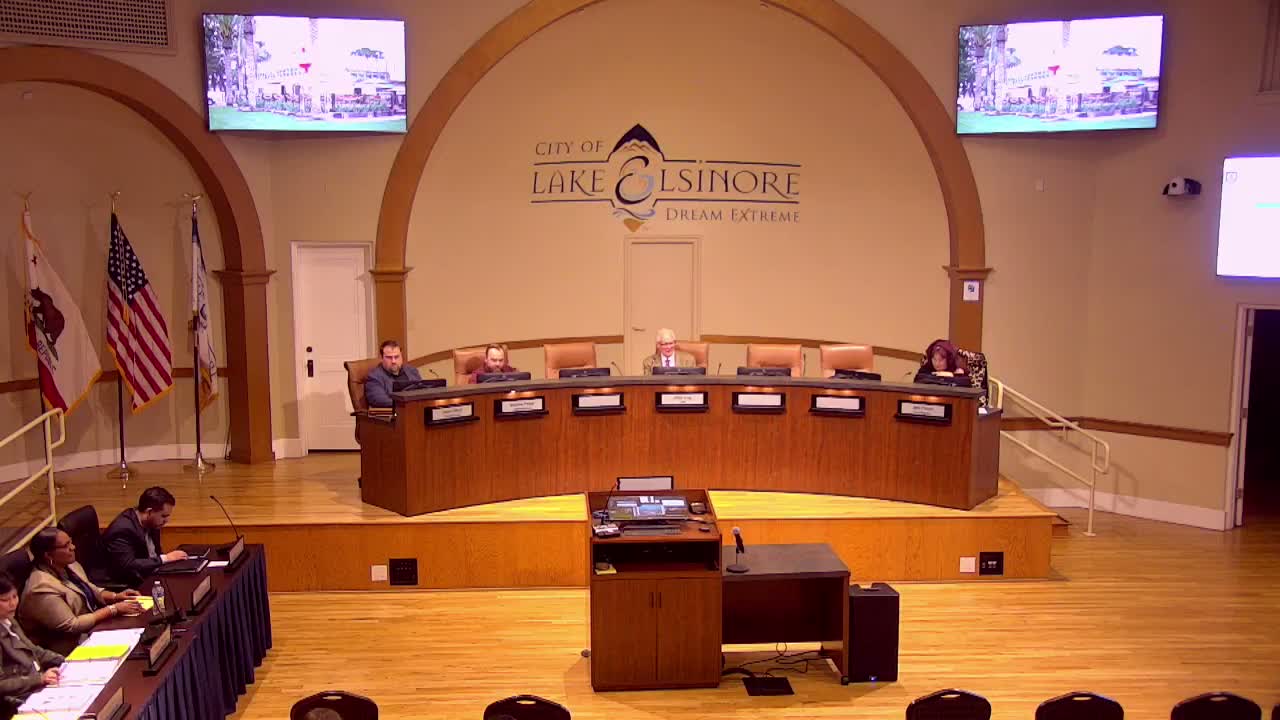
A divided Lake Elsinore Planning Commission on Tuesday declined to approve the Dexter Village residential proposal and instead continued the public hearing to the commission’s Jan. 20, 2026 meeting, asking staff and the applicant to provide additional traffic studies, ingress/egress clarifications and a response to a state request for soil testing.
Contract planner Tamara Harrison of Michael Baker International summarized the application for a roughly 23‑acre site along Dexter Avenue: 137 single‑family detached homes, 84 townhomes, and 230 apartment units (a total of 451 residences), three amenity buildings, and related infrastructure. The applicant is using California’s density‑bonus provisions and proposes 22 very‑low‑income units within the apartment component, Harrison said.
Applicant James Walters described Dexter Village as “an infill development” intended to deliver starter homeownership and infrastructure. Walters said the project would construct frontage improvements, a traffic signal at Dexter and 3rd Street at the applicant’s expense, underground certain power lines, extend water and sewer to serve neighboring areas, and build a storm basin sized to pick up the low point on the applicant’s property. He described the basin as sized to handle “about 340 cubic feet per second” and said, by his calculation, that rate would “fill up an Olympic sized swimming pool in 4 minutes.” Walters also outlined estimated development impact fees totaling about $23 million with line items he cited for Camino Del Norte expansion, parks Quimby fees and school district obligations.
Nearby residents raised concerns about traffic and drainage. Mary Venerable said Dexter and 3rd Street are already used as a shortcut and warned the project could worsen congestion. Her son, Vincent Venerable, questioned whether the basin location would protect properties that receive historic flows from further upstream and asked whether the proposed improvements would address flooding behind adjacent parcels.
Walters responded that single‑family and apartment portions would be gated where shown on the plans, that the basin is sited at the property’s low point and that the developer will construct half‑width right‑of‑way improvements (including a 2‑way left‑turn lane on the developer’s side of Dexter), a 30‑inch transmission water line, and other infrastructure. He said he expects the project to contribute to the Camino Del Norte expansion and that other pending developments will supply additional traffic capacity.
City senior engineer Paul Fizer and traffic consultant Jason Pack told commissioners the city is finalizing design for a Central Avenue/I‑15 interchange improvement (funding pending) and that the project’s traffic study looked at near‑term and cumulative scenarios. Pack said the near‑term mitigation calls for signalization and a two‑way left‑turn lane rather than an immediate four‑lane widening of Dexter, and that the project’s conditioned contributions and off‑site improvements are intended to address intersections in the study.
Commissioners focused on three items before agreeing to continue: (1) vehicle gate queuing and stacking — commissioners asked for detailed queuing analyses showing how many cars can wait without spilling back onto Dexter or 3rd Street; (2) ingress and egress geometry and driveway stacking distances for both phases; and (3) staff’s response to a late comment from the California Department of Toxic Substances Control recommending soil testing at the site. The commission recorded that an initial motion to adopt staff’s recommendation failed on the floor; a subsequent motion to continue carried.
The commission’s directions were procedural rather than substantive approvals: staff and the applicant were instructed to return with refined traffic modeling that includes the queueing analysis for gated entries, clarified plan sheets showing the corrected main entry labeling, and a written response addressing the Department of Toxic Substances Control’s soil‑testing recommendation. The item is scheduled to resume at the Jan. 20, 2026 meeting.
Next procedural step: The planning commission will take the item up again on Jan. 20, 2026, with the additional materials requested by commissioners.