
Delray Beach commission keeps nonprofit funding levels while directing staff to craft a new grant policy
Get AI-powered insights, summaries, and transcripts
Subscribe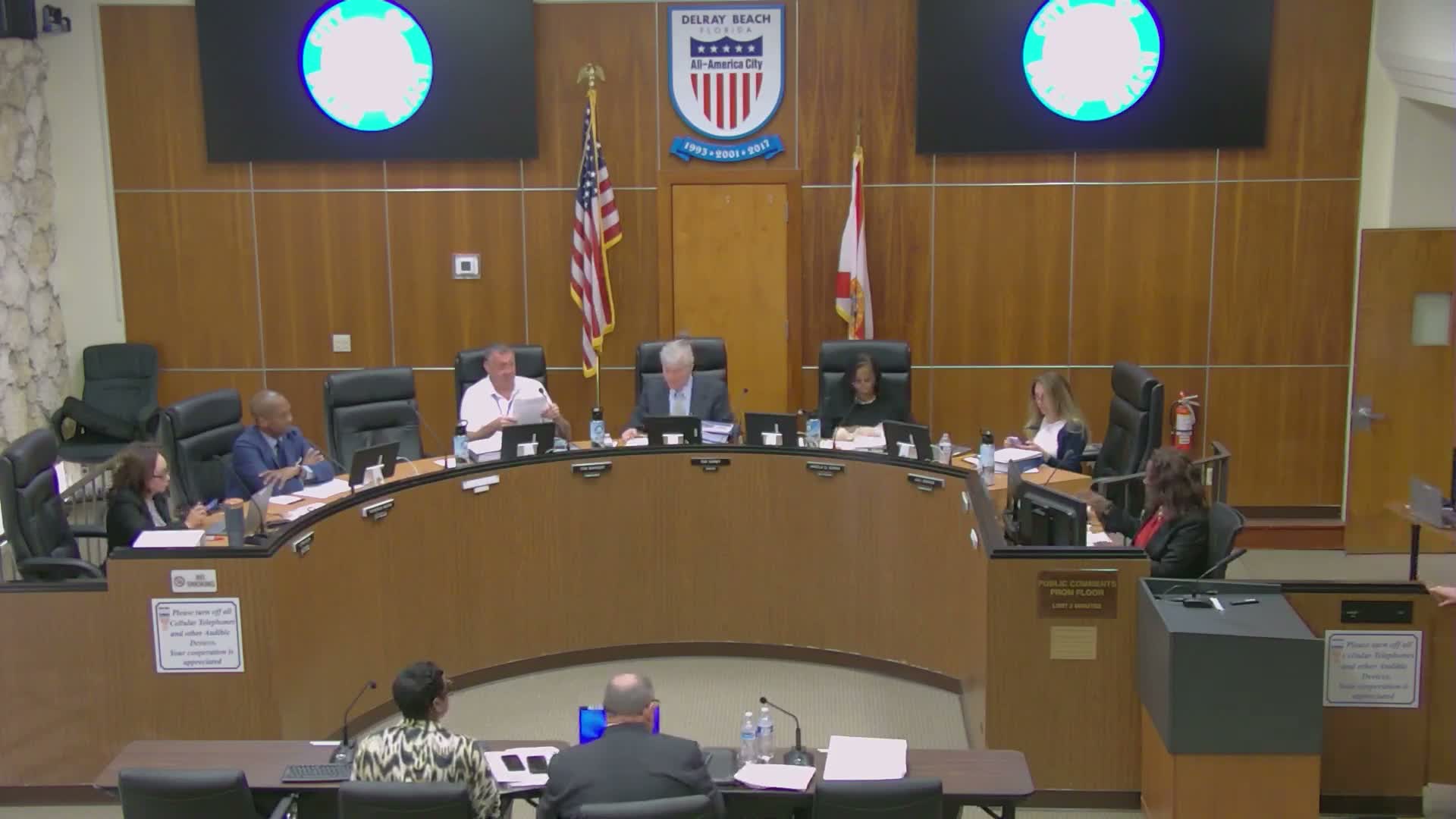
Summary
At a March 9 workshop, the City of Delray Beach commissioners heard staff present three options for nonprofit grants (annual agreements, competitive RFPs, or a hybrid), instructed staff to categorize current grantees, and signaled consensus to maintain current funding levels for the upcoming budget while developing measurable performance standards.
Delray Beach commissioners discussed how the city funds local nonprofits at a March 9 workshop and indicated agreement to hold funding levels steady for the coming fiscal year while staff develops a clearer grant policy.
Staff presented an overview of the city's current practice and options. The presenter identified the city manager's office as currently overseeing funding for several local nonprofits and listed organizations receiving city support, including Achievement Center for Children and Families; Boys and Girls Club of Delray Beach; Spady Cultural Heritage Museum; Delray Beach Museum; Delray Beach Public Library; Delray Beach Historical Society; Sandaway Discovery Center; and Arts Garage. Staff (Speaker 2) said current agreements are annual continuation grants without an open request-for-proposal process and that the existing agreements expire on 09/30/2026.
A separate staff presenter (Speaker 4) laid out three approaches for future allocations: continue annual funding agreements; open a fully competitive grant process with RFPs and scoring criteria; or use a hybrid that reserves some funding for incumbent grantees while opening other funds to competition. Speaker 4 told the commission that "the city attorney has told us that you all cannot, bind future commissions," and noted some federal/state-funded programs (CDBG, SHIP, UDAG) carry their own rules and are excluded from the internal grants policy.
Commissioners focused on two central trade-offs: administrative burden versus accountability. Several members worried a competitive RFP could impose substantial application and review workload on both nonprofits and city staff, and pointed to prior local experience in which competitive processes ultimately funded many of the same incumbents. At the same time, multiple commissioners emphasized the need for clearer performance standards and end-of-year reporting; Speaker 4 noted the Arts Garage agreement as an example of a contract that requires submittal of receipts so the city can verify how funds were used.
One commissioner quantified the city's current non-library support at roughly $1,900,000 (estimated during the discussion) and asked staff to separate lease-only arrangements (visitor center, Chamber of Commerce leases, etc.) from direct program funding when preparing totals. Staff and commissioners agreed that the next steps should include categorizing grantees by service type (for example, after-school/education programs, historic preservation, library/archive services, lease beneficiaries) and defining the policy goals the commission wants grants to advance.
By consensus, commissioners signaled they expect funding levels to remain at current amounts in next year's budget while staff completes categorization and returns with recommended policy details at the commission's May goal-setting session and during the FY26-27 budget process. That direction was described as guidance for staff and not a formal binding vote.
The workshop ended with staff tasked to prepare categorized lists of grantees, cost estimates that separate lease and program support, and draft performance metrics or a rubric to apply across grant recipients for the commission to review during the May session and the budget cycle.