
Senate infrastructure committee debates EZPass transfer rules, rejects Jefferson plate-read amendment
Get AI-powered insights, summaries, and transcripts
Subscribe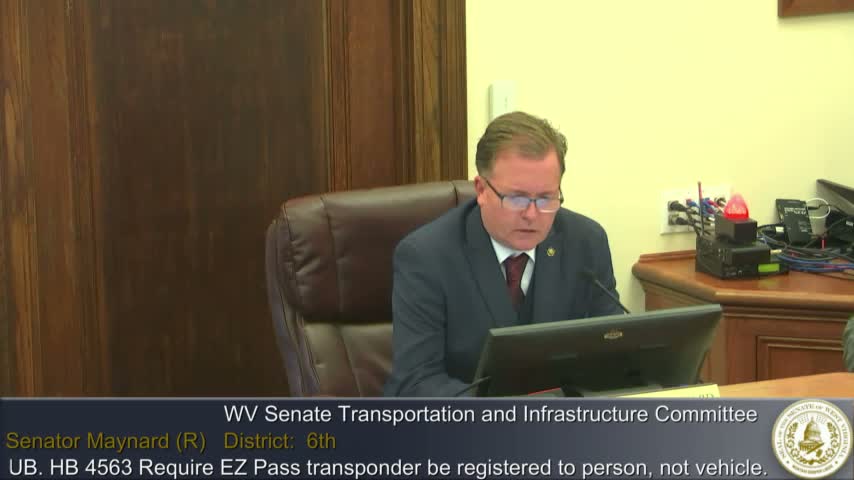
Summary
The West Virginia Senate Infrastructure Committee debated amendments to a bill on EZPass single-fee transponders, heard Parkways Authority testimony, and rejected an amendment clarifying that the authority need not read every license plate; the committee later reported the bill to the full Senate with a do-pass recommendation.
The West Virginia Senate Infrastructure Committee debated whether to codify limits on EZPass single-fee transponders and whether the Parkways Authority should be required to read license plates.
Counsel restated an amendment from the senator from Jefferson that would add language saying nothing in the bill requires the Parkways Authority to read every license plate. Senator from Randolph opposed the Jefferson amendment, arguing that Parkway technology and billing practices still require plate verification and that verifying out-of-state plates could raise costs. "It sounds like they're still going to have to verify all that, which is going to again drive the cost up," the senator from Randolph said.
Senator from Jefferson responded that his amendment would remove a near-term technology deadline and allow the authority time to adopt the necessary systems. The amendment was put to a division vote and was tied 4–4, causing the amendment to fail.
The committee then considered an amendment from the senator from Wetzel to prohibit transferring single-fee transponders between vehicles. Counsel explained that existing EZPass user agreements tie a transponder to one vehicle and that the amendment would codify that contractual practice. Samuel Polley, chief financial officer for the Parkways Authority, told the committee the authority enforces its administrative policy but does not proactively check for violators; users can change vehicle information online as a convenience. "You can go on the app right now, go online and you can change your vehicle information," Polley said.
Polley also told senators the single-fee discount plan applies only to Class 1 passenger vehicles and noted the authority is studying cheaper sticker technology that could make some transferability issues moot. Delegate Danielle Linville, who participated to provide House context, said the single-fee program yields about $5,000,000 annually and questioned whether a complete loss of that revenue would jeopardize bond obligations. "If every last dime of that dropped to 0, would you be in a position where you couldn't meet your bond obligations?" Linville said; the authority replied it would not.
Senator Randolph moved to give the bill a second reference to the Finance Committee to examine fiscal impacts; the division vote failed 4–5. Later, the vice chair moved that the engrossed committee substitute for House Bill 4563 be reported to the full Senate with a recommendation that it do pass; the chair declared the ayes have it and the motion was adopted.
The committee advanced the bill to the full Senate after extended questioning of Parkways Authority staff and a House delegate, with unresolved questions noted about future sticker implementation, contract enforcement practices, and the possible fiscal implications for bondholders.